What Sets Medium and Soft Edge Apart
When you need to balance a bright sky with a darker foreground, a graduated neutral density (GND) filter is a standard tool. In the NiSi 150x170mm range, you can choose between a soft-edged or medium-edged transition line. The difference is not in the density or the filter glass — both use optical glass with nano coating and infrared protection — but in how sharply the dark area transitions to clear. That transition width determines which landscape subjects the filter handles naturally.
A soft edge has a gradual, wide transition. A medium edge has a transition zone that is about 40% smaller than a soft edge, according to NiSi. Neither is better overall; each suits a different type of horizon line.
Soft Edge vs Medium Edge: When to Use Each
The main decision point is whether your horizon is broken by tall, irregular shapes or is relatively clean with low-profile elements.
- Soft Edge — for trees, mountains, and skylines with tall protrusions: The NiSi 150x170mm Nano IR Soft Graduated ND4 (0.6) is densest at the top edge and tapers gradually to clear by the middle. That gentle slope means a tree branch or mountain peak that rises into the sky does not get a sudden dark line across it. The filter is specifically noted as useful for images that feature trees, buildings, mountains, and other elements that protrude into the skyline.
- Medium Edge — for buildings, small mountains, and sunrise/sunset horizons: The NiSi 150x170mm Nano IR Medium Graduated ND4 (0.6) and ND8 (0.9) have a tighter transition zone, about 40% smaller than the soft edge. This works well when the horizon is relatively even — buildings, small mountains, or the clean horizon line at sunrise and sunset. The narrower transition keeps more of the sky dark and more of the foreground clear without a wide gray band.
Two Medium Edge Strengths for Different Light
-
NiSi 150x170mm Nano IR Medium Graduated Neutral Density Filter – ND4 (0.6) – 2 Stop: The NiSi 150x170mm Nano IR Medium Graduated Neutral Density Filter – ND4 (0.6) – 2 Stop has a medium-edged line of transition and is useful for images that feature buildings, small mountains, and other elements that protrude into the skyline. A 2-stop medium edge is a good starting point for sunrise and sunset scenes where the sky is about 2 stops brighter than the foreground.
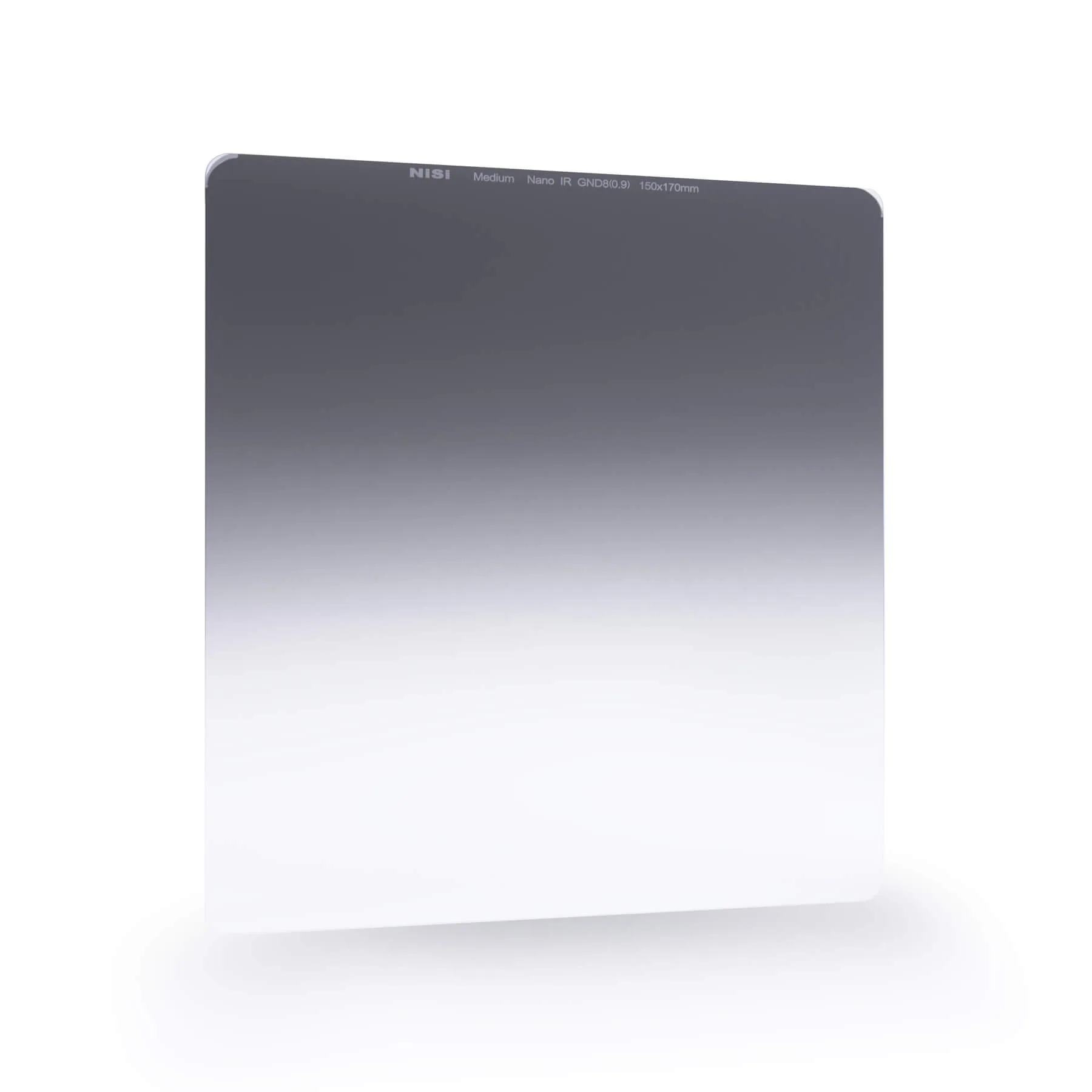
NiSi 150x170mm Nano IR Medium Graduated Neutral Density Filter – ND4 (0.6) – 2 Stop
-
NiSi 150x170mm Nano IR Medium Graduated Neutral Density Filter – ND8 (0.9) – 3 Stop: The NiSi 150x170mm Nano IR Medium Graduated Neutral Density Filter – ND8 (0.9) – 3 Stop also has a medium-edged transition and is compatible with the NiSi S6 filter system. Choose the 3-stop version when the sky is significantly brighter, such as during midday or with reflective water in the frame.
NiSi 150x170mm Nano IR Medium Graduated Neutral Density Filter – ND8 (0.9) – 3 Stop
What Both Edge Types Share
All three filters use NiSi's Nano IR coating, which helps eliminate the infrared light that can cause an unwanted red cast when shooting at small apertures. They are made from high-quality optical glass — not resin — and are waterproof with low reflection. They are compatible with the NiSi 150mm filter system (the soft edge is noted for the 150mm system; the medium edge filters are compatible with the NiSi S6 system).
Because they are 150x170mm rectangular filters, they can be slid up or down in the holder to adjust the transition line position. This gives you fine control during composition.
Making Your Choice
If your typical landscape includes tall trees, jagged mountain ridges, or buildings that break the skyline, a soft edge will hide the transition more naturally. If you often shoot at sunrise or sunset over water or flat land, or with low hills and buildings, a medium edge will give you a cleaner result with less wasted filter area.
The supplied information does not include exact measurements of the transition zone width, so the choice comes down to the general shape of your horizon. Many landscape photographers carry at least one of each edge type in their kit.