Start by reading the slot sizes, not the knife names
The 17-Slot Acacia Knife Block does not label each opening for a specific knife model. Instead, it gives you slot widths, and those widths are the real guide to what goes where. Match the thickest part of each knife's blade or bolster to the slot that fits it, then work down to the smaller knives.
The block measures 10.5" L x 4.5" W x 8.5" H, so it needs a clear counter run of roughly that footprint plus room to lift knives out. Because acacia is a natural wood, the color and grain pattern of each block will vary, which is normal rather than a defect.
The slot layout at a glance
-
17-Slot Acacia Knife Block: 17 slots total: 1 large chef's knife slot at 2.25", 2 chef and Asian-styled knife slots at 2", 3 large bread and task knife slots at 1.5", 9 steak and paring knife slots at 1", 1 kitchen shear slot at 1 3/8" x .5", and 1 honing steel slot at 5/8" x 5/8". These widths tell you which knives can share the block and where the bulky items belong, so you can plan the fill before you start inserting anything.
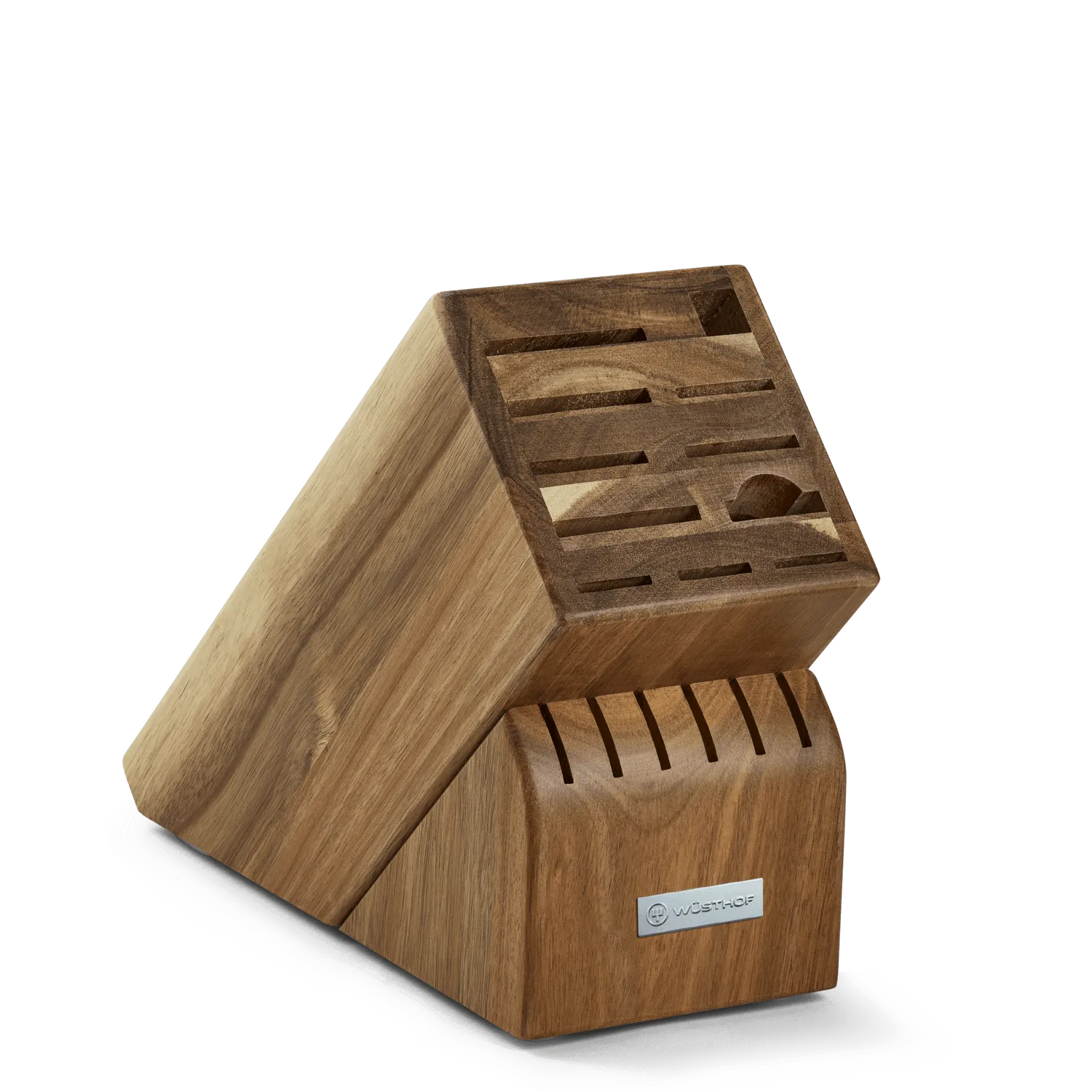
17-Slot Acacia Knife Block
A fill order that keeps the block balanced
Load the largest knives first. That way you are not working around thin blades with a wide chef's knife in your hand, and you can see how much of the block the heavy pieces claim.
- 1. Set the large chef's knife in the 2.25" slot: This is the widest knife opening in the block. Put your largest chef's knife here first so the heaviest blade has the room it needs.
- 2. Fill the two 2" chef and Asian-styled slots: Use these for a second chef's knife or an Asian-styled blade. If you own only one chef's knife, leave the spare 2" slot empty rather than forcing a thinner knife into it.
- 3. Place bread and large task knives in the three 1.5" slots: Serrated bread knives and larger utility or task knives fit here. Keep the bread knife toward the front or an outside edge so you can pull it without grazing neighboring handles.
- 4. Distribute steak and paring knives across the nine 1" slots: This is the largest group of slots, so it is where most households will have spare capacity. Group steak knives together and paring knives together so you can grab the right small knife without hunting.
- 5. Reserve the shaped slots for shears and honing steel: The kitchen shear slot is 1 3/8" x .5" and the honing steel slot is 5/8" x 5/8". These are cut to those tools, so keep them free for that purpose instead of using them for narrow knives.
What each slot group is best used for
- 2.25" slot (1): Your largest chef's knife. Give it the widest opening and keep it there consistently.
- 2" slots (2): A second chef's knife or an Asian-styled knife. Good for the blades you reach for most during prep.
- 1.5" slots (3): Bread knives and large task knives. Serrated blades benefit from having their own space so the teeth do not knock against thinner knives.
- 1" slots (9): Steak knives and paring knives. The most flexible group, and the place to leave breathing room if your collection is still growing.
- Shear slot (1 3/8" x .5"): Kitchen shears. The rectangular opening is shaped for the handles and blades of shears rather than a knife.
- Honing steel slot (5/8" x 5/8"): Your honing steel. Keeping it in the block means it is on hand when you need a quick realignment between tasks.
Organizing by how you cook, not just by size
Once every knife has a home, arrange the groups so your most-used blades sit where your hand naturally lands. Many cooks put the chef's knife and the honing steel nearest the front, keep bread and task knives in the middle, and park steak and paring knives toward the back or one side.
If you store a knife set in the block, check that each knife's widest point actually matches its slot rather than assuming a set was designed for this layout. A knife that sits loosely or stands proud of the block is a sign it belongs in a different opening. The supplied record does not specify which knife models or sets are compatible, so test the fit knife by knife before you commit to an arrangement.
Acacia wood care that the record supports
The supplied product information does not include a cleaning or oiling procedure, so treat the following as sensible handling rather than a manufacturer's instruction. For anything beyond routine wiping, check the care guidance that comes with your block.
- Wipe and dry promptly: Keep the wood from sitting wet. A quick wipe after use and a dry spot on the counter will help the block stay in good condition.
- Keep it out of soaking water: Wood and prolonged soaking do not mix well. Clean the surface without submerging the block.
- Expect grain variation: Each acacia block differs in color and grain. That variation is part of the material, not a sign of damage.
- Store knives dry: Put knives away clean and dry so moisture is not trapped in the slots.
When the 17-slot layout is the wrong fit
This block suits a kitchen with a broad collection: a chef's knife or two, a bread knife, everyday task knives, steak knives, shears and a honing steel. If you own only three or four knives, the nine 1" slots will sit mostly empty, and a smaller block may take up less counter space.
The block is also not a sharpener or a substitute for one. The honing steel slot holds a steel for realigning an edge, but the supplied record makes no claim about sharpening performance. If your knives need more than a hone, address that separately.