What the ply count actually changes
Ply count describes how many metal layers are bonded together, not a simple quality score. A 3-ply build typically pairs a stainless steel cooking surface with an aluminum core and a magnetic stainless exterior. A 5-ply build adds more layers, often more aluminum, to spread heat. The practical differences show up in weight, oven limits, and how the pan feels on the burner.
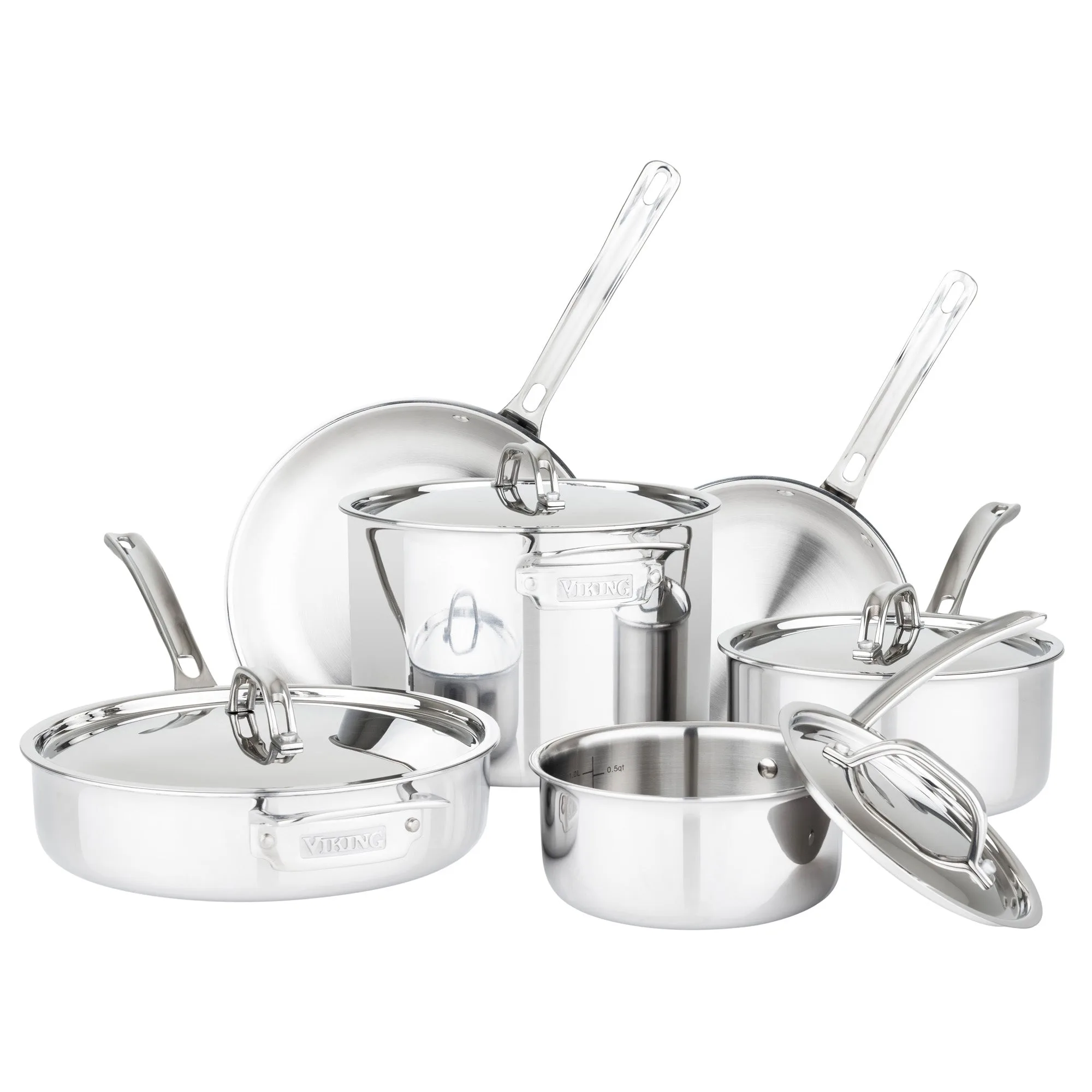
The two Viking sets here illustrate that trade-off clearly: one is a 13-piece 3-ply set with glass lids, and the other is a 10-piece 5-ply set with a hard anodized exterior and stainless lids. Neither is automatically better; each fits a different cooking routine.
3-ply vs 5-ply: the evidence side by side
- Construction: The 3-ply set uses non-reactive 304 stainless steel interior, an aluminum core, and magnetic stainless steel exterior. The 5-ply set uses 304 stainless interior, a 3-ply aluminum core, and hard anodized aluminum exterior.
- Oven safety: The 3-ply set is oven safe to 600°F/315°C; its glass lids are safe to 400°F/204°C in a preheated oven. The 5-ply set is oven and grill safe to 500°F/260°C.
- Lids: The 3-ply set includes vented glass lids for look-and-cook visibility. The 5-ply set uses 304 stainless steel domed lids intended to enhance heat circulation.
- Piece count and sizes: The 3-ply set has 13 pieces including an 8-quart stock pot, pasta insert, 5.25-quart sauté pan, 4-quart soup pot, 3-quart and 2.25-quart sauce pans, and 10-inch and 8-inch fry pans. The 5-ply set has 10 pieces: 8-inch and 10-inch fry pans, 2-quart and 3-quart sauce pans, a 4-quart sauté pan, and a 5-quart Dutch oven.
- Surface and care: Both are dishwasher safe with handwash recommended. The 5-ply set's hard anodized exterior is a different material from the 3-ply set's polished stainless exterior; the supplied records do not include separate care instructions for either exterior beyond dishwasher and handwash guidance.
When 5-ply earns its place
If you often cook on induction and want a heavier, more substantial feel, the 5-ply set's construction and hard anodized exterior may appeal. The stainless domed lids are also a better match if you regularly oven-braise or finish dishes under a broiler within the 500°F/260°C limit. The 5-quart Dutch oven adds a covered vessel the 3-ply set does not list.
Is 5-ply cookware worth it? Only if the extra layers and the specific pieces match how you cook. The supplied records do not include test data on heat distribution, so the case for 5-ply rests on construction, oven limits, and the included shapes, not on measured performance claims.
Evidence for the 5-ply set
-
Viking 5-Ply 10-Piece Hard Anodized Stainless Steel Cookware Set with Stainless Lids: 5-Ply Construction: Non-reactive 304 Stainless Steel interior, 3-Ply Aluminum Core, and Hard Anodized Aluminum Exterior for Even Rim-to-Rim Heat Transfer Shows the layer structure and the hard anodized exterior, which is the main material difference from the 3-ply set.
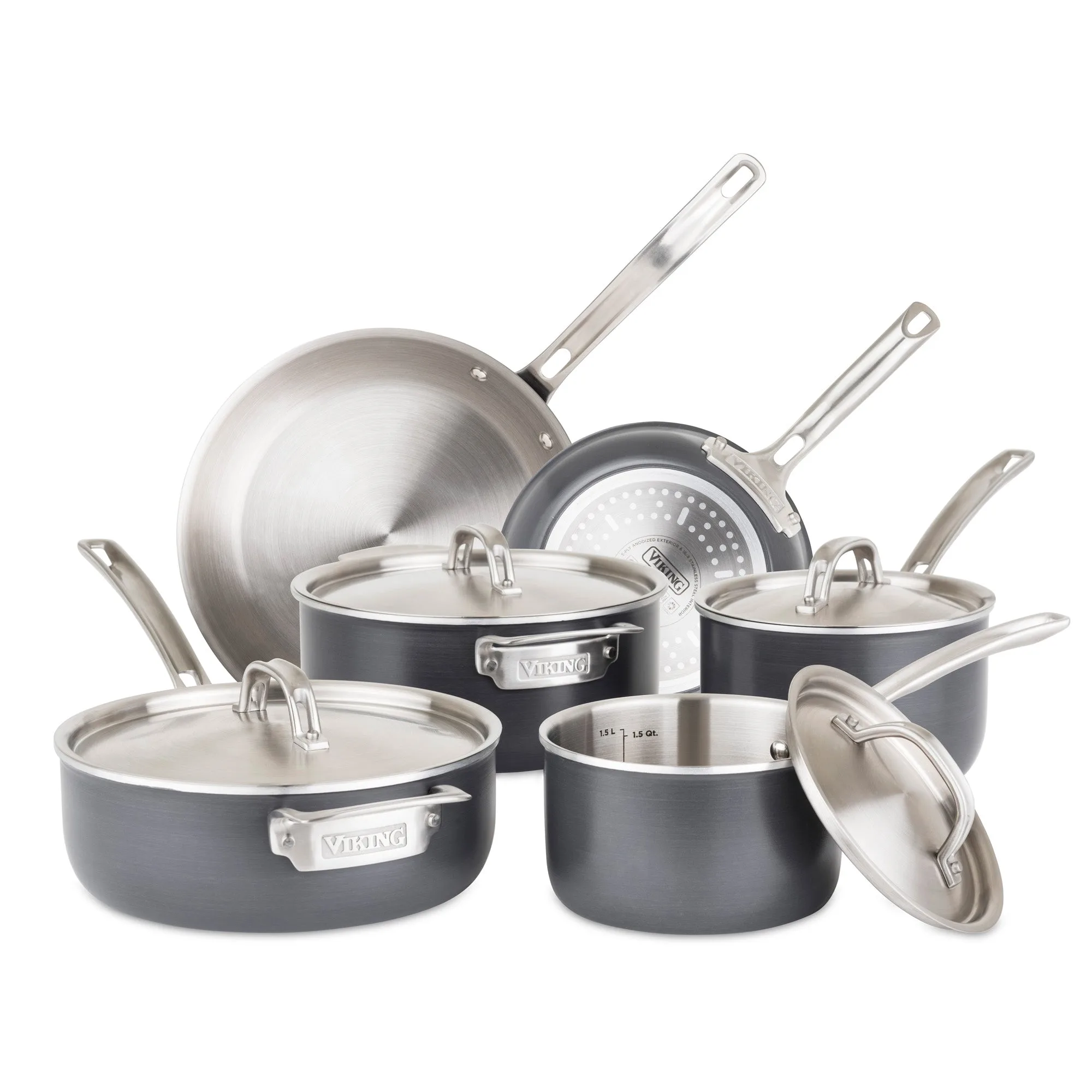
Viking 5-Ply 10-Piece Hard Anodized Stainless Steel Cookware Set with Stainless Lids
-
Viking 5-Ply 10-Piece Hard Anodized Stainless Steel Cookware Set with Stainless Lids: Oven and Grill Safe to 500°F/260°C Sets a clear upper limit for oven and grill use, lower than the 3-ply set's 600°F/315°C pan limit.
-
Viking 5-Ply 10-Piece Hard Anodized Stainless Steel Cookware Set with Stainless Lids: 304 Stainless Steel Domed Lids Enhance Heat Circulation for More Even Cooking Explains the lid design and why it may suit covered oven cooking better than glass lids with a lower heat limit.
Where 3-ply fits better
The 3-ply set's higher pan oven limit (600°F/315°C) and larger piece count make it a stronger fit if you want more vessels, including a stock pot with pasta insert, and you do not need a Dutch oven. The vented glass lids let you monitor cooking without lifting the lid, which is useful for simmering and reducing sauces. The trade-off is that the glass lids are only safe to 400°F/204°C in a preheated oven, so you will need to swap lids or leave them off for high-heat oven work.
The 3-ply set also includes volume markings on the pan interior, which can simplify measuring. The 5-ply set lists interior volume markings as well, so that feature is not a differentiator here.
Evidence for the 3-ply set
-
Viking 3-Ply Stainless Steel 13-Piece Cookware Set with Glass Lids: 3-Ply Construction made of non-reactive 304 stainless steel interior, aluminum core, and magnetic stainless steel exterior Defines the 3-ply build and confirms it is induction-compatible through the magnetic exterior.
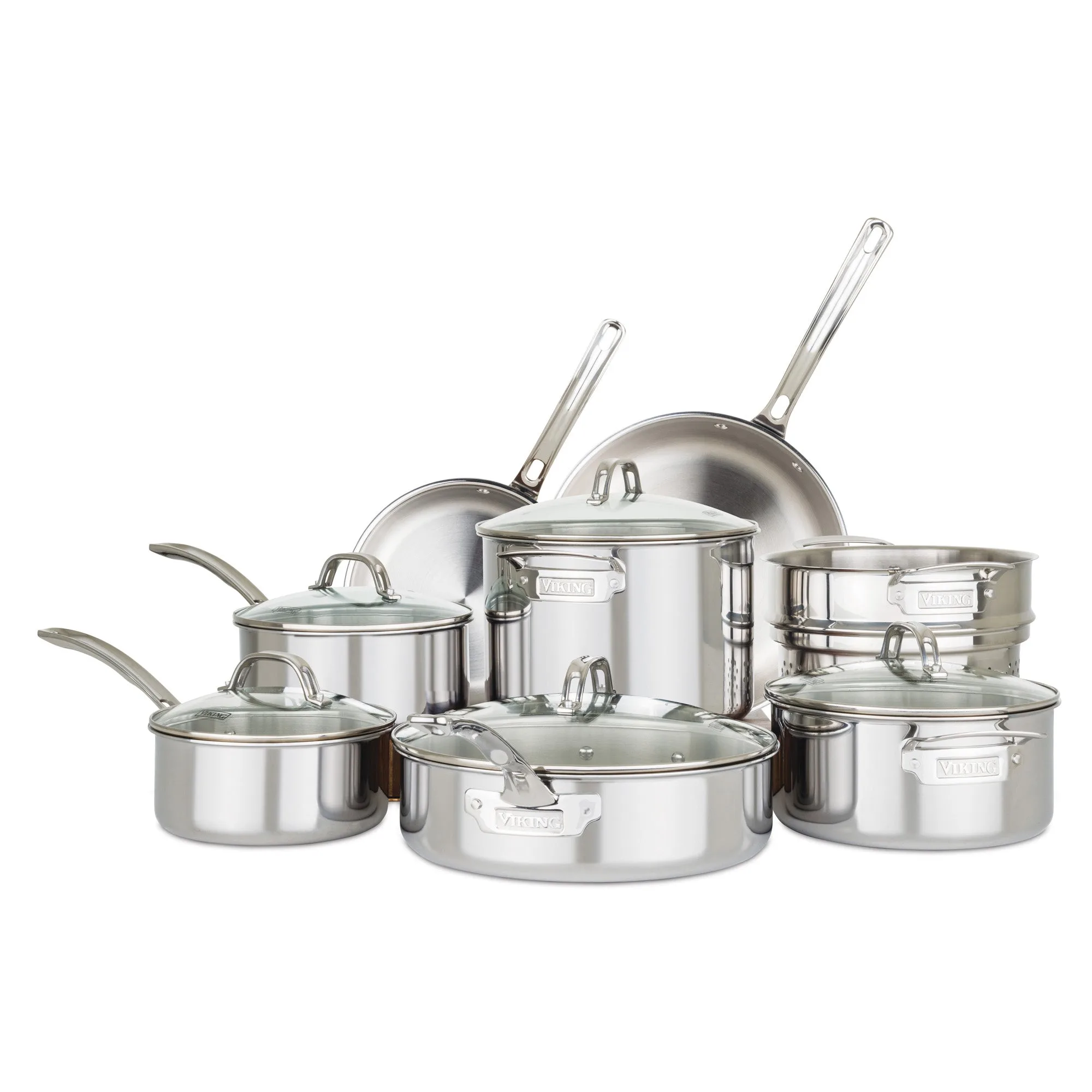
Viking 3-Ply Stainless Steel 13-Piece Cookware Set with Glass Lids
-
Viking 3-Ply Stainless Steel 13-Piece Cookware Set with Glass Lids: Oven safe up to 600°F/315°C. Glass Lids to 400°F/204°C in a preheated oven Shows the pan can handle higher oven heat than the 5-ply set, but the glass lids cannot, which affects how you use the set in the oven.
-
Viking 3-Ply Stainless Steel 13-Piece Cookware Set with Glass Lids: Includes 8 Qt. Stock Pot with Glass Lid and Pasta Insert, 5.25 Qt. Sauté Pan, 4 Qt. Soup Pot, 3 Qt. and 2.25 Qt. Sauce Pans, 10" and 8" Fry Pans Lists the actual vessels, so you can compare against the 5-ply set's 10-piece lineup and your storage space.
Hard anodized vs 3-ply: a third option to weigh
The 5-ply set's hard anodized exterior is not the same as a nonstick hard anodized pan; it is the outside layer of a clad stainless set. If you were considering a hard anodized vs 3-ply cookware comparison, note that the 5-ply set here still has a stainless steel cooking surface, so it behaves like clad stainless on the inside. The hard anodized exterior is darker and may hide stains differently, but the supplied records do not specify separate cleaning instructions for it beyond dishwasher safe and handwash recommended.
For a pure 3-ply set with a polished stainless exterior, the Viking 3-ply set is the direct option in this catalog. The choice between them comes down to oven limits, lid material, piece count, and whether you value the 5-ply build's extra layers and Dutch oven.
Decision rules for your kitchen
- Choose the 3-ply set if:: You want more pieces including a stock pot and pasta insert, you regularly oven-cook above 500°F/260°C without lids, and you prefer seeing through glass lids at normal stovetop temperatures.
- Choose the 5-ply set if:: You want a heavier clad build, a Dutch oven for covered cooking, stainless lids for oven use up to 500°F/260°C, and you do not need a pasta insert or a 4-quart soup pot.
- Check your storage:: The 3-ply set has 13 pieces, including two fry pans and a stock pot; the 5-ply set has 10 pieces. Measure your cabinet space before deciding.
- Confirm your cooktop:: Both sets are compatible with electric, gas, grill, induction, and oven, according to the supplied records.