Two Shields, Different Jobs
When choosing an Arduino shield, it helps to start with what you need the shield to do. The 4 Channel Relay Shield (HCARDU0102) and the Funduino XBee Sensor Expansion Board V5 serve very different purposes, even though both plug into an Arduino via standard headers. This comparison looks at their interfaces, power handling, and the kinds of projects each supports, so you can decide which one fits your build.
What Each Shield Offers
-
4 Channel Relay Shield: The 4 Channel Relay Shield uses four relays that can be individually controlled via 4 digital pins on your Arduino. It includes an onboard 5V regulator and uses screw terminals for relay contacts, so no soldering is required. This makes it a safe, solderless way to switch higher-voltage loads (like lights or motors) from an Arduino's logic-level pins.
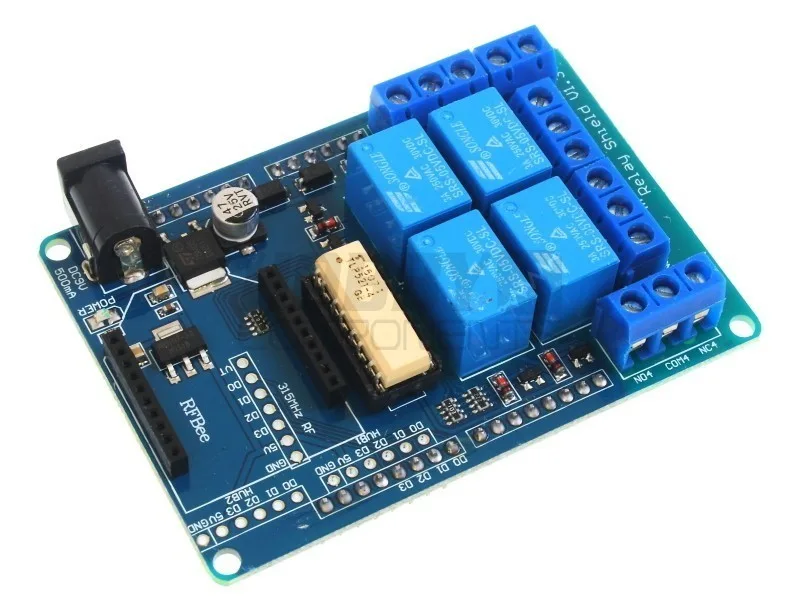
4 Channel Relay Shield
-
Funduino XBee Sensor Expansion Board V5 RS485 BlueBee Bluetooth SD Card Module Interface: The Funduino XBee Sensor Expansion Board V5 provides 14 digital I/O ports, including 12 servo interfaces, power distribution connections, and support for XBee, BlueBee Bluetooth, RS485, and an onboard SD card module interface. This board is designed for expanding sensor networks, wireless communication, and data logging, not for switching high-power loads.
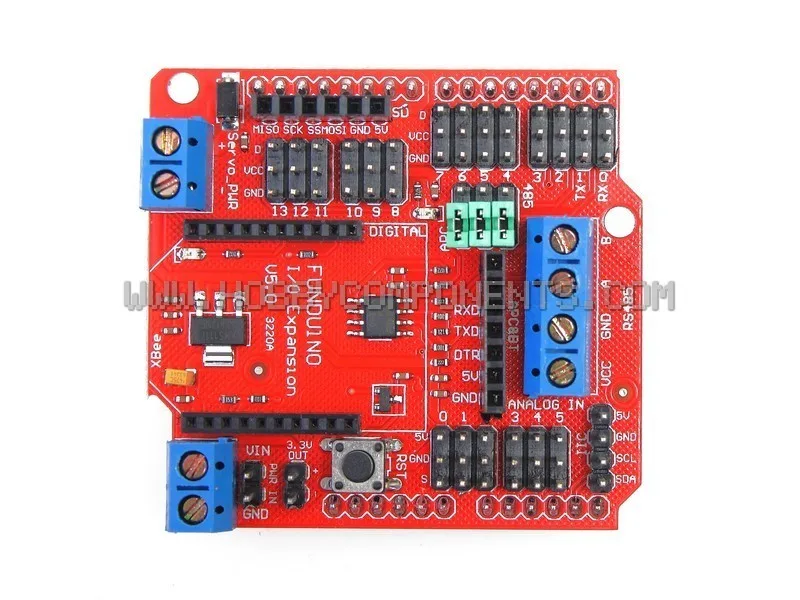
Funduino XBee Sensor Expansion Board V5 RS485 BlueBee Bluetooth SD Card Module Interface
Key Differences at a Glance
These two shields share the same physical connection (Arduino headers) but diverge in nearly every other aspect.
- Primary function: The relay shield switches external loads on and off. The Funduino board expands digital I/O and adds wireless and storage interfaces.
- Power handling: The relay shield includes an onboard 5V regulator and is meant to control separate power circuits. The Funduino board provides power distribution connections for sensors and servos.
- Interface type: Relay shield: 4 digital pins for relay control, screw terminals for load wiring. Funduino board: 14 digital I/O (12 usable as servo interfaces), plus XBee, Bluetooth, RS485, and SD card slot.
- Soldering required: The relay shield uses screw terminals and headers; no soldering is needed. The Funduino board's supplied evidence does not confirm soldering requirements, so check your specific module.
Which Shield for Your Project?
If your project needs to switch mains-voltage devices, lamps, pumps, or other high-power loads safely from an Arduino, the 4 Channel Relay Shield is the straightforward choice. Its screw terminals and onboard regulator simplify wiring, and each relay is controlled independently by a digital pin.
If your project involves multiple sensors, servo motors, wireless data transfer, or logging data to an SD card, the Funduino XBee Sensor Expansion Board V5 offers the necessary I/O and interface options. It is not designed for power switching, but it can coordinate many low-power components.
For a project that needs both relay switching and sensor expansion, you would typically use one shield at a time or stack them with careful attention to pin conflicts and power budgets.