Quick answer
Use the 4" S Leaf paper from Paper Pieces to create elegant leaf motifs in quilt borders, either as a repeating vine or as corner accents. For best results, pair it with a contrasting fabric and baste it securely before stitching.
Why the S Leaf shape works in borders
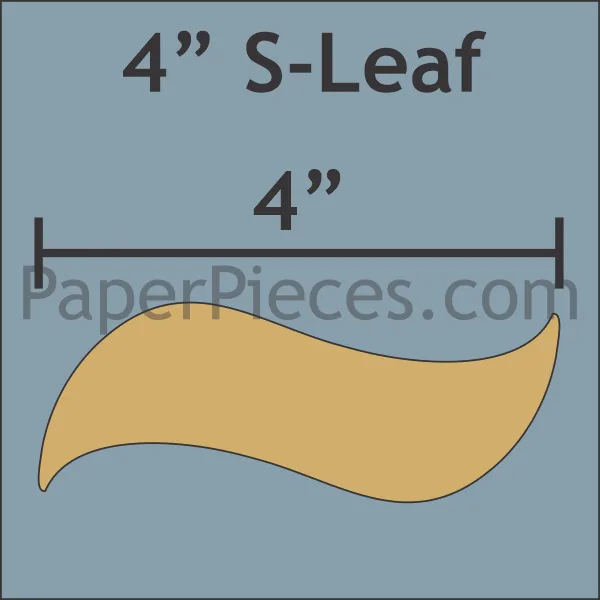
The S Leaf is a single leaf shape with a gentle curve, which makes it a natural fit for border designs that need movement. Its 4-inch size gives it presence without overwhelming a typical quilt border width of 6 to 12 inches.
Unlike geometric EPP shapes like hexagons or diamonds, the S Leaf reads as an organic motif. That makes it useful for appliqué-style borders, where you want the leaf to look like part of a vine or wreath rather than a repeating tessellation.
One trade-off: because the S Leaf is not a regular polygon, you cannot tessellate it seamlessly. You will need to plan gaps or pair it with other shapes, such as stems or small circles, to create a cohesive border pattern.
Placement strategies for leaf borders
For a classic vine border, arrange the S Leaf papers in a diagonal line, alternating the direction of the leaves. This creates a rhythmic wave that moves along the border.
For corner accents, place a single S Leaf in each corner, pointing inward or outward. This works well when your quilt top has a strong central motif and you want the border to frame it without competing.
If you are working with a border that has a specific width, measure the space first. The 4-inch leaf will fit comfortably in a 6-inch or wider border, but in a narrower border you may need to trim the seam allowance or choose a smaller leaf shape.
Fussy cutting and fabric choice
Fussy cutting the S Leaf can highlight a specific part of a fabric print, such as a flower or a butterfly. Because the shape is curved, you will need to align the paper carefully on the fabric and check that the motif sits where you want it.
For borders, consider using a fabric that contrasts with the quilt background. A solid or tone-on-tone fabric in a darker shade will make the leaf stand out, while a busy print may hide the leaf shape.
Keep in mind that the S Leaf has a seam allowance, so the finished leaf will be slightly smaller than 4 inches. Plan your border layout with that finished size in mind.
Diagnosing your border leaf problem
- Symptom: Your border leaves look uneven or the curve doesn't flow the way you expected.
- Likely cause: The leaves may be placed without a consistent directional pattern, or the fabric print is distracting from the leaf outline. Check that all leaves point in the same general direction or alternate consistently.
- Corrective action: Lay out all S Leaf papers on your border fabric before basting. Adjust the angle and spacing until the rhythm looks right, then baste each leaf securely. Use a removable fabric marker to trace the placement before you commit.
- When to stop or choose another option: If the 4-inch leaf feels too large for your border width, or if you need a more geometric look, switch to a smaller leaf shape or use hexagons or diamonds instead. Test a single leaf in the border corner before basting the entire set.
Product spotlight
-
4" S Leaf: The 4" S Leaf from Paper Pieces is a precision-cut paper shape designed for English paper piecing appliqué and leaf variations. Its precision cutting ensures consistent leaf shapes, which is critical for a uniform border design.
4" S Leaf