Quick answer
A 6.35mm TRS female to dual RCA female splitter lets you send a stereo signal from a mixer, audio interface, or headphone amp to two RCA inputs on a home stereo or recording deck. It works best when your source has a single 6.35mm stereo output and your destination uses separate left/right RCA jacks.
Why use a TRS female to dual RCA female splitter?
This adapter is ideal when your audio source (like a mixer, audio interface, or keyboard) has a single 6.35mm (1/4 inch) TRS stereo output, but your amplifier, powered speakers, or receiver only accept RCA inputs. The Y-splitter breaks the stereo signal into left and right channels without needing an extra cable or converter box.
A key trade-off: the splitter is female on both ends, so you must supply your own 6.35mm TRS cable (male to male) from the source and two RCA cables (male to male) to the destination. This gives you flexibility in cable length and quality, but adds one more connection point.
Gold plating: does it matter?
Gold-plated connectors resist corrosion and maintain consistent conductivity over time, especially in humid or dusty environments. For permanent installations or gear that stays connected for months, gold plating reduces the risk of signal degradation. For occasional use or dry climates, standard nickel plating is usually fine.
The 6.35mm TRS female to dual RCA female splitter from Innov8 Wholesale Ltd features gold-plated connectors, which help preserve signal integrity in longer cable runs or when connecting valuable studio equipment.
Common setup mistakes
Mono source confusion: If your source outputs a mono signal on a TS (tip-sleeve) connector, this splitter will send the same mono signal to both RCA outputs. It only splits a stereo signal when the source uses a TRS (tip-ring-sleeve) connector.
Cable quality mismatch: Using a low-shielded 6.35mm cable or poor-quality RCA cables can introduce hum or noise, especially over longer distances. Match the cable quality to your gear and environment.
Decision rules for choosing and using a 6.35mm TRS female to dual RCA female splitter
- Confirm your source is stereo: Check that your source device has a 6.35mm TRS (tip-ring-sleeve) output. If it uses a TS (tip-sleeve) mono jack, this splitter will send the same mono signal to both RCA outputs.
- Use separate cables for flexibility: Because both ends are female, you need a 6.35mm TRS male-to-male cable from source to splitter, and two RCA male-to-male cables from splitter to destination. This lets you choose the exact lengths and quality for each segment. Avoid exceeding 15 ft (4.5 m) total cable length to prevent signal loss.
- Match connectors to your gear: If your amplifier or receiver has color-coded RCA inputs (red for right, white/black for left), label your cables accordingly. The splitter itself is unmarked, so you must keep track of left/right routing.
- Consider gold plating for permanent setups: Gold-plated connectors resist corrosion better than nickel. If your splitter will stay connected for months or years, the extra cost is worthwhile. For occasional use, standard connectors are sufficient.
Product spotlight
-
6.35mm (1/4") TRS Female to Dual RCA Female Stereo Audio Y Splitter Cable 0.5m Gold Plated: Gold-plated connectors for improved conductivity and corrosion resistance. This helps maintain a clean stereo signal over time, especially in permanent installations or humid environments.
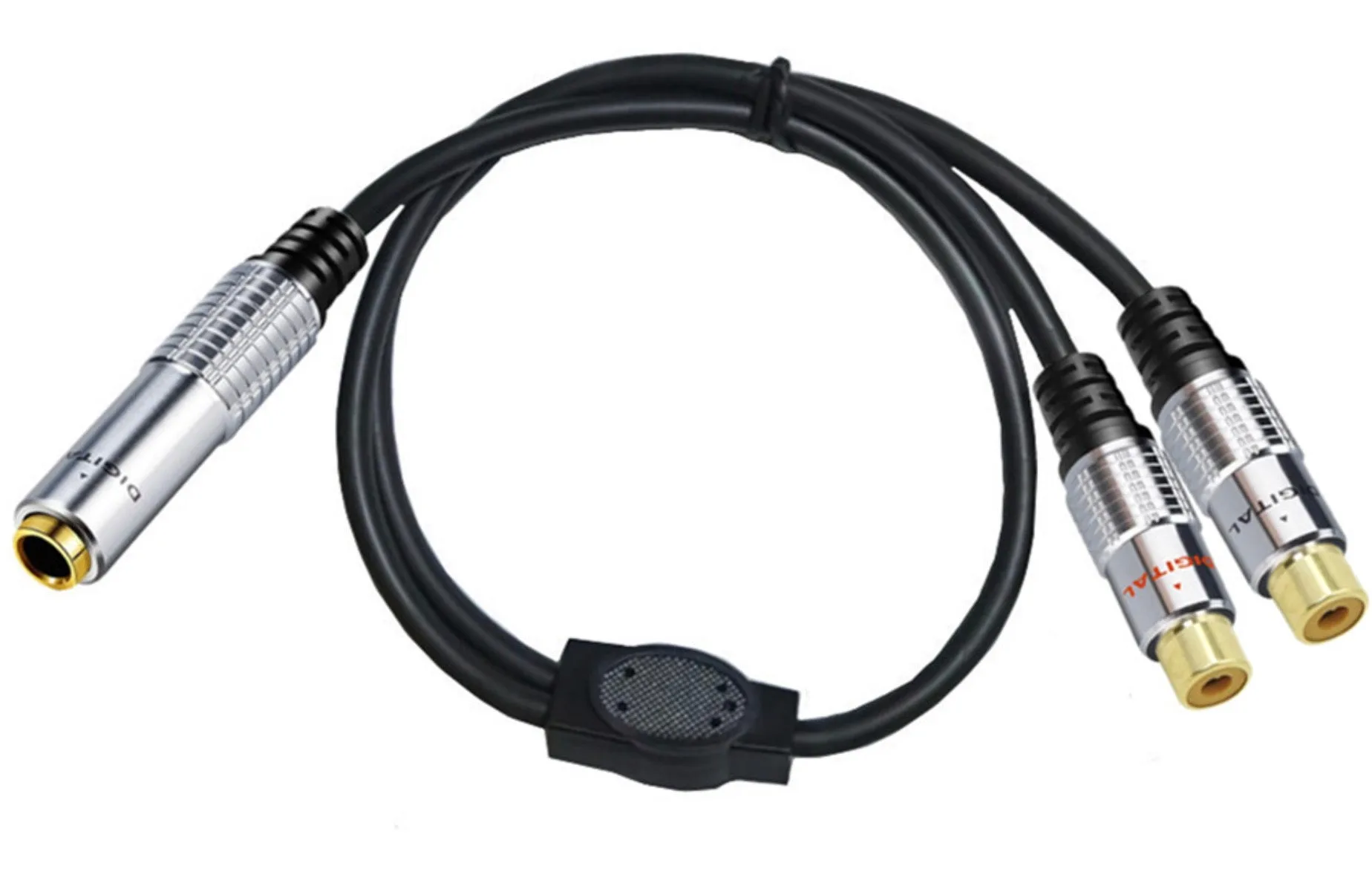
6.35mm (1/4") TRS Female to Dual RCA Female Stereo Audio Y Splitter Cable 0.5m Gold Plated
Who should use this splitter?
Best for
- Musicians connecting a mixer or keyboard to a home stereo system
- Home studio owners routing a headphone amp output to recording gear with RCA inputs
- Anyone needing a flexible, cable-length-adjustable stereo split solution
Not ideal for
- Mono sources (use a simple TS to RCA cable instead)
- Balanced audio connections (use a TRS to XLR adapter)
- Very short permanent connections where a molded Y-cable would be more convenient