Quick answer
Choose a coiled 6.35mm extension cable for stage or pedalboard use where you need tangle-free flexibility and short reaches; choose a straight cable for fixed studio setups where you want consistent routing and minimal strain on connectors.
Coiled cables: flexibility with a trade-off
A coiled 6.35mm extension cable naturally retracts, which keeps excess length out of the way and prevents tangles. This makes it ideal for moving between instruments or pedals in a confined space. However, the coil adds weight and can create tension if stretched too far, so it is not meant for long, permanent runs.
Straight cables: predictable and low-stress
Straight cables lie flat and route cleanly along walls, racks, or floor channels. They put less physical stress on connectors because there is no spring-like pull. The downside is that any extra length becomes loose cable that you must manage, which can become a tripping hazard or collect dust in a permanent setup.
Signal quality: the connector matters more than the coil
Whether you choose coiled or straight, the signal path is determined by the cable's construction and connectors. Gold-plated connectors resist corrosion and maintain a clean connection over time. Ferrite cores on some cables suppress high-frequency noise, which is especially useful in environments with many electronic devices. A coiled cable with these features can perform just as well as a straight one, as long as you do not overstretch it.
Decision rules: coiled vs straight
- If you move around on stage or between pedals: Choose a coiled cable. It retracts to a manageable length and reduces tangling when you change positions frequently. Keep the coiled cable within its natural stretch range to avoid tension on the connectors.
- If you are setting up a fixed studio or rack: Choose a straight cable. It routes cleanly and avoids the constant pull of a coil that could stress connections over time. Measure the exact distance and buy the shortest straight cable that fits to minimize excess length.
- If you need a long run (over 10 feet): Avoid coiled cables for long distances; the coil adds resistance and can cause signal degradation. Use a straight cable of appropriate gauge. For runs over 10 feet, consider a balanced TRS cable to maintain signal integrity.
Product facts
-
6.35mm 1/4" TRS Stereo Male to Female Coiled Audio Extension Cable 24K Gold Plated: This 6.35mm TRS stereo male-to-female coiled extension cable features 24K gold-plated connectors and ferrite core noise suppression. The gold plating helps maintain a reliable connection over time, while the ferrite core reduces interference in live sound or studio settings.
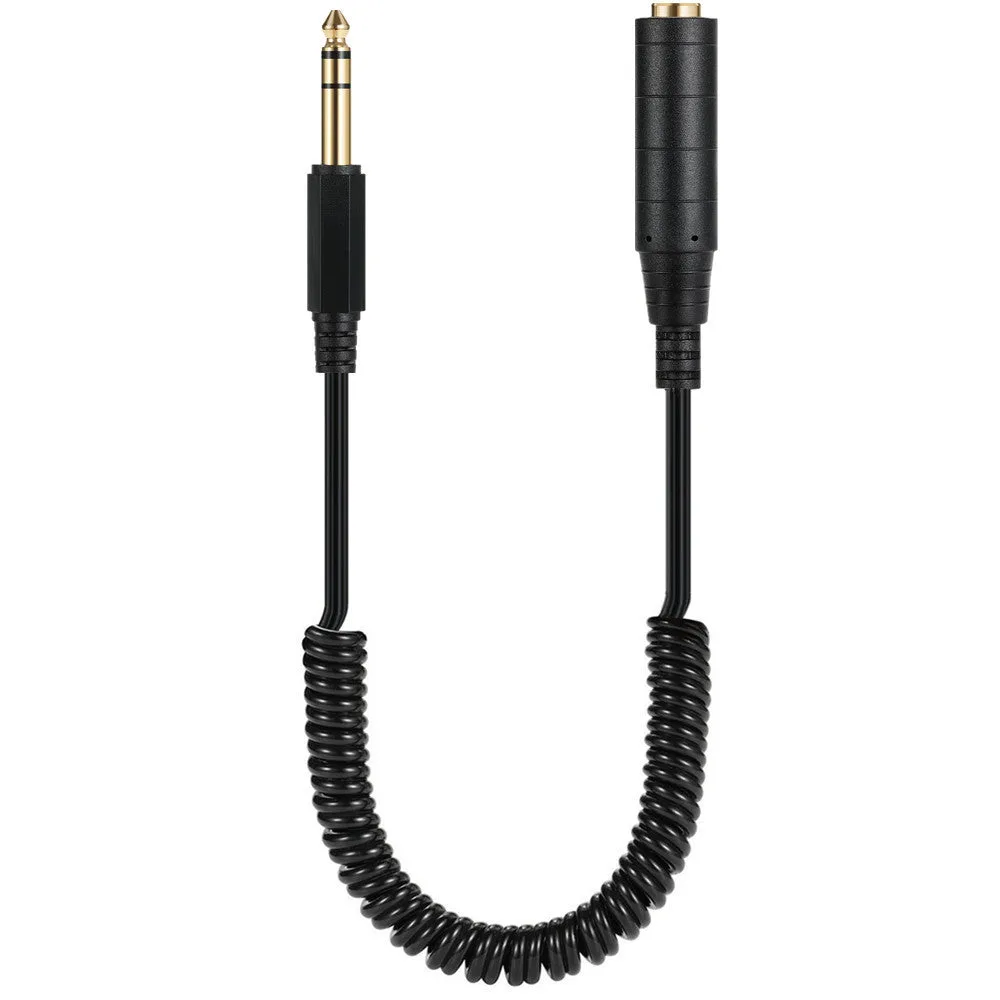
6.35mm 1/4" TRS Stereo Male to Female Coiled Audio Extension Cable 24K Gold Plated
Which one fits you?
Best for
- Musicians who need a tangle-free extension between a guitar and pedalboard on stage
- Studio setups where the cable stays in one place and you want clean routing
Not for
- Permanent installations over long distances, where a straight cable is more reliable
- Users who need to stretch a coiled cable to its full length constantly, as this can damage the cable