What the Blush 1990s set is actually selling
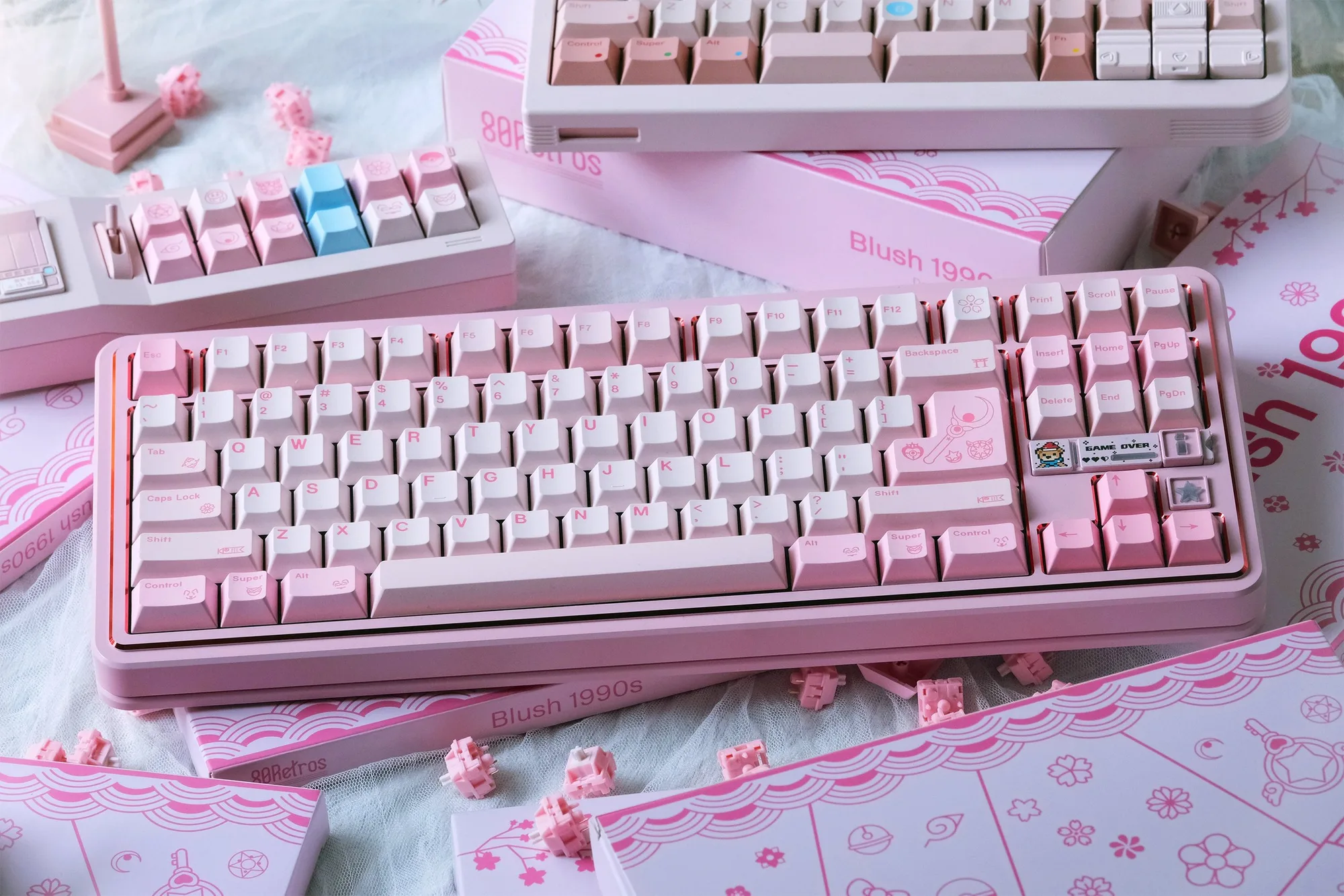
The Blush 1990s set is 80Retros' second pink-toned keycap release, built around cherry blossoms and Shoujo Manga aesthetics from the Sailor Moon era. That reference point matters more than the label: this is a soft, layered pink set rather than a single flat pastel, so what you see on a product page depends heavily on the four shades working together across the board.
The palette draws on four Pantone references — 670C, 706C, 496C and 707C — which is why the set reads as a gradient of blush tones rather than one uniform color. If you are shopping for blush pink keyboard keycaps, that layering is the main reason to pick this set over a simpler single-tone option.
Core specs at a glance
-
80Retros Blush 1990s PBT Keycap Set: Profile: Cherry (factory/standard height) Cherry profile is the familiar sculpted height most people expect, so you can plan your build around a known shape rather than an exotic one.
80Retros Blush 1990s PBT Keycap Set
-
80Retros Blush 1990s PBT Keycap Set: Material: PBT (~1.6mm), with semi-transparent sections The wall thickness and material are the practical details that shape how the set feels and how light behaves through parts of the caps.
-
80Retros Blush 1990s PBT Keycap Set: Legend process: PBT double-shot (alpha/letter zone); ink printing (remaining keys) Legends are not produced the same way across the whole set, which is worth knowing before you assume uniform legend construction.
Why the legend split matters more than the color story
Most buyers fixate on the pink palette, but the legend detail is the more useful thing to understand. The alpha and letter zone uses PBT double-shot legends, while the remaining keys use ink printing. That is a two-process set, not a uniform one.
In practice this is a construction note, not a warning. It tells you the letter keys and the surrounding keys are not made the same way, so if legend consistency across every cap is a priority for you, factor that in. The supplied information does not describe durability differences between the two processes, so treat this as a description of how the set is built rather than a claim about wear.
Cherry profile and the fit question
The set uses Cherry profile at factory/standard height, which is the most common starting point for custom builds and the easiest to plan around. If you already like a sculpted, gently angled row profile, this is familiar ground.
What the supplied information does not confirm is which specific layouts, bottom-row widths or stabilizer positions the kits cover. Cherry profile describes the height and shape of the caps, not the layout coverage of a given kit. Before ordering, check the kit contents against your board's layout — particularly if you use a non-standard bottom row or a compact layout — because the catalog evidence here does not list per-kit key counts or layout support. That is a gap in the supplied information, not a confirmed limitation of the product.
Choosing between the five kit options
The set is sold in several kitting configurations. Which one makes sense depends on whether you are dressing a full board, adding accents, or filling gaps in an existing set.
- Base Kit: The straightforward choice if you want to cover a board with the core Blush 1990s look and do not need novelty or alpha extras.
- Base + Novelty + Alpha: The most complete option in the listing, bundling the base coverage with novelty and alpha additions in one purchase.
- Novelty: For buyers who already have base coverage and want the accent keys that carry the Shoujo Manga theme.
- Alpha: Useful if you want to swap just the letter zone — relevant here because the alpha/letter zone is the part with PBT double-shot legends.
- Blooming: A separate kitting option in the listing; the supplied information does not detail its contents, so confirm what it includes before relying on it for full coverage.
The semi-transparent sections and what they change
Part of the set uses semi-transparent sections, which is a design choice that affects how the caps look on a lit board. The supplied information describes the material as PBT at roughly 1.6mm with these semi-transparent areas, but it does not confirm backlight transmission behavior, shine-through performance or how the transparency interacts with specific lighting setups.
If a particular lighting effect is central to your build, treat that as something to verify rather than assume. The color palette is well documented — four Pantone shades — but the optical behavior of the transparent sections is not.
Price context and who this set suits
The catalog lists the set at USD 84.18 against a comparison price of USD 122.00. At that level, the value case rests on the layered four-shade palette and the PBT construction rather than on exotic materials or a rare profile.
This set fits you if you want a soft, retro-leaning pink theme with a familiar Cherry profile and are comfortable checking kit coverage against your own board. It is a weaker match if you need documented layout support for an unusual board, want a single flat color, or require confirmed backlight behavior before buying. Those are the honest trade-offs — the aesthetic is well specified, the layout and lighting details are not.