Quick answer
Match the MOON 861 to speakers you already know are demanding and to a preamp that gives you the inputs and volume control you actually use. If either piece is still undecided, choose the speaker first, then pick a preamp with a clean signal path and the features your sources require.
Why the 861 changes the speaker-first rule
Most power amp buying advice starts with the amplifier and works backward to speakers. The 861 is better approached the other way around. Its design brief is to stay composed and colorless under load, so the speaker becomes the variable that decides whether the amplifier's stability and resolution are assets or overkill.
If your speakers are efficient and easy to drive, the 861's headroom may never be exercised. That is not a fault, but it means the money spent on that headroom could have gone toward source quality or room treatment instead. Decide what your speakers actually ask for before committing.
The preamp decision is about features, not power
A power amplifier has no volume control and no source switching, so the preamp carries all of that. With the 861, the useful question is not whether a preamp is 'good enough' but whether it offers the inputs, gain structure, and control you need without adding coloration the amplifier was built to avoid.
A network player preamplifier can simplify a system by combining streaming and volume control in one chassis. A separate line preamp gives you more flexibility for turntables and outboard DACs. Neither is automatically better; the right choice depends on how many sources you run and whether you want one box or several.
What the catalog does not tell you
The supplied product record describes the 861's design philosophy and its relationship to the MOON 888 and North Collection, but it does not list power output, gain, input impedance, or binding-post options. Those omissions are a real limitation for matching calculations.
Do not guess at those figures or assume they match another MOON model. Confirm them with the manufacturer or your dealer before you buy speakers that sit at the edge of what the amplifier can drive. Treat any matching advice that relies on invented specifications as unreliable.
Decision rules for matching the 861
- Start with the speaker load: If your speakers are known to be current-hungry or have low, uneven impedance, the 861's stated design goal of maintaining control under demanding loads is the reason to shortlist it. If your speakers are easy to drive, audition the 861 against a lower-power amplifier before assuming the extra capability is worth the price. Confirm the speaker's impedance and sensitivity before you compare amplifiers.
- Choose the preamp by source count: Count your sources first. If you stream and need only one or two digital inputs, a network player preamplifier keeps the chain short. If you run a turntable, a DAC, and a disc player, choose a line preamp with enough inputs and a volume control that suits the 861's gain. List every source and cable before you choose a preamp chassis.
- Check gain compatibility, not just brand: A preamp with very high gain can make the volume control unusable in the first part of its range with a powerful amplifier. Ask your dealer whether the preamp and the 861 are gain-compatible in your room, and plan to audition at normal listening levels rather than at show volume. Audition at the level you actually listen at, not just loudly.
- Budget for the whole chain: A stereo power amplifier selection at this level only makes sense if the preamp and speakers are not the weak link. If your current preamp or speakers are entry-level, upgrade those first or split the budget rather than spending it all on the 861. Set a total system budget before you price the amplifier alone.
- Use the power amp buying checklist: Before buying, confirm: speaker impedance and sensitivity, preamp gain and input count, cable and connector types, rack space and ventilation, and whether you need balanced or single-ended connections. If any answer is unknown, resolve it before purchase. Write the answers down; unresolved items are reasons to wait.
Product facts
-
861 Wzmacniacz mocy: The MOON 861 is a stereo power amplifier derived from the MOON 888 and built around the North Collection design philosophy. That lineage tells you the 861 is intended to deliver music with controlled confidence rather than added color, so speaker choice should focus on what your room and speakers need, not on compensating for the amplifier.
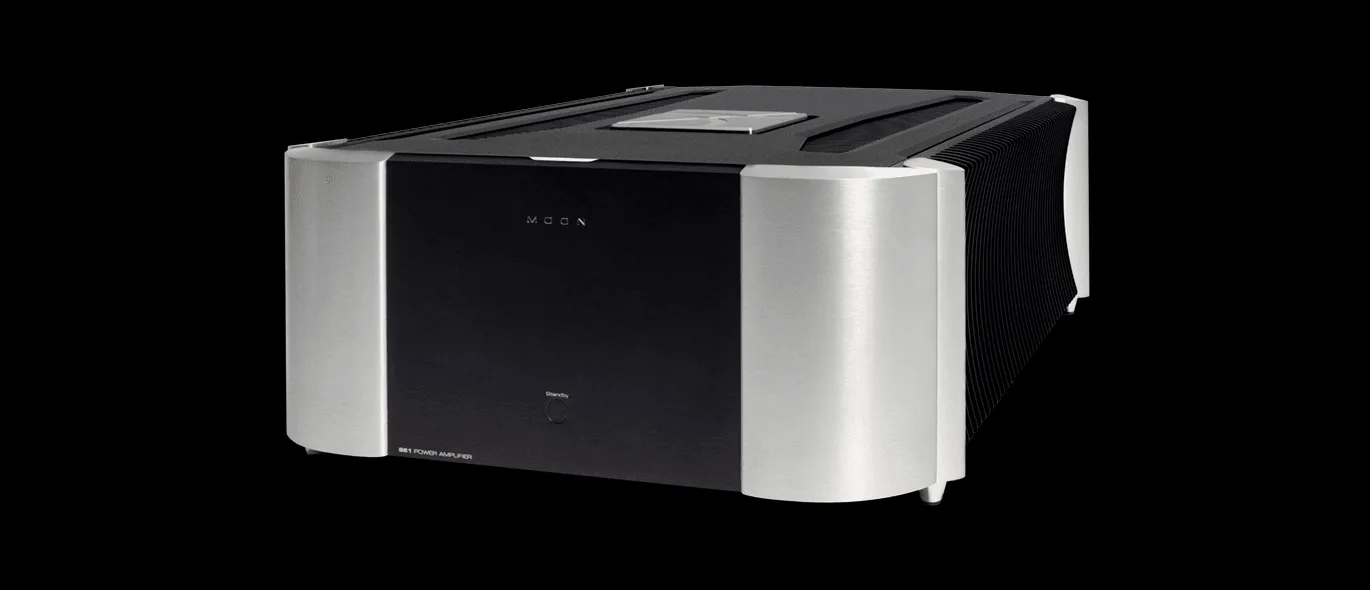
861 Wzmacniacz mocy
Who should choose the 861
Best for
- Listeners with demanding speakers who want a composed, uncolored stereo power amplifier
- System builders who already have a preamp with suitable gain and enough inputs
- Buyers planning a North Collection system around the 861's design lineage
Not for
- Listeners with efficient speakers who will never use the amplifier's headroom
- Buyers who have not yet confirmed speaker impedance or preamp gain
- Anyone who needs integrated streaming and volume control in a single chassis