Quick answer
For most first jewelry studios, the 110mm Flat Ultra Mill with Ductile Frame is the better buy: its wider, larger-diameter rollers handle more sheet-metal sizes with less flex, and it costs only slightly more than the 90mm model. Choose the 90mm Flat Rolling Mill if bench space and budget are tight and you mostly work with narrow stock.
What the roller width actually changes
Roller width sets the widest sheet you can feed through in one pass. The 90mm mill accepts stock up to 90mm wide, while the 110mm mill takes 110mm. That 20mm difference matters when you are rolling sheet for bracelets, wide cuffs, or large blanks: with the narrower mill you either buy pre-cut narrow sheet or accept more passes and edge alignment work.
Both mills share the same 5mm maximum opening and the same 4:1 gear ratio, so the feel at the handle is similar. The practical difference is how much material you can present to the rollers at once.
Roller diameter and why it affects sheet quality
The 90mm mill uses 42.6mm diameter rollers; the 110mm mill uses 55mm rollers. A larger roller diameter spreads the rolling load over a longer contact arc, which generally reduces the tendency of thin sheet to distort or curl. For jewelers rolling down to foil thicknesses, the larger rollers on the 110mm model give more predictable results on wide, thin stock.
Both models are rated to produce metal foil as thin as .001 inch, so the foil capability itself is not the deciding factor. The difference is how comfortably each handles wider sheet on the way down to that thickness.
Frame, gears, and the ductile-frame advantage
Both mills use a ductile frame, precision hobbed gears from solid steel rather than cast gears, and maintenance-free bronze bushings. That shared construction means you are not trading away durability by choosing the smaller mill. The ductile frame resists the flex that cheaper cast frames can develop under load, which keeps the roller gap consistent across the sheet.
Because the core engineering is the same, the decision comes down to capacity and price rather than build quality.
Price and value trade-off
At catalog prices, the 90mm mill is USD 467.89 and the 110mm mill is USD 471.25—a difference of about USD 3.36. Given that the 110mm model offers 20mm more roller width and a larger roller diameter for that small premium, it is the stronger value for anyone who expects to roll sheet regularly.
The 90mm mill still makes sense if your bench is shallow, your work is mostly narrow strip and wire-adjacent stock, or you want to put the savings toward other tools.
Key trade-offs to weigh
- Width vs. bench space: The 110mm mill gives you 20mm more working width but takes up more bench depth. Measure your mounting area before choosing; if you are tight on space, the 90mm mill may fit where the 110mm will not. Confirm your bench can accommodate the mill's footprint and handle swing before ordering.
- Roller diameter vs. technique: Larger 55mm rollers on the 110mm mill reduce curling on wide thin sheet, but they do not replace proper annealing and light passes. If you routinely roll wide stock, the larger diameter is the bigger practical upgrade. Plan to anneal between passes regardless of mill size.
- Price vs. long-term use: The 110mm mill costs only about USD 3 more at catalog price. If you expect to roll sheet wider than 90mm even occasionally, the small premium is easy to justify; if your work is consistently narrow, the 90mm mill leaves budget for other tools. Base the choice on the widest sheet you realistically expect to roll, not on today's project.
Product facts at a glance
-
90MM Flat Rolling Mill, Ductile Frame: 90mm roller width, 42.6mm roller diameter, 4:1 gear ratio, 5mm maximum opening. A compact footprint for narrow sheet and strip, with the same reduction gearing as the larger mill.
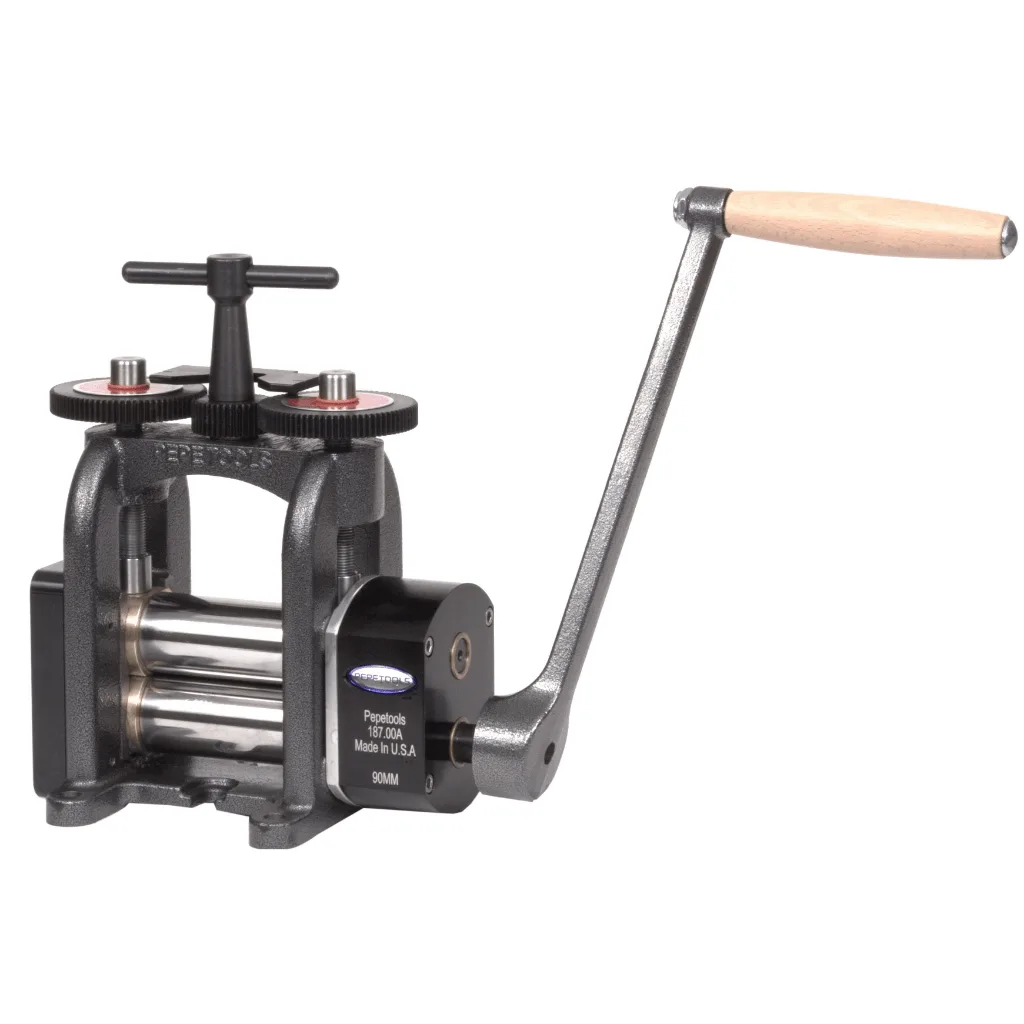
90MM Flat Rolling Mill, Ductile Frame
-
110MM Flat Ultra Mill with Ductile Frame: 110mm roller width, 55mm roller diameter, 4:1 gear ratio, 5mm maximum opening. Wider, larger rollers handle broader sheet with less edge alignment work for a few dollars more.
110MM Flat Ultra Mill with Ductile Frame
110MM Flat Ultra Mill with Ductile Frame
Which mill fits your studio
Best for
- Jewelers who regularly roll sheet wider than 90mm, such as cuff and bracelet blanks
- Studios that want the most capacity for a minimal price difference
- Makers rolling thin sheet who want the stability of larger-diameter rollers
Not for
- Very small benches where the larger mill's footprint is a problem
- Jewelers whose work is limited to narrow strip and who prefer to save the small price difference
- Anyone needing powered rolling; both models are manually operated