Quick answer
Install the Adaptive Cutting System 48-Tooth Saw Blade by matching the arbor size, orienting the teeth correctly, and tightening to the recommended torque. For first cuts, set blade height just above the material and feed steadily.
Understanding the 48-tooth blade design
The 48-tooth configuration balances rip and crosscut performance in solid wood, plywood, and sheet goods. The 2.2mm kerf removes less material than a standard full-kerf blade, reducing waste and motor strain. The anti-vibration slots in the laser-cut steel body keep cuts quiet and smooth, especially during long rips.
When to choose a different blade
For heavy ripping of thick hardwood, a lower tooth count (24–30) clears chips faster. For ultra-fine crosscuts or melamine, a 60- or 80-tooth blade reduces chip-out. The 48-tooth is a versatile all-rounder, not a specialist for either extreme.
Step-by-step setup and first cuts
- 1. Check arbor and blade compatibility: Confirm your saw has a 20mm arbor hole. The ACS blade will not fit 5/8" or 1" arbors without an adapter. Common mistake: forcing a blade onto the wrong arbor size can damage the arbor or blade center. Measure your arbor before opening the blade package.
- 2. Install the blade with correct tooth orientation: Place the blade on the arbor so the teeth point downward at the front of the saw (toward the operator). The rotation arrow on the blade should match the saw's direction. Common mistake: reversing the blade causes dangerous kickback and poor cut quality. Double-check the rotation arrow before tightening the arbor nut.
- 3. Tighten the arbor nut to specification: Use the included arbor wrench and tighten firmly, but do not overtighten. Most saws require 15–25 ft-lb of torque. Common mistake: overtightening can warp the blade or strip the arbor threads. A snug, non-wobble fit is safer than maximum torque.
- 4. Set blade height for the material: Raise the blade so the top tooth is about 1/8" to 1/4" above the workpiece top surface. For thin plywood, use the lower end; for 2x lumber, use the higher end. Common mistake: setting the blade too high increases exposure and tear-out. Lower blade height reduces risk and improves cut quality.
- 5. Make the first cut with steady feed rate: Turn on the saw and let it reach full speed. Feed the workpiece at a consistent pace—not so slow that the blade burns the wood, not so fast that the motor bogs. The 48-tooth blade cuts smoothly through plywood and solid wood without forcing. Common mistake: hesitating mid-cut creates burn marks on the edge. If you see burn marks, increase feed speed slightly or check for dull teeth.
Product details
-
Adaptive Cutting System 48-Tooth Saw Blade: 6 1/2" (165mm) diameter, 20mm arbor hole, 2.2mm-wide kerf, 48 carbide-tipped teeth, anti-vibration slots. The 20mm arbor fits most compact and track saws; the thin kerf reduces waste and load on the motor, while anti-vibration slots keep cuts quiet and stable.
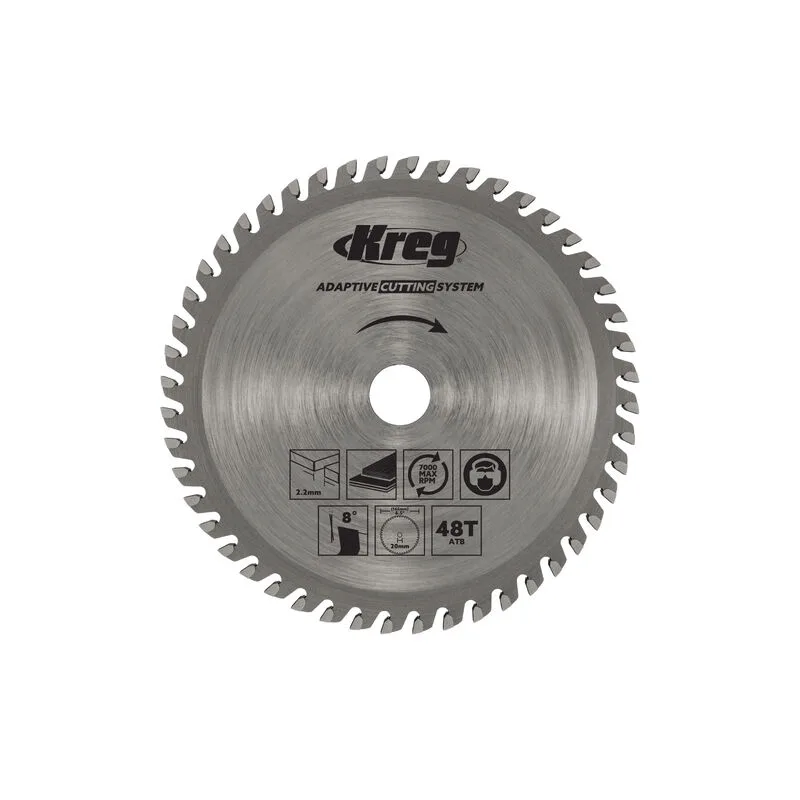
Adaptive Cutting System 48-Tooth Saw Blade