Two Reloads, One Shared Hardware Set
The AeroTech E18-4W and F22-7J are both mid-power RMS reload kits, but they are not interchangeable in the same rocket without checking thrust, delay and propellant behavior. The E18-4W is a 24mm reload that requires RMS-24/40 motor hardware. The F22-7J is a 29mm reload that requires RMS-29/40-120 hardware. That single difference decides which kit you can actually build and fly.
Both kits are assembled by the user and include internal motor components and FirstFire Initiators. Neither kit includes the reusable aluminum motor hardware, so you need the correct hardware set before either reload becomes a flyable motor.
E18-4W: The 24mm White Lightning Reload
-
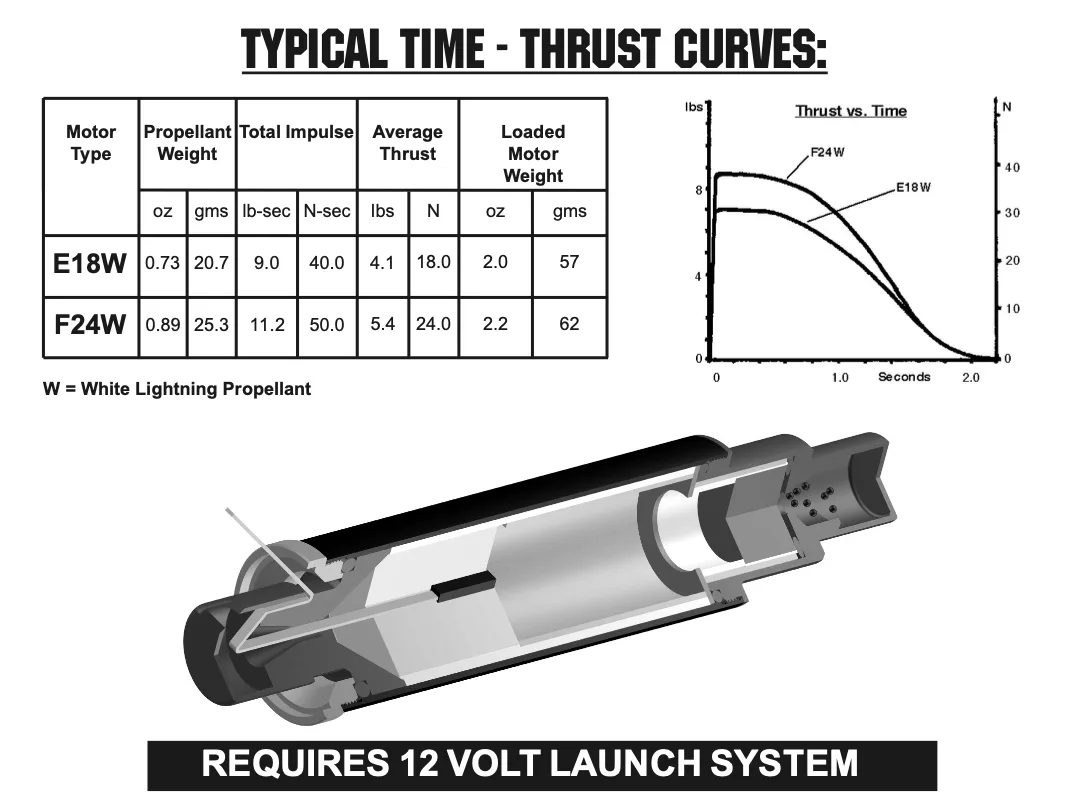
AeroTech E18-4W RMS-24/40 Reload Kit (3 Pack) - 51804: Motor Diameter: 0.938 inches (24mm); Casing Length: 2.75 inches (70mm) This is a 24mm reload, so it fits RMS-24/40 hardware and smaller motor mounts than the 29mm F22-7J.
AeroTech E18-4W RMS-24/40 Reload Kit (3 Pack) - 51804
-
AeroTech E18-4W RMS-24/40 Reload Kit (3 Pack) - 51804: Total Impulse: 36.5 N-sec; Average Thrust: 17.1 newtons; Peak Thrust: 30.1 N-sec; Thrust Duration: 2.1 seconds; Delay Time: 4 seconds Lower total impulse and a shorter 4-second delay suit lighter rockets or flights where you want earlier recovery deployment.
-
AeroTech E18-4W RMS-24/40 Reload Kit (3 Pack) - 51804: Propellant: White Lightning; the kit comes with 3 rocket motor reloads White Lightning produces a bright white flame and dense white smoke, and the 3-pack gives you three flights from one purchase.
F22-7J: The 29mm Black Jack Reload
-
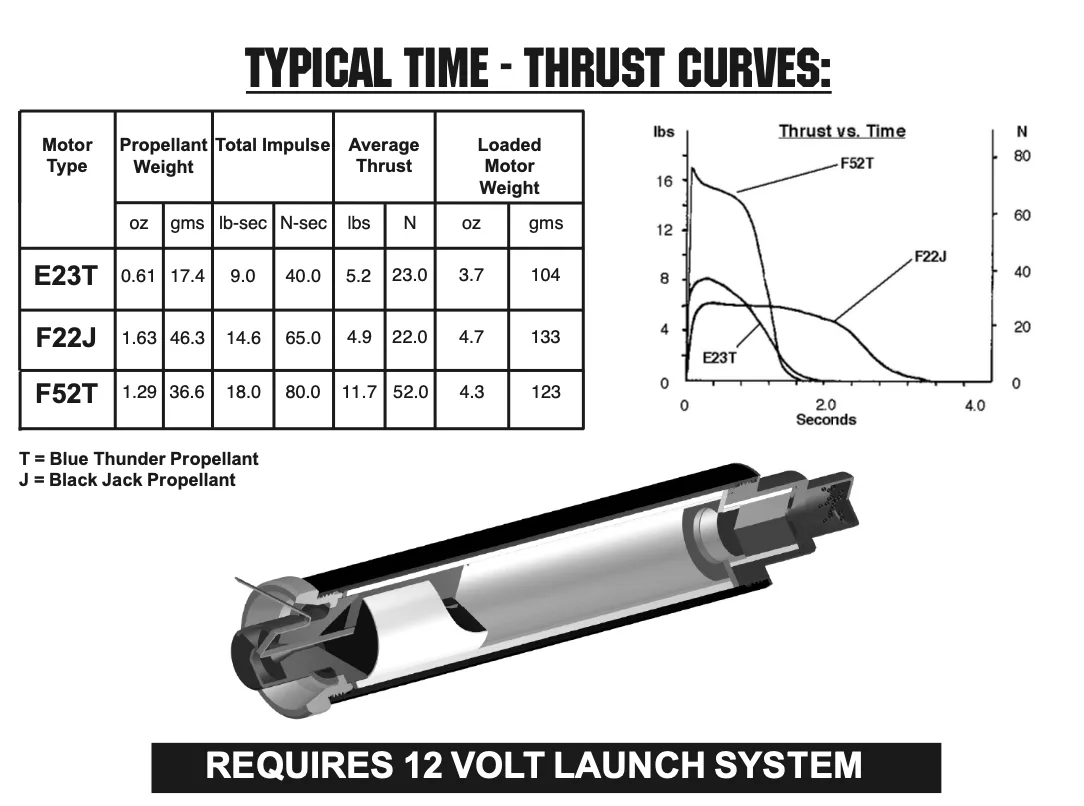
AeroTech F22-7J RMS-29/40-120 Reload Kit (1 Pack) - 62207: Motor Diameter: 1.125 inches (29mm); Casing Length: 4.875 inches (124mm) This is a 29mm reload, so it requires RMS-29/40-120 hardware and will not fit a 24mm motor mount.
AeroTech F22-7J RMS-29/40-120 Reload Kit (1 Pack) - 62207
-
AeroTech F22-7J RMS-29/40-120 Reload Kit (1 Pack) - 62207: Total Impulse: 65 N-sec; Average Thrust: 19.6 newtons; Peak Thrust: 31.2 N-sec; Thrust Duration: 3.31 seconds; Delay Time: 7 seconds Higher total impulse and a longer 7-second delay suit heavier rockets or flights that need more coast time before recovery.
-
AeroTech F22-7J RMS-29/40-120 Reload Kit (1 Pack) - 62207: Propellant: Black Jack; the kit comes with 1 rocket motor reload Black Jack produces a visible black exhaust plume and denser dark tracking smoke, and this kit is a single reload rather than a multi-pack.
Side-by-Side: What Changes Between E18-4W and F22-7J
The table below uses only the supplied catalog specifications. Where a value is not listed, treat it as a decision limitation rather than a product flaw.
- Motor diameter: E18-4W: 0.938 inches (24mm). F22-7J: 1.125 inches (29mm). This is the first compatibility check.
- Required hardware: E18-4W requires RMS-24/40 hardware. F22-7J requires RMS-29/40-120 hardware. Hardware is sold separately for both.
- Total impulse: E18-4W: 36.5 N-sec. F22-7J: 65 N-sec. The F22-7J delivers more total impulse.
- Average thrust: E18-4W: 17.1 newtons. F22-7J: 19.6 newtons. The F22-7J has slightly higher average thrust.
- Peak thrust: E18-4W: 30.1 N-sec. F22-7J: 31.2 N-sec. The peak values are close, but the F22-7J sustains thrust longer.
- Thrust duration: E18-4W: 2.1 seconds. F22-7J: 3.31 seconds. The F22-7J burns longer.
- Delay time: E18-4W: 4 seconds. F22-7J: 7 seconds. Choose based on when you want recovery deployment.
- Propellant: E18-4W: White Lightning, bright white flame and dense white smoke. F22-7J: Black Jack, black exhaust plume and darker tracking smoke.
- Reloads per kit: E18-4W: 3 reloads. F22-7J: 1 reload.
- Propellant weight: E18-4W: 21 grams. F22-7J: 46.3 grams.
- Motor weight: E18-4W: 58.9 grams. F22-7J: 135.6 grams.
How to Decide for Your Rocket
Start with the motor mount. If your rocket accepts 24mm motors, the E18-4W is the only one of these two that fits. If it accepts 29mm motors, the F22-7J is the candidate. Do not try to adapt one to the other; the catalog lists different hardware requirements for each.
Next, look at the delay. The E18-4W uses a 4-second delay, while the F22-7J uses a 7-second delay. A shorter delay deploys recovery sooner after burnout; a longer delay lets the rocket coast longer. Which is right depends on your rocket's mass and drag, and the supplied information does not include a recommended maximum liftoff weight for either motor.
Finally, consider what you get in the pack. The E18-4W kit includes 3 reloads, which is useful if you plan repeated flights on the same 24mm hardware. The F22-7J kit includes 1 reload and is marked as a clearance item that is cancelled when stock is gone, so availability may be limited.
Compatibility and Safety Checks Before You Buy
- Mid Power vs High Power: Both kits are mid-power RMS reloads. The catalog states that mid-power RMS reload kits are not compatible with High Power RMS products.
- Age and proof of age: The sale of this high power motor to persons under 18 years of age is currently prohibited by federal law. Orders containing either item will not ship until proof of age, such as a copy of a driver's license, is received.
- Shipping: The E18-4W listing states it is U.S. mailable with no hazmat fee. The F22-7J listing does not include that statement in the supplied information.
- Liftoff weight: AeroTech/Quest currently does not list or post recommended maximum liftoff weights for mid-power and high-power motors due to the variables involved. Use simulation software such as RockSim or OpenRocket to model your rocket before flying.
Which RMS-24/40 Reload to Buy
If you already own RMS-24/40 hardware and want three flights with a bright white flame and a short delay, the AeroTech E18-4W RMS-24/40 Reload Kit (3 Pack) is the straightforward choice. If you own RMS-29/40-120 hardware, want more total impulse and a longer delay, and prefer Black Jack's dark tracking smoke, the AeroTech F22-7J RMS-29/40-120 Reload Kit is the match. The two kits do not share hardware, so the decision is really about which motor system your rocket and your range box already support.