What the AeroTech J250W-14A DMS Motor Is and Who It's For
The AeroTech J250W-14A is a single-use motor from the Disposable Motor System (DMS) line. It comes as a kit that you assemble yourself, but the nozzle and propellant are already installed. The motor uses a filament-wound fiberglass casing, a glass-reinforced composite phenolic nozzle, and White Lightning composite propellant, which produces a bright white flame, dense white smoke, and a throaty roar at liftoff.
This is a high-power motor requiring Level 2 High-Power certification through the National Association of Rocketry (NAR) or Tripoli Rocketry Association to purchase. Federal law also prohibits sale to persons under 18. If you hold Level 2 certification and are looking for a 54mm single-use motor with adjustable delay, the J250W-14A is a solid option.
Key Specifications for Flight Planning
-
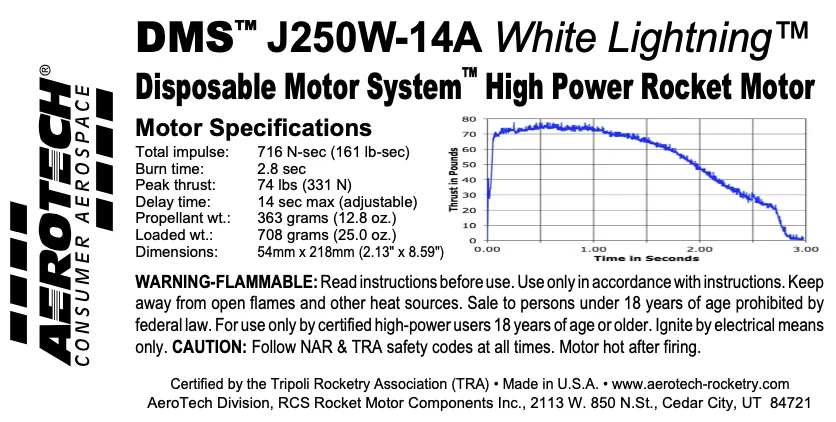
AeroTech J250W-14A 54mm x 218mm Single Use DMS 1-Motor Kit - 102514: Total Impulse: 716 N-sec; Average Thrust: 250 newtons; Peak Thrust: 331 newtons; Thrust Duration: 2.8 seconds. These numbers tell you the motor delivers a moderate, sustained push over nearly three seconds, which is useful for lifting heavier rockets or achieving higher altitudes without excessive acceleration.
AeroTech J250W-14A 54mm x 218mm Single Use DMS 1-Motor Kit - 102514
-
AeroTech J250W-14A 54mm x 218mm Single Use DMS 1-Motor Kit - 102514: Motor Diameter: 2.125 inches (54mm); Casing Length: 8.58 inches (218mm); Propellant Weight: 363 grams; Motor Weight: 708 grams. You need a rocket with a 54mm motor mount tube that can accommodate the 218mm casing length. The total motor weight (708g) plus propellant contributes to your rocket's liftoff mass.
-
AeroTech J250W-14A 54mm x 218mm Single Use DMS 1-Motor Kit - 102514: Delay Time: adjustable up to 14 seconds. You can fine-tune the delay between burnout and ejection charge deployment, which is critical for matching the motor to your rocket's descent profile. The Universal Delay Drilling Tool (UDDT) is required for adjustment and is not included.
Assembly and Delay Adjustment Steps
The AeroTech J250W-14A DMS motor requires a few setup steps before use. Follow these in order.
- 1. Obtain the Universal Delay Drilling Tool (UDDT): The UDDT is required to adjust the delay time and is sold separately in the AeroTech Accessories section. Without it, you cannot shorten the factory-set delay.
- 2. Set the desired delay time: Use the UDDT to drill the delay element to your target delay (up to 14 seconds). The motor comes with a maximum delay; you shorten it by drilling. Follow the tool's instructions carefully to avoid drilling too far.
- 3. Pour in the ejection charge: After adjusting the delay, you must add the ejection charge (black powder) into the forward closure. The motor does not come pre-loaded with the ejection charge.
- 4. Install the FirstFire Initiator: The motor pack includes one FirstFire Initiator. Install it per the manufacturer's instructions for reliable ignition.
What the Catalog Does Not Tell You
AeroTech/Quest does not list recommended maximum liftoff weights for mid-power and high-power motors due to the many variables involved (rocket weight, drag, stability, etc.). For flight simulation, they recommend using RockSim software (available at apogeerockets.com) or OpenRocket Simulator (openrocket.info) to estimate altitude, velocity, and optimal delay for your specific rocket.
The motor requires HAZMAT shipping via UPS or FedEx, and your order will not ship until you provide proof of age (e.g., driver's license) and proof of Level 2 certification. Plan for additional shipping costs and documentation time.
What's in the Box and What's Not
- AeroTech J250W-14A 54mm x 218mm Single Use DMS 1-Motor Kit - 102514: This AeroTech motor pack comes with 1 rocket motor and 1 FirstFire Initiator. You get the motor and one igniter, but you must supply the UDDT, ejection charge powder, and any additional igniters if you plan multiple flights.
- AeroTech J250W-14A 54mm x 218mm Single Use DMS 1-Motor Kit - 102514: The nozzle and propellant are already installed. You do not need to handle propellant grains or nozzle assembly, which simplifies preparation compared to reloadable motor systems.
Legal and Safety Requirements
This is a high-power motor requiring Level 2 certification through NAR or Tripoli. Federal law prohibits sale to persons under 18. You must provide proof of certification and age before the order ships. The motor is certified by TRA, NAR, and the Canadian Association of Rocketry (CAR).
Always follow your certifying organization's safety code for high-power rocketry, including launch site dimensions, distance from spectators, and recovery system requirements.