Start with how the set actually plays
The African Safari Stacking Animals & Bag is a balance-and-stack toy, not a puzzle with one correct answer. The catalog describes the play simply: stack the chunky animal blocks high, then watch them topple. That loop of building and knocking down is the core of the toy, and it is what separates it from peg puzzles or fixed-shape sorters.
For a parent choosing between stacking sets, that distinction matters. A toppling stack invites repeated attempts and quick reset, while a puzzle rewards a single finished solution. If your toddler likes cause and effect, the safari set gives them a lot of it in a small footprint.
What the catalog confirms
-
African Safari Stacking Animals & Bag: The set comprises 9 chunky wooden animal blocks in a safari theme, painted in colorful hues. Nine pieces is enough to build a real stack without turning tidy-up into a chore, and the animal shapes give toddlers something to name and sort as they play.
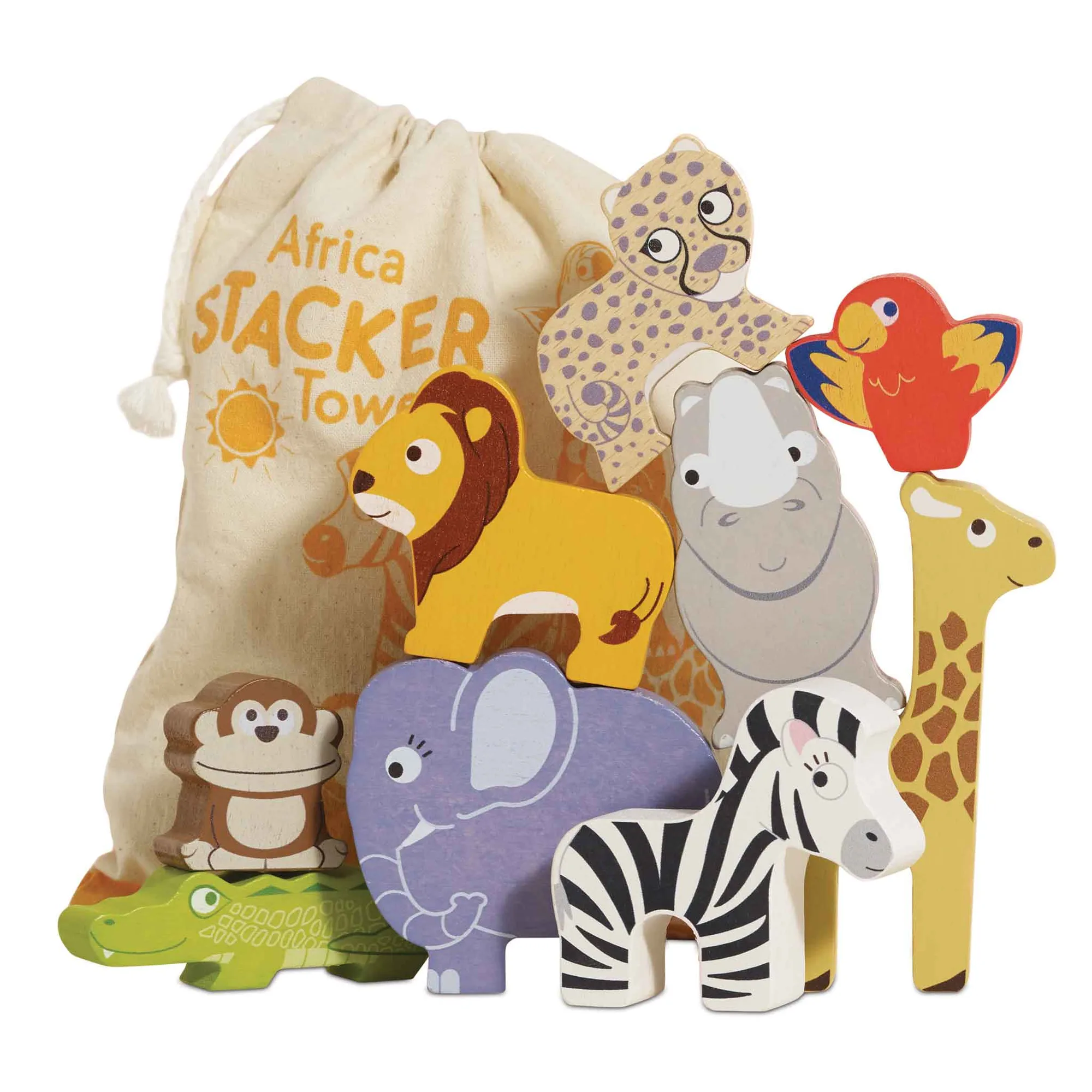
African Safari Stacking Animals & Bag
-
African Safari Stacking Animals & Bag: The blocks are crafted from sustainable FSC-certified wood. If wood sourcing is part of your buying decision, this is a concrete, checkable claim rather than vague eco wording.
-
African Safari Stacking Animals & Bag: The set includes a storage bag. A bag changes where the toy lives: it can travel to a grandparent's house or a restaurant table without loose blocks rolling around.
Why the storage bag is a real buying factor
Loose wooden blocks are easy to lose and annoying to gather. A stacking toy with storage bag solves the practical side of that: the whole set has one home, and it can leave the house as a single item. That matters more than it sounds, because a toy that travels gets used more often than one that stays in a playroom.
The trade-off is that a bag is not a display piece. If you want the set to sit out on a shelf as part of the room, the bag will end up in a drawer. Neither approach is wrong; just decide which one fits your home before you buy.
What the supplied information does not tell you
The catalog does not state a specific age range for this set, and it does not list care instructions or safety warnings. That is a limitation of the supplied record, not a claim that the product lacks them. Before buying for a child under three, check the packaging or the retailer's product page for the manufacturer's stated age guidance and any small-parts warning.
The set is also listed in a single Standard variant, so there is no size or color choice to make. What you see is what you get: nine animal blocks and a bag.
Stacking animals vs. a stacking ring or peg puzzle
Use this to decide whether the safari set is the right first stacking toy or a second one.
- African Safari Stacking Animals & Bag: Nine chunky animal blocks plus a bag. Best when you want open-ended balancing, animal naming, and a set that packs away for travel. The toppling play is the point, so expect noise and resets.
- Classic stacking rings: Usually a single vertical post with graded rings. Simpler to master and tidier, but less variety in shape and less pretend-play potential.
- Peg puzzle: One correct place for each piece. Good for matching and fine motor control, but it does not offer the build-and-crash loop that keeps some toddlers engaged.
Decision rules before you add it to the basket
- Buy it if your child already enjoys knocking things down: The catalog's own description leads with stacking high and watching the blocks topple, so the toy is built around that cause-and-effect play.
- Buy it if the toy needs to travel: The included storage bag is the clearest practical advantage over loose block sets.
- Check the age guidance first if your child is under three: The supplied record does not state an age range, so confirm it on the packaging or product page before purchase.
- Skip it if you want a quiet, single-solution toy: A peg puzzle or stacking ring is a better fit for children who prefer order over experimentation.
Where it fits alongside other safari play
The animal blocks can act as a small safari pretend play set on their own: line them up, name them, and build a stack. They are not a full playset with scenery or figures, so if your child already has a safari animal collection, this set adds a portable building element rather than duplicating it.
At the catalog price of USD 16.22 against a comparison price of USD 24.95, it sits in the pocket-money-to-gift range. That makes it a reasonable add-on to a larger wooden animal purchase, or a first stacking set where you want wood rather than plastic.