Quick answer
Use the Air Ball Coanda Effect kit to run three simple experiments that show how air clings to surfaces and lifts a ball. These activities take about 15 minutes each and need only common household items.
Why the Coanda effect matters
The Coanda effect explains why air follows a curved surface instead of flying straight off. This principle is behind airplane wings, hair dryers, and even how a spoon hangs from a faucet. The Air Ball kit makes it visible by floating a foam ball on a stream of air that bends around the ball's surface.
What you need besides the kit
The Air Ball kit includes 16 parts: the fan, ball, and assembly pieces. For these experiments, you will also need a small piece of cardboard (about 4x6 inches), a table or flat surface, and a marker. No glue or tape required.
Three Coanda effect experiments with the Air Ball
- Assemble the Air Ball fan: Connect the fan motor to the battery pack and snap the fan blade onto the motor shaft. Attach the nozzle piece to the front of the fan housing. Make sure the fan blows air straight out of the nozzle. A loose fan blade will reduce airflow and make the ball drop. Push the blade until it clicks.
- Float the ball in a straight stream: Turn on the fan and hold it pointing straight up. Place the foam ball into the air stream just above the nozzle. Adjust the fan angle slightly to center the ball. The ball should hover about 2-3 inches above the nozzle. If the ball shoots sideways, the fan is tilted too much. Start with the fan perfectly vertical.
- Bend the air stream with a cardboard curve: Hold a piece of cardboard vertically next to the air stream, about 1 inch from the nozzle. Slowly move the cardboard closer until the ball moves sideways toward the cardboard. The air is sticking to the cardboard surface (Coanda effect). Move the cardboard very slowly. If you move it too fast, the ball will fall out of the stream.
- Make the ball follow a curved path: Tilt the fan to a 45-degree angle while keeping the ball floating. Hold the cardboard curve above and behind the ball. The ball will follow the curved cardboard instead of falling straight down. This shows how air wraps around surfaces. The ball may drop if the cardboard is too far away. Keep it within 2 inches of the ball.
About the Air Ball kit
-
Air Ball - Coanda Effect: The Air Ball - Coanda Effect is a CrunchLabs build from the Toys category, created for kids and adults who want to learn to think like engineers. This kit focuses on the Coanda effect and comes with 16 total parts. With only 16 parts, you can assemble the experiment in under 10 minutes and focus on testing the physics rather than complex construction.
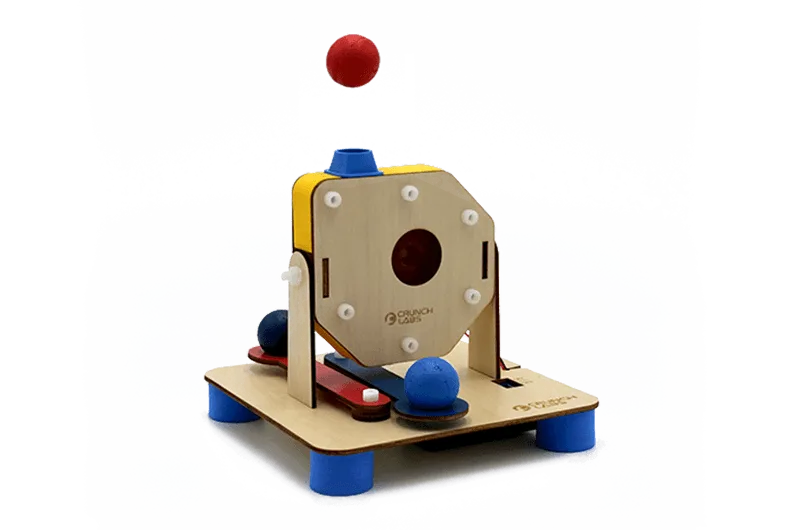
Air Ball - Coanda Effect