The claims worth checking before you buy
Floral fragrance oils attract a lot of shorthand: they are too sweet, too heavy, too fleeting, or only suitable for certain rooms. Some of that is personal taste, but some is presented as fact. The American Beauty fragrance oil gives us a concrete record to test those claims against. It is inspired by St. Regis hotels and lists a full note pyramid, so we can separate what the supplied information supports from what it does not.
Below, each myth gets a verdict based only on the catalog details: the notes, the available sizes, and the stated inspiration. Where the record is silent, we say so rather than filling the gap with guesswork.
Myths checked against the American Beauty record
- Myth: Floral fragrance oils are always sweet and one-dimensional: The American Beauty note list is more layered than a single sweet floral. It opens with zesty lemon, jasmine, and tropical pineapple, moves into rose, mulberry, muguet, and cyclamen, and closes with musk, amber, and cashmere wood. The citrus top and woody base mean the floral heart sits inside a broader structure, not on its own.
- Myth: A floral oil is too strong for a small room: The supplied information does not include a room-size recommendation or a dosage guide, so no strength claim can be confirmed either way. What the record does show is a range of bottle sizes from 20 ml to 500 ml. Choosing a smaller bottle is a practical way to start without committing to a large format, but the catalog does not state how much oil to use per room.
- Myth: Floral scents are only for bedrooms: The product description says the oil is intended to transform any environment and mirror the charm of the St. Regis hotel. That wording is not limited to a single room type. The catalog does not rank rooms by suitability, so treat any claim that this scent belongs only in a bedroom as opinion rather than a documented limitation.
- Myth: All floral oils smell the same: The American Beauty pyramid is specific: lemon, jasmine, and pineapple at the top; rose, mulberry, muguet, and cyclamen in the middle; musk, amber, and cashmere wood at the base. That combination is the documented scent. Any claim that it smells identical to another floral oil is not supported by the supplied record.
- Myth: A hotel-inspired oil is a dupe of a hotel's own product: The record says the scent is inspired by St. Regis hotels. Inspired by is not the same as an official hotel product, and the catalog does not claim otherwise. Read the description as a style reference, not a certification of origin.
What the American Beauty record actually confirms
-
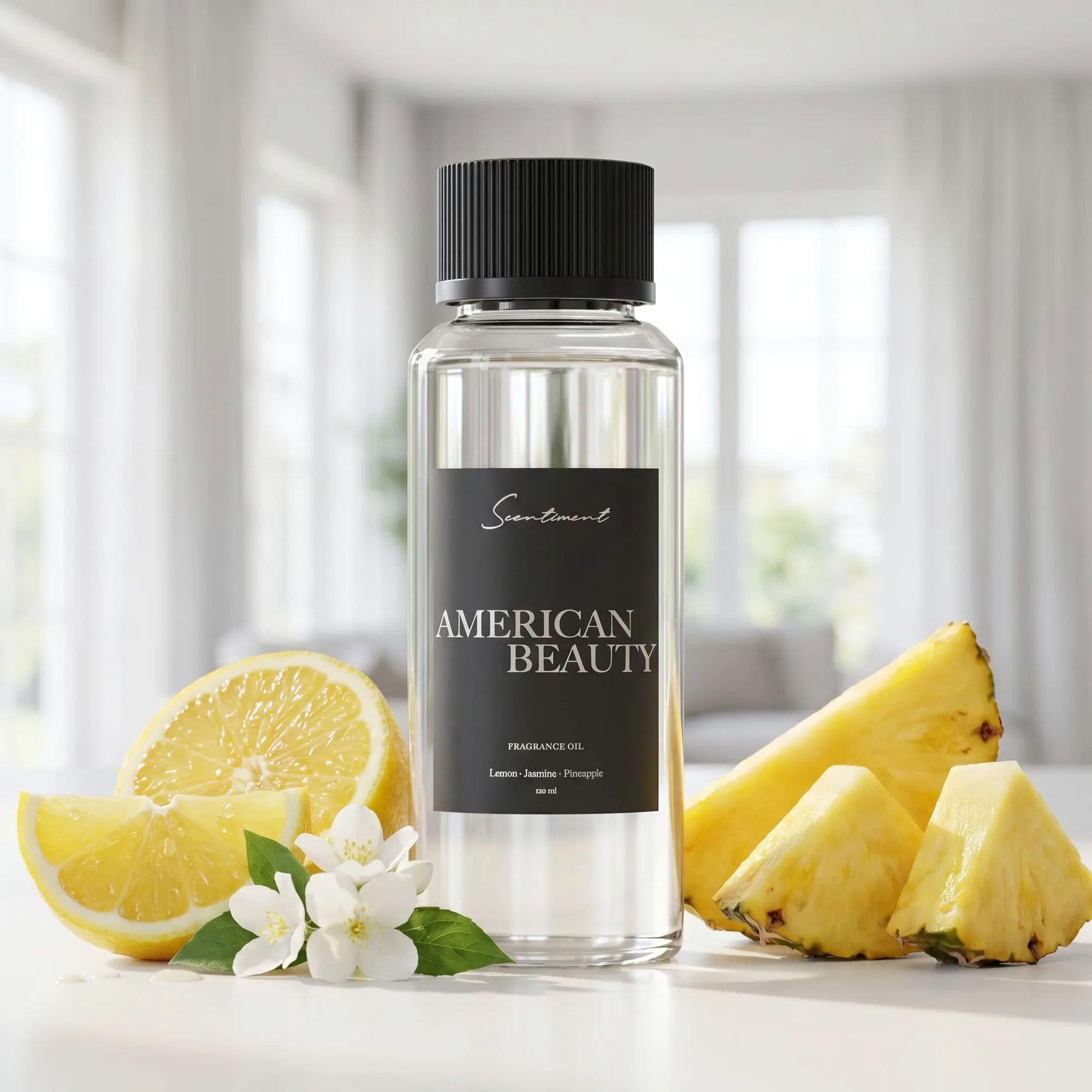
American Beauty: Top notes: zesty lemon, jasmine, tropical pineapple. Mid notes: rose, mulberry, muguet, cyclamen. Base notes: musk, amber, cashmere wood. This is the documented scent structure. It supports the idea that the oil is a layered floral with citrus and woody accents, not a plain sweet floral.
American Beauty
-
American Beauty: Available sizes: 20 ml, 50 ml, 120 ml, and 500 ml. The size range is the clearest documented way to manage how much oil you buy. It does not, by itself, tell you how long a bottle lasts or how strong the scent will be.
-
American Beauty: The description says the oil is inspired by St. Regis hotels and is intended to transform any environment into a haven of luxury. This explains the positioning of the scent and supports using it across home spaces, but it is marketing language rather than a room-by-room usage instruction.
The longevity question the catalog does not answer
Longevity is the claim most often stated as fact and least often documented. The supplied record for American Beauty does not include a burn time, a diffusion duration, a recommended refill interval, or a shelf life. It also does not state how long the scent lasts in a diffuser or on a reed. That means any specific longevity figure you see elsewhere is not confirmed by this product information.
What you can do is treat longevity as something to observe in your own setup. The catalog gives you four bottle sizes, so you can start with a smaller format and note how the scent performs in your space before buying a larger one. The record does not supply a usage rate, so avoid treating any online dosage chart as an official instruction for this oil.
Why the floral reputation sticks, and where it comes from
Floral oils often get labeled heavy or old-fashioned because the category is broad. American Beauty shows why that label is too blunt. Its top notes include lemon and pineapple, which read bright, while the base leans on musk, amber, and cashmere wood, which read warm. The floral middle is real, but it is framed by both ends of the spectrum.
That structure is the honest takeaway: floral is a family, not a single strength setting. The supplied notes tell you what this particular floral leans toward. They do not tell you how intense it will be in your diffuser, because the record includes no concentration or diffusion instructions.
Practical ways to judge the myths for yourself
- Start with the smallest size that fits your trial: The 20 ml option is the lowest-commitment way to test the scent in your own space. Move to 50 ml, 120 ml, or 500 ml only after you know how the oil performs for you. The catalog does not state a usage rate, so this is a purchasing strategy, not a dosage instruction.
- Match the scent profile to the room, not the label: The record describes a bright opening and a warm base. Use that description to decide whether the scent suits a space where you want a lifted but grounded impression. The catalog does not assign the oil to specific rooms.
- Separate inspiration from specification: The St. Regis reference is a style cue. The notes are the specification. If you like lemon, jasmine, pineapple, rose, mulberry, muguet, cyclamen, musk, amber, and cashmere wood, the record gives you a reason to try it. If you dislike one of those notes, the inspiration line should not override that.