Quick answer
Choose ANL when your amplifier power wire needs a high-current main fuse, typically a large-gauge run feeding one or more amps, and choose AGU for smaller, single-amp runs where an 80 amp fuse matches the wire and load. Match the fuse rating to the wire gauge and expected current first, then pick the Stinger Shoc-Krome fuse body that fits your holder.
What actually separates ANL from AGU
The two formats differ mainly in physical size, holder style and the current range they are built to cover. ANL fuses are the larger bolt-in style you see in high-current main runs near the battery, while AGU fuses are the smaller glass-tube style that fits a compact AGU holder. Neither format is inherently safer than the other; the correct choice is the one that matches your wire, your expected current and the holder you can mount securely.
Because the fuse only protects the wire it sits in, the fuse rating must never exceed the wire's current capacity. A fuse that is too large lets the wire overheat before the fuse blows; a fuse that is too small nuisance-blows on normal peaks.
When a 200 amp ANL fuse makes sense
A 200 amp ANL fuse suits a heavy main feed, such as a large-gauge run from the battery to a distribution block or a high-output amplifier bank. In those setups the fuse's job is to protect the long cable run, not to protect the amplifier itself, so the rating follows the wire rather than the amp's wattage.
- Use ANL when your holder and wire are sized for high current and you need one main fuse near the battery.
- Do not assume 200 amps fits every system; confirm your wire gauge and total expected current before buying.
When an 80 amp AGU fuse makes sense
An 80 amp AGU fuse fits smaller single-amp installations where the power wire and amplifier draw stay within that range. Its compact holder is easier to mount in tight spaces, which is why AGU remains common in modest systems. The trade-off is that AGU holders and glass fuses generally suit lower-current runs, so they are a poor fit for a big multi-amp feed.
Where the fuse belongs in the chain
Place the main fuse as close to the battery's positive terminal as practical, before the wire runs through the vehicle. This protects the entire cable length if it shorts against metal. If you run a distribution block to several amps, each branch can carry its own smaller fuse, but the main fuse still protects the feed.
Step-by-step: fusing an amplifier power wire
- Confirm the wire gauge and current: Identify your power wire gauge and the total current your amplifier or amps will draw, then check the wire's rated capacity. Common mistake: sizing the fuse to the amplifier's advertised wattage instead of the wire. Write down the wire gauge and target current before choosing a fuse.
- Pick the fuse format and rating: Choose ANL for a high-current main feed and AGU for a smaller single-amp run, then select a rating at or below the wire's capacity. For a heavy main run this may be a 200 amp ANL fuse; for a modest single-amp setup an 80 amp AGU fuse may be appropriate. The fuse rating must never exceed what the wire can safely carry.
- Match the holder to the fuse: Buy a holder built for the fuse body you chose, since ANL and AGU fuses are not interchangeable. Common mistake: buying a fuse before checking which holder you already have or can mount. Confirm holder compatibility before ordering.
- Mount the main fuse near the battery: Install the holder as close to the positive battery terminal as practical, on a solid surface away from heat and moving parts. Common mistake: placing the fuse far down the run, which leaves the first stretch of cable unprotected. Keep the unprotected cable length between battery and fuse as short as possible.
- Connect, torque and test: Make clean connections, tighten the fuse holder hardware firmly without crushing the fuse, then verify polarity and test the system at low volume before pushing it. Common mistake: leaving a loose fuse connection, which causes heat and voltage drop. Recheck fuse tightness after the first few hours of use.
Stinger Shoc-Krome fuses in this guide
-
Stinger SPF52200 PRO Shoc-Krome 200 Amp ANL Fuse: Stinger SPF52200 PRO Shoc-Krome is a 200 amp ANL-style fuse. It fits high-current main runs where your wire and holder are rated for that load.
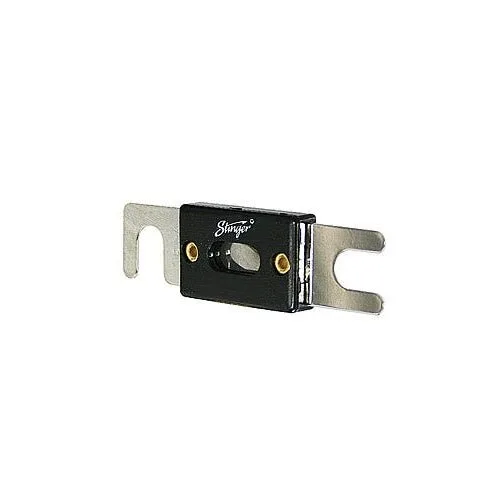
Stinger SPF52200 PRO Shoc-Krome 200 Amp ANL Fuse
-
Stinger SPF5180 PRO 80 AMP AGU Shoc-Krome (5/pack): Stinger SPF5180 PRO 80 AMP AGU Shoc-Krome fuses come in a 5-per-pack. The multi-pack lets you keep spares on hand for a smaller AGU-fused amplifier run.
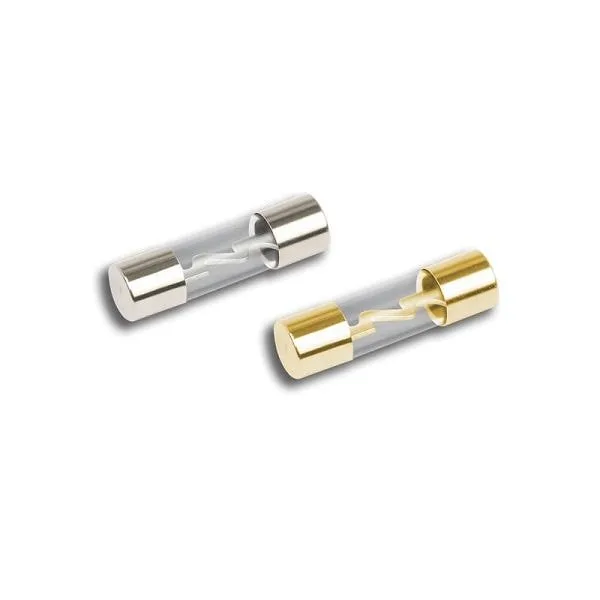
Stinger SPF5180 PRO 80 AMP AGU Shoc-Krome (5/pack)