Quick answer
To cook with the Anolon Endurance+ 34cm French skillet on induction, preheat it on medium for 2–3 minutes, use a small amount of oil or butter, and keep the heat at medium or lower for most foods. The skillet's hard-anodised base heats fast and evenly, so high heat is rarely needed and can damage the nonstick coating.
Why this large skillet behaves differently on induction
The Anolon Endurance+ 34cm French skillet is built with a hard-anodised base that is twice as strong as stainless steel, according to the manufacturer. On induction, that dense base absorbs energy quickly and spreads it across the wide cooking surface, so the pan reaches temperature faster than thinner cookware. That efficiency is helpful for searing and stir-frying, but it also means you need to dial down the heat sooner than you might expect.
A common mistake is treating induction like gas: blasting the burner on high and waiting for the pan to heat. With this skillet, high heat can overheat the nonstick coating and cause food to stick or burn. Start on medium and give the pan a minute or two to stabilise. The 34cm size also holds more food than a standard frypan, so batches that fill the pan will steam rather than brown; cook in smaller batches when you want a crust.
When the 34cm size is an advantage—and when it isn't
This skillet shines when you need a wide surface for family meals: searing four chicken thighs at once, sautéing a full head of chopped greens, or making a large frittata. The open French shape (sloped sides) makes it easy to toss vegetables and slide food onto a plate. However, the wide base can crowd a small induction zone. Check that your cooktop's largest ring matches the pan's base diameter; if the pan overhangs significantly, heat transfer may be uneven. Also note that the skillet is oven safe to 200°C (392°F), so you can finish dishes in the oven, but the handle will be hot—use a mitt.
Step-by-step induction cooking with the Anolon Endurance+ 34cm skillet
- Match the pan to the induction zone: Place the skillet on the largest induction ring that fits its base. If the base overhangs the ring by more than 2 cm, choose a smaller ring or accept that the outer edge may cook more slowly. A poorly matched zone can leave the pan's edges underheated, so rotate the pan halfway through cooking if you see uneven browning.
- Preheat on medium, not high: Set the induction cooktop to medium (around 4–6 out of 10) and let the skillet heat for 2–3 minutes. Add a drop of water—it should sizzle and evaporate quickly. Do not preheat empty on high; the nonstick coating can degrade. If the pan smokes before you add food, it is too hot. Remove it from the heat and let it cool for a minute before continuing.
- Use just enough oil or butter: Add 1–2 teaspoons of oil or butter and swirl to coat the base. For lean proteins or eggs, use a little more. The nonstick surface releases food well, but a thin film of fat improves browning and flavour. Avoid aerosol cooking sprays, which can build up on nonstick coatings over time and reduce their release properties.
- Cook in batches to avoid steaming: Add food in a single layer with space between pieces. For a 34cm skillet, that means about 4–6 chicken thighs or 500g of vegetables. Overcrowding traps moisture and prevents browning. If you hear a loud sizzle that fades to a simmer, the pan is cooling down—cook fewer pieces at once or increase the heat slightly.
- Adjust heat as you cook: Keep the induction setting at medium or lower for most tasks. For searing, you can briefly raise it to medium-high, but reduce the heat once the food is browned. Stir or flip food regularly to promote even cooking. Listen for a steady sizzle: a violent crackle means the heat is too high, while silence means it is too low.
- Finish in the oven if needed: The skillet is oven safe to 200°C (392°F). Transfer it to a preheated oven to finish thick cuts or frittatas. Remember that the handle and entire pan will be hot—use oven mitts. Check your oven's maximum temperature; if it exceeds 200°C, do not use the skillet in it.
- Cool before cleaning: Let the skillet cool completely before washing. Wash by hand with warm, soapy water and a soft sponge, or place it in the dishwasher if you prefer. Avoid abrasive cleaners and metal scouring pads. Never plunge a hot pan into cold water—thermal shock can warp the base and damage the nonstick coating.
Product facts
-
Anolon Endurance+ Nonstick Induction Open French Skillet 34cm: Hard-anodised construction that is twice as strong as stainless steel, per the manufacturer. The dense base resists warping and heats evenly on induction, but it also means the pan responds quickly to temperature changes, so lower settings work better.
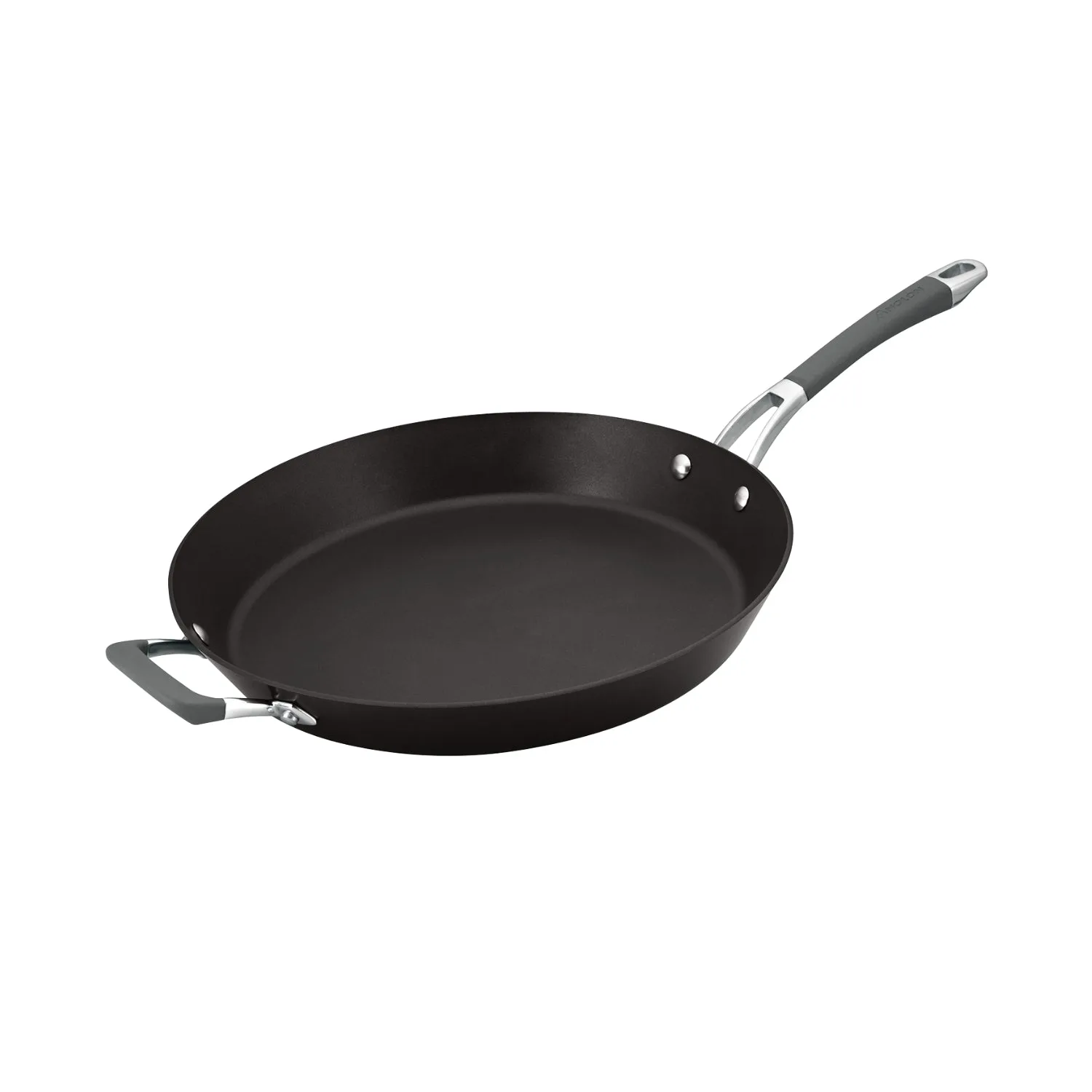
Anolon Endurance+ Nonstick Induction Open French Skillet 34cm