Quick answer
Choose an armored CAT6A slim patch cable with spring-protected strain relief when your cabling runs through high-density panels, tight conduit bends, or areas where cables are frequently repositioned. The spring boot reduces stress on the connector and extends cable life in these demanding spots.
Why spring strain relief matters in tight spaces
Standard patch cables use a fixed boot that can crack or separate after repeated bending. The spring-loaded boot on a slim armored cable absorbs movement and maintains a small bend radius, which is critical when routing cables through crowded patch panels or narrow cable trays.
In data centers or AV racks where cables are often swapped or rerouted, the spring relief prevents the connector from pulling loose at the termination point. This reduces intermittent connection issues and the need for early replacements.
Trade-off: thicker boot vs. standard slim profile
The spring-protected boot adds a few millimeters around the connector. While the cable itself remains 30AWG slim, the connector area is slightly bulkier than a standard slim boot. In extremely dense 1U patch panels with very tight side clearance, this could block adjacent ports if not planned.
If your setup has generous spacing and you rarely touch the cables, a standard slim armored cable without the spring boot may be sufficient and slightly easier to route through very narrow channels.
When a 30AWG slim cable is the right choice
The 30AWG conductor size makes the cable thinner and more flexible than standard 24AWG or 26AWG patch cables. This is ideal for high-density environments where airflow and space are at a premium. However, the thinner conductor has slightly higher DC resistance, so it is best suited for shorter runs (typically under 15 meters) where signal loss is minimal.
For longer runs or PoE+ applications, verify that the cable's resistance and current capacity meet your power budget. The slim profile trades some power-handling margin for density.
Decision rules for choosing spring strain relief
- Frequent cable moves or re-patching: If you regularly swap cables between ports (e.g., in a data center or lab), the spring strain relief absorbs repeated bending and prevents connector damage. Choose the spring-protected version.
- Tight bends near the connector: When the cable must bend sharply right at the port (e.g., behind a wall-mounted rack or inside a small enclosure), the spring boot maintains a safe bend radius and avoids kinking. Standard boots may crack under this stress.
- High-density patch panels with side clearance: Measure the gap between adjacent ports. If you have at least a few millimeters of side clearance, the spring boot fits. In extremely dense panels with zero side clearance, a standard slim boot may be easier to insert. If in doubt, test one spring-protected cable in your tightest port before buying in bulk.
- Short cable runs (under 15 m): The 30AWG conductor is best for runs up to 15 meters. For longer runs or PoE+ devices, confirm the cable's resistance meets your power requirements. The spring strain relief does not affect electrical performance.
Product facts
-
Armored CAT6A Slim Ethernet Patch Cable with Spring-Protected Strain Relief – 30AWG: Features Behpex’s patented armoured boot and spring-protected strain relief for an exceptionally small bending radius. This design lets you route the cable through tight corners and crowded panels without damaging the connector or the cable jacket, reducing failure points in high-traffic network racks.
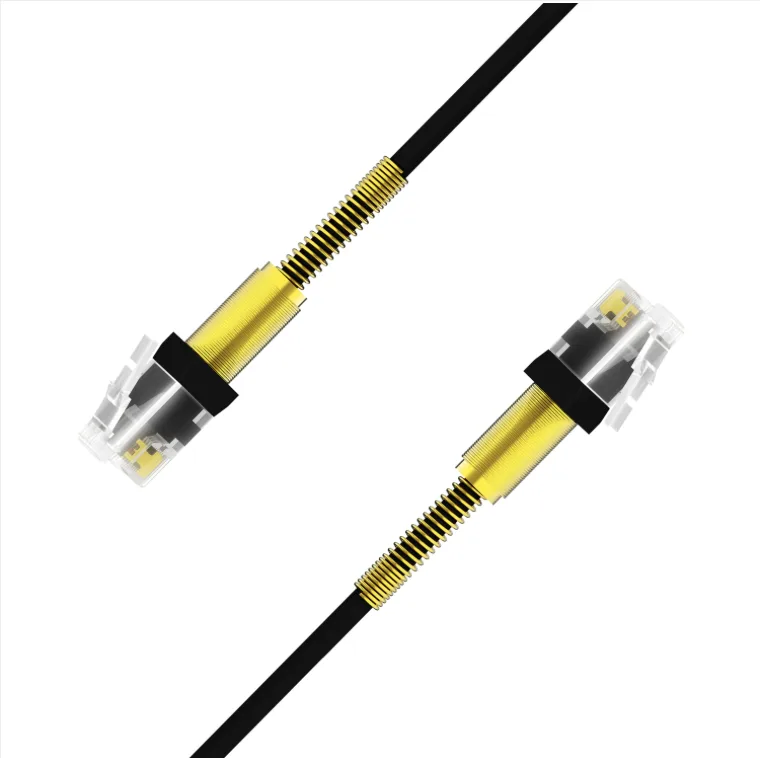
Armored CAT6A Slim Ethernet Patch Cable with Spring-Protected Strain Relief – 30AWG
Who should choose this cable
Best for
- Network technicians patching frequently in data centers or server rooms
- AV installers routing cables through tight conduit or behind equipment racks
- Anyone needing a durable network cable for high-density patch panels with moderate side clearance
Not ideal for
- Extremely dense 1U panels with zero side clearance between ports (consider a standard slim boot)
- Long cable runs over 15 meters (look for a thicker gauge armored cable instead)