The case for buying twelve teas instead of one
A green tea sampler pack solves a specific problem: you want a daily green tea, but you don't yet know whether you prefer a plain Himalayan cup, a floral jasmine, or something spiced like kahwa. Buying a full pack of one tea is a gamble. Buying twelve single bags is a cheap way to learn your own taste before you commit.
The Assorted Green Tea Sampler from Teacurry is built around that idea. It puts twelve named green teas in one box, so the decision you're making is not "which flavor sounds nice" but "which of these twelve do I actually want to drink again tomorrow."
What the sampler actually contains
-
Assorted Green Tea Bags - Deluxe Green Tea Sampler | Pack Of 12 Tea Bags: The pack includes 12 premium green tea varieties, each included in the pack: Blue Green Tea, Chamomile Green Tea, Hibiscus Green Tea, Himalayan Green Tea, Jasmine Green Tea, Kashmiri Kahwa Green Tea, Mint Green Tea, Moringa Green Tea, Rose Green Tea, Tulsi Green Tea, Ashwagandha Green Tea, and Turmeric Green Tea. You can see the full flavor map before buying, so you know whether the range leans floral, herbal, spiced, or plain.
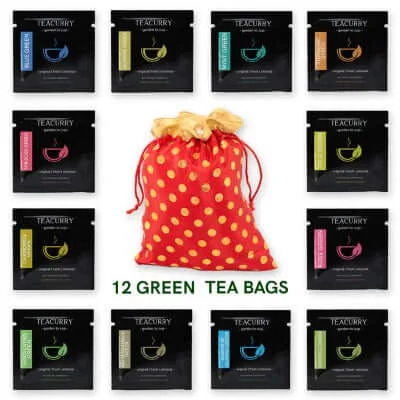
Assorted Green Tea Bags - Deluxe Green Tea Sampler | Pack Of 12 Tea Bags
-
Assorted Green Tea Bags - Deluxe Green Tea Sampler | Pack Of 12 Tea Bags: The sampler uses whole leaf green teas, free from dust or fannings, blended with 100% natural ingredients. Whole leaf rather than dust is the difference between a cup that tastes like tea and one that tastes like a tea bag.
-
Assorted Green Tea Bags - Deluxe Green Tea Sampler | Pack Of 12 Tea Bags: The teas contain no preservatives or artificial flavors, are 100% vegetarian and natural, and adhere to recommended standards by FSSAI, WHO, and NCBI. Useful if you're choosing a sampler for everyday drinking and want a clean ingredient list rather than flavoring.
Who this 12-bag variety pack suits — and who it doesn't
A sampler is a tool for narrowing down, not a bulk buy. Be honest about which side of that line you're on.
- Good fit: you're new to green tea: Twelve different bags let you find out whether you like floral, minty, spiced, or plain green tea without wasting a full pack on the wrong one.
- Good fit: you drink one cup a day and want variety: One bag per variety means roughly twelve different cups, which is a realistic way to rotate flavors through a couple of weeks.
- Good fit: you're buying a gift for a tea drinker: A named assortment is easier to give than a single flavor, because the recipient can pick what appeals to them.
- Weaker fit: you already know your favorite: If you already drink Himalayan green tea every morning, a sampler spends money on eleven teas you didn't ask for.
- Weaker fit: you need a large daily supply: Twelve bags is a tasting set, not a month of one tea. If you want volume of a single flavor, buy that flavor instead.
How to taste green tea from a sampler without fooling yourself
The point of a sampler is comparison, so taste in a way that makes comparison possible. Brew one bag at a time, and taste the plain teas before the strong ones — start with Himalayan, then move to floral teas like jasmine and rose, then the herbal and spiced blends such as tulsi, mint, and kahwa. Strong flavors linger on the palate and will make a delicate cup taste like nothing.
Keep the water off a rolling boil for green tea; a gentler pour protects the leaf from a harsh, bitter cup. Use the same mug and roughly the same amount of water each time so the only variable is the tea. If a cup tastes bitter, the usual culprits are water that's too hot or a bag left in too long — not necessarily the tea itself.
The supplied catalog does not include steeping times or water temperatures for this sampler, so treat the first cup of each variety as a calibration: taste early, then adjust. That's not a flaw in the product; it's simply information the listing doesn't provide, and it's why tasting one bag at a time matters.
Sampler vs. a single-flavor pack: a quick decision
- Assorted Green Tea Sampler (12 bags): Best when your goal is discovery: you get twelve named varieties, whole leaf tea, and a clear picture of what you'd rebuy. The trade-off is that you only get one bag of each.
- A single-flavor green tea pack: Best when you already know what you like and want a steady daily supply. The trade-off is that you learn nothing new and risk buying a large amount of a tea you don't love.
What the catalog does and doesn't tell you before you buy
The listing is clear on the important buying facts: twelve named varieties, whole leaf tea free from dust and fannings, natural ingredients, vegetarian, and no preservatives or artificial flavors. It also states that the teas are blended for overall well-being and describes the assortment as gentle on the palate.
What it doesn't provide is preparation detail — no steeping times, water temperatures, or storage instructions are included in the supplied information. Allergen and dietary suitability beyond "100% vegetarian" is also not confirmed in the supplied details, so if you have a specific allergy or dietary requirement, check the packaging when it arrives rather than assuming. None of this makes the sampler a bad buy; it just means you should plan to taste and adjust rather than follow a printed recipe.
A simple tasting routine for your first week
- Day 1–2: the plain teas: Start with Himalayan Green Tea and Blue Green Tea to set a baseline for what green tea tastes like in this range.
- Day 3–5: the floral teas: Taste Jasmine, Rose, and Hibiscus. Note which floral note you'd happily drink again.
- Day 6–8: the herbal and spiced blends: Move to Mint, Tulsi, Moringa, Chamomile, Ashwagandha, Turmeric, and Kashmiri Kahwa. These are the strongest flavors, so taste them after the delicate ones.
- Day 9+: decide what you'd rebuy: By now you'll know your one or two favorites. That's the tea to buy in a full pack next time.