Quick answer
Start with a simple border or single-color shape, then let your child copy or invent patterns one row at a time. Keep sessions short and praise the process, not just the result.
Why start simple with the Atelier Fischer Mosaic
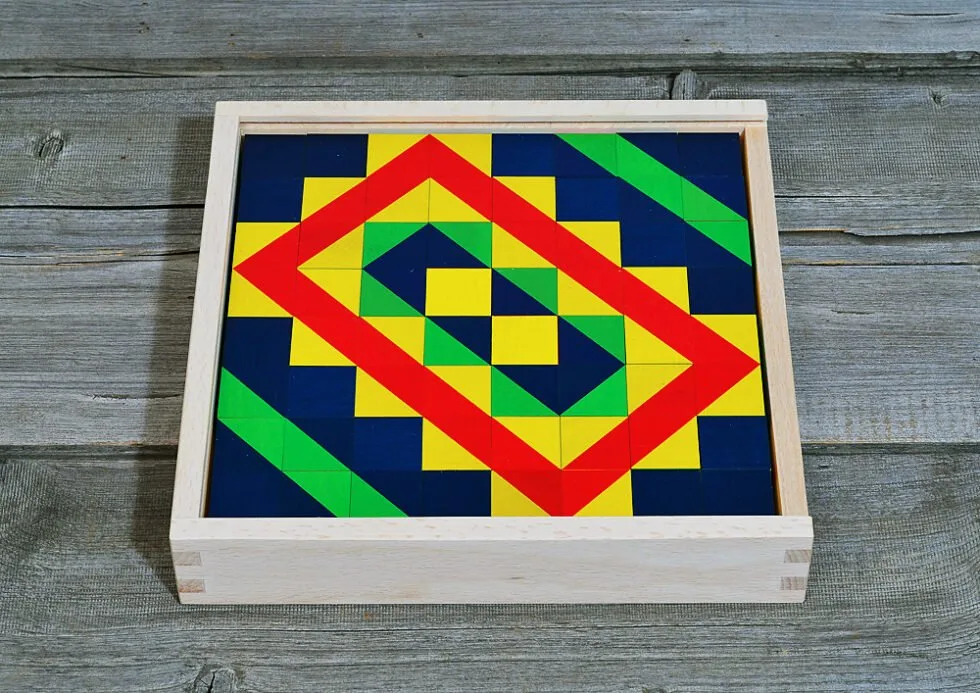
The 64 maple cubes have colored prints on all sides, so every turn changes the design. For a preschooler, that can be exciting but also overwhelming. Beginning with a small, defined area—like a border or a single shape—helps them focus on one decision at a time and experience success early.
Adapting patterns for different skill levels
A 4-year-old may need you to place the first few cubes and narrate what you’re doing. By 5 or 6, many children can follow a simple printed pattern or copy a design you build beside them. If your child loses interest, switch to free play and return to patterns later—there’s no rule that every session must be structured.
How to play: step-by-step pattern ideas
- Set up a defined workspace: Empty the cubes onto a tray or mat with a raised edge to keep them from rolling away. Place the wooden box nearby for easy cleanup. A contained space reduces frustration and keeps the focus on building.
- Begin with a single-color border: Ask your child to pick one color and line up cubes along the edge of the tray or a square outline you draw on paper. Use only that color for the border. Borders teach sequencing and give a clear finish line.
- Build a simple 2x2 or 3x3 block: Show your child how to place four or nine cubes of the same color together to form a square. Then encourage them to add a second block of a different color next to it. Small blocks build confidence before trying larger patterns.
- Copy a pattern from a photo or card: Take a photo of a simple pattern you’ve made (like a checkerboard or a diagonal stripe) and let your child recreate it beside you. Start with patterns that use only two colors. Copying strengthens visual matching and attention to detail.
- Create a repeating row: Help your child make a row that repeats a sequence, such as red-blue-red-blue. Once they master two colors, try three-color repeats like red-blue-yellow. Repeating rows introduce early math concepts like patterns and prediction.
- Encourage free design with a theme: Suggest a theme like “a garden” or “a house” and let your child arrange cubes freely. Ask them to tell you about their design. Open-ended play supports creativity and language skills.
Product facts
-
Atelier Fischer Mosaic 64 pieces: The set includes 64 maple cubes with colored prints on all sides, stored in a sturdy wooden box. The all-side prints mean each cube offers multiple pattern options, and the box keeps the pieces organized between sessions.
Atelier Fischer Mosaic 64 pieces