Quick Answer
Choose individual au gratin dishes when you want built-in portion control and more browned edges; choose one large baker when you need a single centerpiece or are feeding a crowd with fewer pieces to wash. For most mixed menus, a set of small dishes plus one large baker covers both jobs.
Portion control and serving style
Individual dishes let each person get a defined serving, which matters for rich sides like scalloped potatoes or for a plated dinner where you want the dish to arrive already portioned. A large baker is better when the food is passed at the table and guests serve themselves.
The trade-off is flexibility versus presentation: small dishes look intentional on the plate, but a large baker keeps the whole batch hot and together.
Browning and edge-to-center ratio
Smaller dishes expose more surface area relative to volume, so more of the food sits near the hot edge and browns. A single large baker gives you one broad top surface; the center stays softer while the perimeter browns.
If your menu depends on a crisp top, individual dishes help. If you want an even, creamy interior with a single browned crust, one large baker is easier to manage.
Oven space and batch cooking
Multiple small dishes can crowd a rack and block airflow if they are packed tightly; a single large baker uses one footprint but takes longer to heat through. For a big batch, one large baker usually fits more food per rack position.
The exception is when you need different toppings or doneness levels at once: small dishes let you pull one out early or finish one under the broiler without affecting the rest.
Cleanup and storage
One large baker means one piece to wash, which matters on weeknights. A set of small dishes multiplies washing and storage, though stackable sets take less cabinet depth than a wide baker.
Check dishwasher and microwave claims before you commit; the supplied Gracious Dining set is listed as microwave and dishwasher safe, but a large baker's care instructions vary by product.
Key Trade-offs to Weigh
- Portion control vs. flexibility: Individual dishes give fixed servings and a plated look; a large baker lets guests choose their own portion and keeps leftovers in one vessel. Decide whether your menu is plated or passed before choosing.
- Browning vs. even heat: Small dishes brown more of the surface; a large baker gives one broad top and a softer center, so match the format to the texture you want.
- Oven load vs. washing up: One large baker uses one rack spot and one wash; a set of small dishes can crowd the oven and multiply cleanup, but lets you finish dishes separately. Count your rack space and your patience for washing before buying a set.
Product Facts
-
Gibson Home Gracious Dining Oval Au Gratin Baking Dishes, 4-Piece Set – 15 oz Oven Safe Ceramic Small Casserole Dishes with Handles, Microwave & Dishwasher Safe Mini Bakeware, White: This 4-piece set of oval ceramic baking dishes holds 15 oz each and has sturdy side handles. The 15 oz size suits individual servings of casseroles, sides, or desserts, and the handles help you move hot dishes to the table with balance.
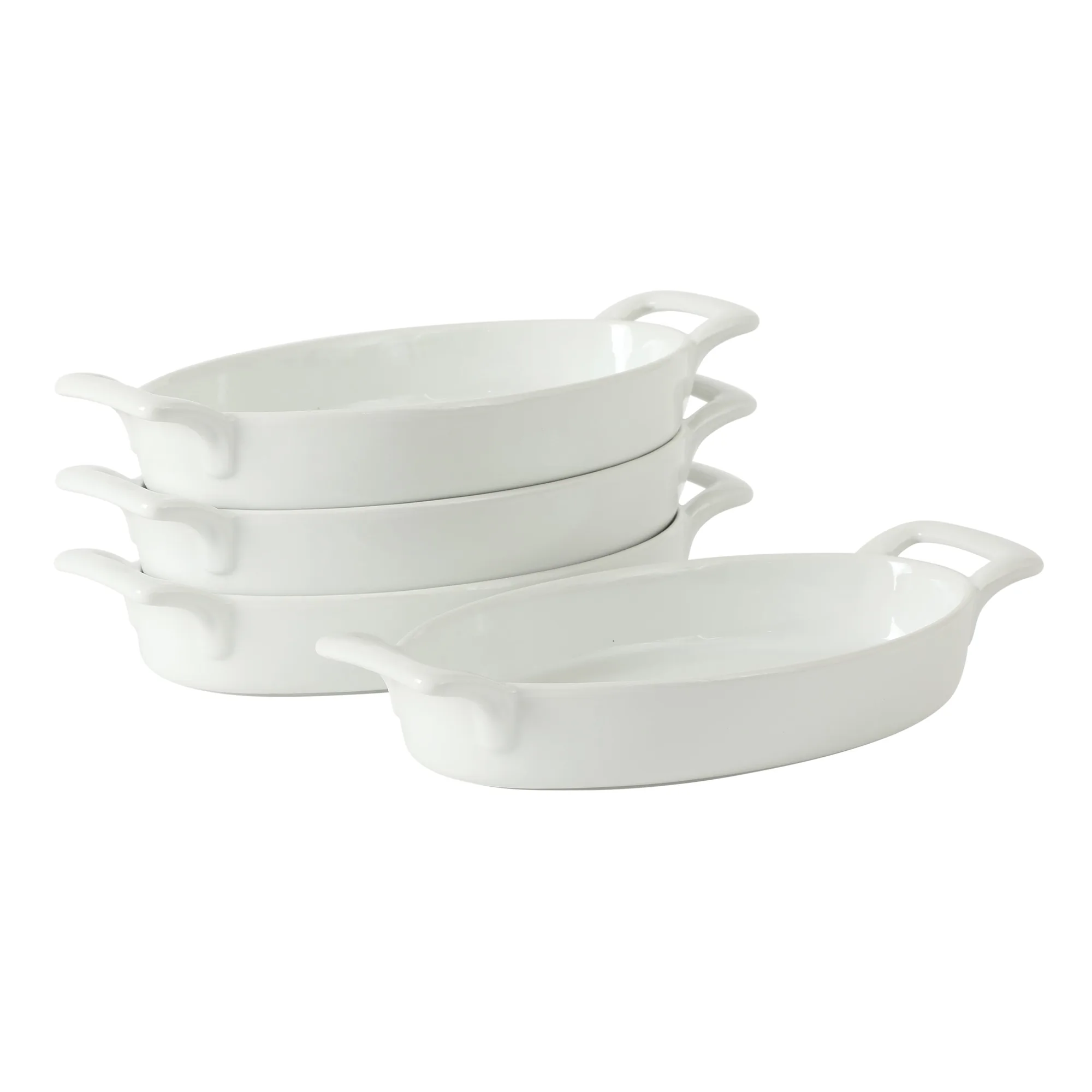
Gibson Home Gracious Dining Oval Au Gratin Baking Dishes, 4-Piece Set – 15 oz Oven Safe Ceramic Small Casserole Dishes with Handles, Microwave & Dishwasher Safe Mini Bakeware, White
Which format fits you?
Choose individual au gratin dishes if
- You serve plated portions and want more browned edges
- You cook for two to four people and want to finish dishes separately
Choose one large baker instead if
- You regularly feed a crowd from one dish and want minimal washing
- You need a single centerpiece for a holiday table