Aura at a glance: a bluffing game you can teach in minutes
Aura is a modern card game for 2–4 players, ages 8 and up, with a play time of 20–40 minutes. It is designed as a gateway game: easy to learn, but with enough depth to keep experienced players engaged. The core idea is simple—protect your own deck while removing cards from your opponents’ decks—but the hidden information and bluffing make every turn a small puzzle.
Each player starts with their own deck of cards. The deck contains five distinct types of cards, represented by five colors. Those colors are visible on both the backs and fronts of each card, creating the effect of an observable aura when you hold them. You win by having the most cards remaining at the end of the game.
How to set up Aura
Setup is straightforward, but a few small habits make the first game smoother.
- Give each player their own deck: Separate the cards into individual decks—one per player. The supplied rules begin with each player having their own deck, so start there.
- Check the colors: Each deck contains five colors, and those colors are visible on both the backs and fronts of the cards. This matters for bluffing and for reading the table later.
- Choose a starting player: The supplied instructions do not specify a first-player method, so agree on one before play—youngest player, highest roll, or whoever dealt last.
- Keep the rulebook handy: Because Aura is easy to learn but difficult to master, keep the rulebook nearby for the first few turns. The supplied information covers the core turn action but not every edge case.
The core turn: play face down, protect your deck, attack theirs
On your turn, you play a card face down. The supplied preparation and operating instructions describe the goal clearly: take turns playing cards face down in an attempt to both protect your deck and remove cards from your opponents’ deck. That single sentence captures the tension of Aura—every face-down card is either defense or offense, and your opponents cannot know which until it is revealed.
When the cards are revealed, anything can happen. That is why flexibility matters more than a fixed plan. You are not just playing cards; you are managing uncertainty and nudging your opponents into bad guesses.
Aura strategy tips for beginners
These tips focus on the decision-making the supplied rules support. They are not official tournament advice, but practical habits for your first several games.
- Bluff with purpose: Because cards are played face down, your opponents only see the color on the back. Use that to your advantage: sometimes play a card that looks defensive but sets up an attack later.
- Watch the colors, not just the count: The five colors are visible on both sides of each card. Track which colors are disappearing from your deck and which are accumulating in opponents’ decks. That pattern is your best clue about what is safe to play face down.
- Stay flexible: The game rewards players who can pivot. If your original plan was to protect your deck, but an opponent is close to running out of cards, switch to pressure. The rulebook notes that when cards are revealed, anything can happen—so avoid overcommitting to one strategy.
- Protect your deck early, attack later: In a 20–40 minute game, the early turns often set the tone. Use them to shore up your own deck while you learn opponents’ habits. Then shift to removing their cards once you have a sense of their patterns.
Aura product facts
-
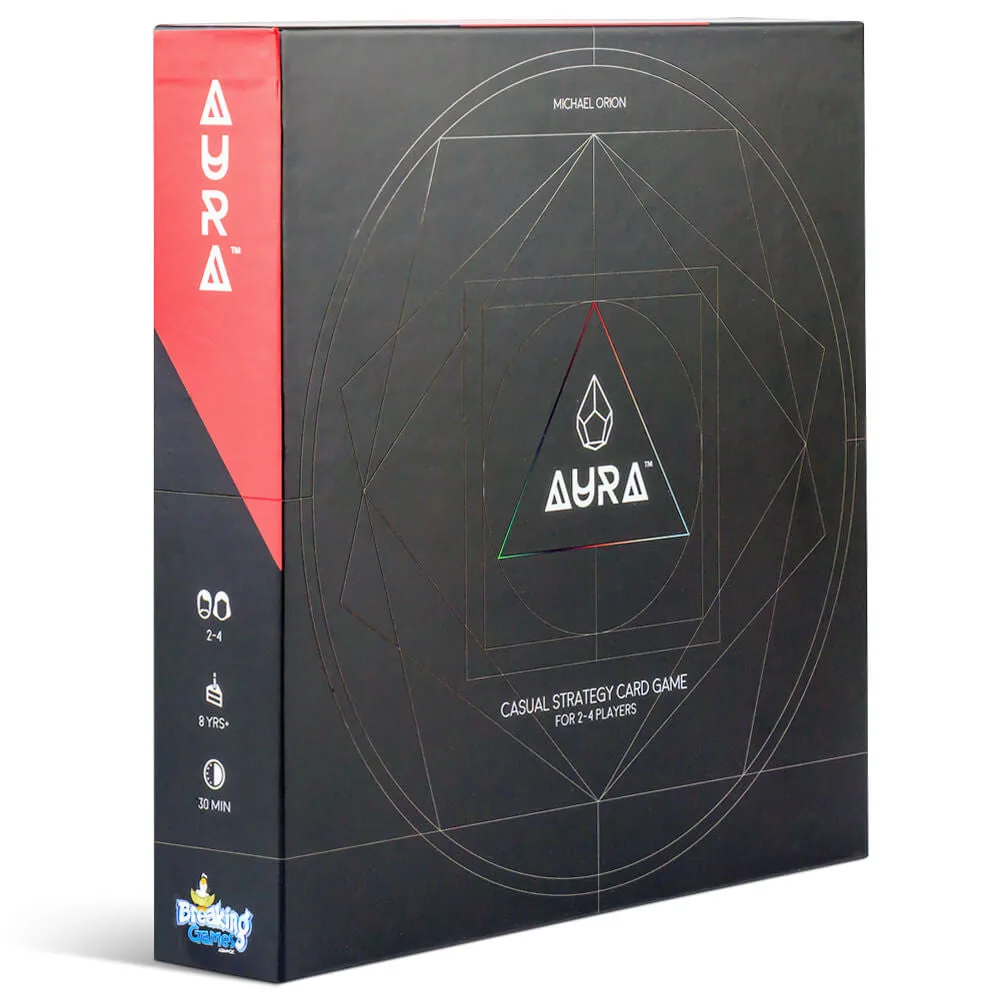
Aura: Number of Players: 2–4 Aura works as a two-player duel or a fuller four-player table, so you can play it as a couple’s game or a small family game.
Aura
-
Aura: Age Group: 8+ The listed age range makes it a candidate for family game night with older children, though you should judge based on the individual child.
-
Aura: Time to Play: 20–40 Minutes That range fits a quick weeknight game or a filler between longer titles, and it gives you a realistic expectation for teaching time.
-
Aura: Win by having the most cards remaining at the end of the game This is the win condition to keep in mind when deciding whether to play offensively or defensively on your turn.
Reading the board: what to watch for
Aura does not use a central board, but the table state is still readable. Each player’s deck size is public information, and the colors on the backs of cards in hand are visible to you. Pay attention to how many cards each opponent has left and which colors they seem to be holding. If an opponent suddenly starts playing more aggressively, they may be trying to end the game before you can recover.
Because the colors appear on both the backs and fronts, you can sometimes infer what an opponent is holding based on what they have played. That inference is not foolproof—bluffing is part of the game—but it gives you a better basis for your face-down choices than guessing blindly.
Common beginner mistakes to avoid
These are pitfalls that new players often fall into, based on the game’s bluffing structure.
- Playing too predictably: If you always play defense when you have a lead, opponents will notice and exploit it. Mix in aggressive plays even when you are ahead.
- Ignoring deck size: The win condition is having the most cards remaining. If you focus only on attacking, you may neglect your own deck and lose by a small margin.
- Forgetting that cards are revealed: Face-down cards do not stay secret forever. When they are revealed, your earlier bluffs become information for your opponents. Plan for that reveal.
Is Aura a good fit for your group?
Aura suits players who enjoy light bluffing and hand management. The 8+ age range and 20–40 minute play time make it a reasonable choice for families with older children or for adult groups that want a quick, interactive card game. It is not a heavy strategy game, and the supplied information does not describe a solo mode or expansion content, so plan for 2–4 players at the table.
If you are looking for a gateway game that rewards reading your opponents and staying flexible, Aura is built around exactly that. If your group prefers open information and long-term planning, the bluffing element may feel too chaotic. Either way, the first game will teach you more than any guide—so shuffle up and see how the colors fall.