Quick answer
Start the routine shift about a week before school, name feelings out loud, and use short play sessions to rehearse the school day. A school transition kit like the Back To School Toolkit gives you ready-made activities for self-worth, growth mindset, tantrums, and empathy, so you are not building everything from scratch during a stressful week.

Back To School Toolkit
The first week of school rarely goes the way we picture it. Kids who were fine in June can suddenly cling, melt down over socks, or go quiet at pickup. That is not a sign you did something wrong. It is a sign their nervous system is doing a lot of work at once.
This guide walks through an ordered process you can start a week or two before day one and keep using through the first Friday. It uses a back to school toolkit as the backbone, but the steps work with whatever you already have at home.
Why the first week feels big for kids
Young children are managing new adults, new room rules, a new bathroom routine, and a much longer day without their usual people. Even kids who love school spend energy on social navigation and self-control that they do not have to spend at home. That is why the meltdown often happens at 5 p.m. in your kitchen, not in the classroom.
Knowing this changes what you prepare. You are not trying to remove nerves. You are trying to give kids words for what they feel and a small set of routines they can predict, so their brain has less to solve at once. That is the real job of a school transition kit.
- Expect regression for a week or two: bedtime resistance, clinginess, and big feelings at home are common and usually temporary.
Step 1: Move bedtime and wake time before school starts
Shift bedtime earlier by 15 minutes every two or three nights until you reach the school-night target. Do the same with wake time, even on weekends. This is the single most effective step for a calm first week school start, because tired kids have far less capacity for new demands.
Common mistake: changing bedtime and wake time on the same night. That usually backfires into a late, wired night. Pick one and move it gradually.
- Checkpoint: if your child is still lying awake 30 minutes after lights out, move bedtime back 10 minutes and hold there for three nights.
Step 2: Rehearse the morning in order, out loud
Walk through the morning sequence together: wake, bathroom, dress, breakfast, shoes, bag, door. Say it in the same order every time, and let your child practice it once or twice before the first day. Predictable order reduces the number of decisions a child has to make while tired.
Keep the list short. Four to six steps is plenty for most young kids. If your child can read, write the steps on a card and let them check them off. If not, use simple drawings.
- Common mistake: adding new responsibilities like packing their own lunch during the first week. Add those in week three, not week one.
Step 3: Name feelings before they get big
First week of school anxiety in kids often shows up as behavior rather than words. A child who says "my tummy hurts" or refuses shoes may be telling you they are worried. Give them the vocabulary: excited, nervous, worried, left out, proud, tired.
A school feelings toolkit helps here because it turns abstract emotions into something kids can see and touch. You can also do this with a simple feelings chart or by naming your own feelings during the day. "I felt nervous about my meeting this morning" teaches more than a lecture about being brave.
- Checkpoint: if your child can name a feeling and pick one small action, that is a win. You are not aiming for a child who never feels nervous.
Step 4: Use play to practice the hard parts
Play is how young children process new experiences. Ten minutes of pretend school, with stuffed animals as students, lets a child act out saying goodbye, asking for help, or finding their cubby. You will often learn more from their script than from direct questions.
Keep it light and let them lead. If they want to play the teacher, let them. If they replay the same goodbye scene three times, that repetition is the point. This is also where a structured game can carry the load when you are out of ideas.
- Common mistake: turning play into a quiz. If you start asking "and what do you do if you feel scared?" the play stops being useful.
Step 5: Build a goodbye ritual you can repeat
Decide on one short goodbye and use it every day: two hugs, one high five, then you go. Predictable endings help kids trust that you will come back. Longer goodbyes usually make the drop-off harder, not easier.
If your child cries at drop-off, that is normal and does not mean the ritual failed. Teachers see this every year and are skilled at redirecting. Give it two weeks before you judge whether it is working.
- Checkpoint: if drop-off is still intense after two weeks, ask the teacher what happens in the first ten minutes after you leave. That tells you more than the goodbye itself.
Step 6: Protect the after-school window
The first hour after pickup is often the hardest part of the day. Your child has been holding it together for hours and now feels safe enough to fall apart. Plan for low demands: snack, movement, quiet play, no big questions.
Save "how was school?" for later, or replace it with something specific and easy: "Who did you sit next to at lunch?" Specific questions are easier to answer than open ones, especially for kids who are still tired.
- Common mistake: scheduling appointments, lessons, or playdates every day during the first week. Leave at least two afternoons completely open.
Your first-week action plan, in order
- One week out: shift sleep: Move bedtime and wake time 15 minutes earlier every two to three nights until you hit the school schedule. Checkpoint: aim to be at the school wake time for at least three mornings before day one.
- Five days out: rehearse the morning: Say the morning steps in the same order and practice them once or twice. Keep the list to four to six items. Do not add new chores during week one.
- Three days out: name feelings: Introduce feeling words and use a school feelings toolkit or feelings chart so your child can point to what they feel. Model it yourself first. Kids copy what they see.
- Two days out: play school: Do ten minutes of pretend school and let your child lead. Replay goodbyes, asking for help, and finding their spot. If they repeat a scene, that is processing, not a problem.
- Day one: use one goodbye ritual: Two hugs, one high five, then go. Keep it identical every day so your child can predict the ending. Crying at drop-off does not mean the ritual failed.
- First week: protect after-school time: Snack, movement, quiet play. Ask specific questions instead of "how was school?" Keep at least two afternoons completely unscheduled.
- End of week one: review and adjust: Notice which step helped most and which one you skipped. Keep the two that worked and drop the rest. If drop-off is still intense after two weeks, check in with the teacher.
What is in the Meandmine Back To School Toolkit
- Back To School Toolkit: Includes four play kits: Self Worth, Growth Mindset, Tantrum, and Empathy, designed to ease back to school anxiety through at-home play. This covers the four areas that most often derail the first week: confidence, frustration tolerance, big feelings, and getting along with others. It saves you from assembling separate activities during an already busy month.
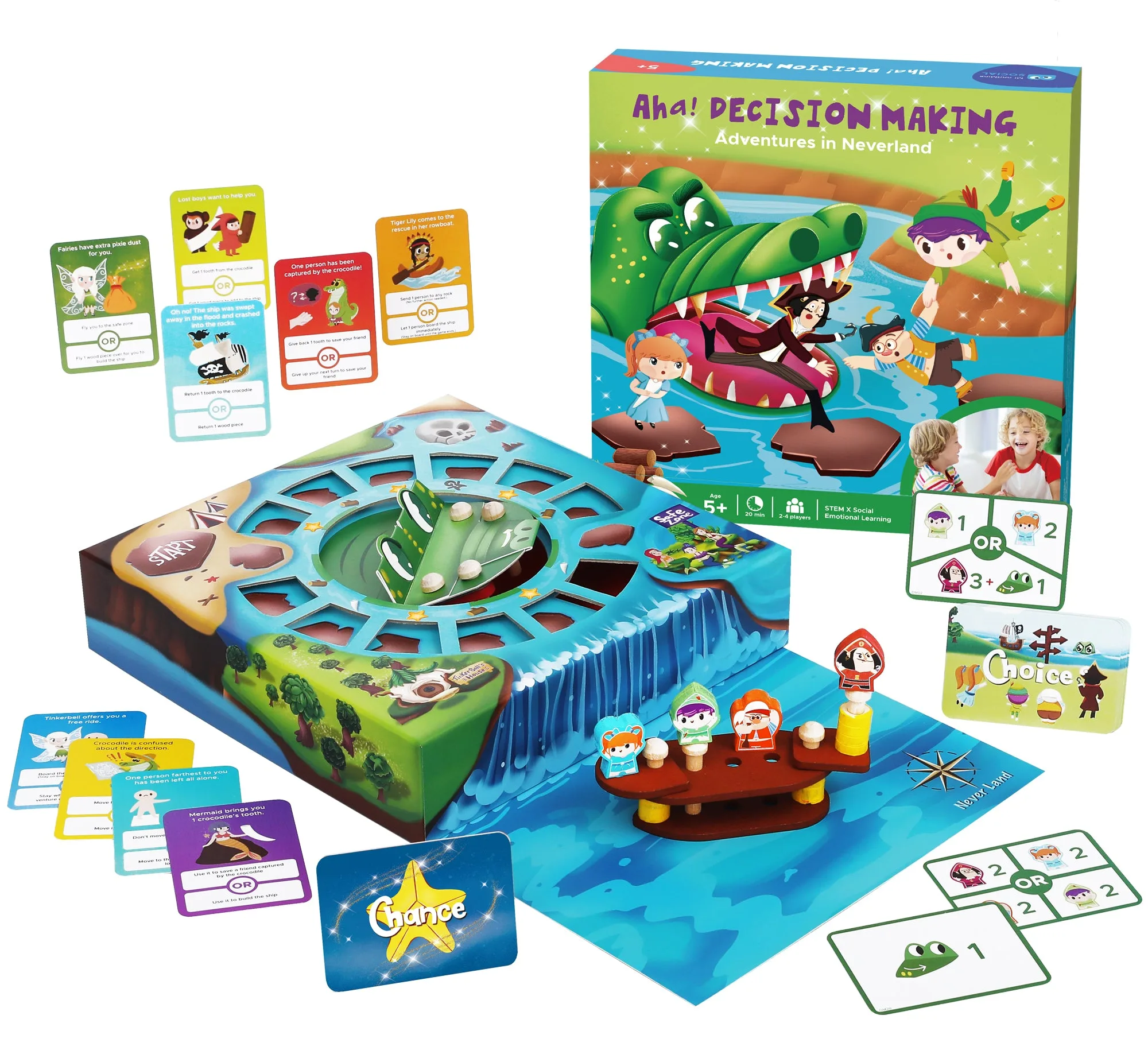
- Aha! Decision Making: A strategy game with a Neverland storybook and 3D crocodile game board, built around practicing positive choices and problem solving. Useful if your child's first-week stress shows up as indecision or conflict with peers. The game gives them a low-stakes way to practice choosing and recovering from a wrong choice.
- Amazing Me - Monthly Program: A monthly program format, priced at USD 14.98 with a catalog comparison price of USD 29.95. A lower-commitment way to keep the self-worth and feelings work going after the first week, when the novelty of a new toolkit has worn off.
You do not need a perfect first week. You need a predictable routine, language for feelings, and a few minutes of play that lets your child practice the hard parts. Start with sleep and the morning order, add feelings and play as you go, and give the whole thing two weeks before you decide it is not working.