Quick answer
Choose the smallest ball end mill radius that still clears your smallest inside corner, then pick the shortest length of reach that clears the deepest part of the cut. If those two rules conflict, split the job into a roughing pass with a longer-reach bit and a finishing pass with the smaller radius.
Why radius and reach pull in opposite directions
A ball nose bit cuts a rounded bottom, so the tip radius sets the smallest inside corner it can leave and the size of the scallops between passes. A smaller radius reaches finer detail but needs more stepover passes and removes material more slowly. A larger radius, such as a 3/8 ball nose spiral bit, clears material faster and leaves a broader, smoother arc, but it cannot enter tight pockets.
Length of reach is the distance from the tip to the start of the shank. A long reach ball nose bit can drop into deep cavities, but every extra inch of unsupported length is a lever that amplifies deflection. That is why a 1/16 long-reach bit with 1/2 inch of reach is a different tool from a standard 1/8 ball nose bit with the same tip style: one trades rigidity for depth, the other keeps stiffness for shallow detail.
When the catalog does not list every dimension
Some listings give tip diameter, shank, length of cut, and overall length but not a separate reach figure. Treat the listed length of cut as the depth the flutes can work, and do not assume a reach number that is not published. If your toolpath needs a specific clearance, measure the bit you receive or ask before ordering rather than guessing from the overall length.
Step-by-step ball nose selection
- Measure the smallest inside corner: Find the tightest radius in your toolpath. The bit radius must be equal to or smaller than that corner, so a 1/8 inch radius cannot clean a 1/16 inch corner. Common mistake: choosing by the largest feature instead of the smallest. Write the corner radius on the job sheet before opening the catalog.
- Measure the deepest cut: Compare the depth of the cavity to the published length of cut or length of reach, not the overall length. If the shank would rub the workpiece before the tip reaches depth, the bit is too short. Checkpoint: add clearance for the collet nut above the part.
- Check for a conflict between radius and reach: If the corner needs a small radius but the cavity is deep, a single short bit will not do both. Plan a roughing pass with a longer-reach bit and a finishing pass with the small radius, or accept a larger corner radius. Common mistake: forcing a long, thin bit to take a heavy cut. Reduce feed or depth of cut on any long-reach pass to limit deflection.
- Match the shank to your collet: Confirm the shank diameter fits the collet you have. A 1/2 inch shank and a 1/4 inch shank need different collets, and mixing them up mid-job wastes a setup. Checkpoint: the shank must seat fully in the collet, not bottom out on the flutes.
- Set stepover from the radius: Smaller radii need tighter stepover to keep scallops acceptable. Start conservative and increase only after checking the finished surface. Common mistake: carrying a stepover from a larger bit onto a smaller one and leaving visible ridges. Inspect the first pass before running the whole job.
Three sizes in the catalog and where they fit
-
3/8″ Ball Nose Spiral Bit – 1/2″ Shank (AstraHP Coated): 3/8 inch tip diameter on a 1/2 inch shank, with 1-1/4 inch length of cut and 3-1/2 inch overall length. The large radius and stiff shank suit broad surfacing and fast material removal where inside corners are generous.
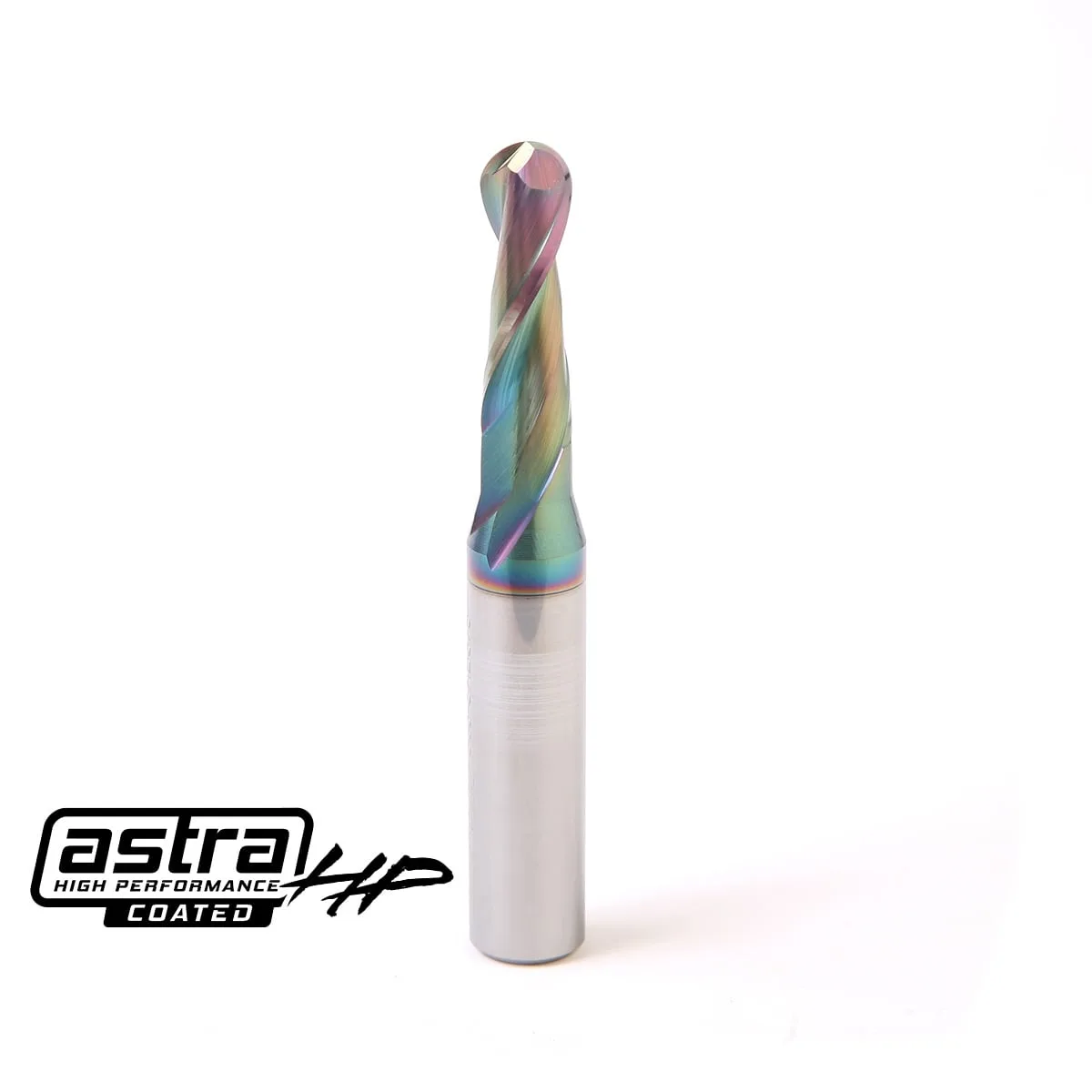
3/8″ Ball Nose Spiral Bit – 1/2″ Shank (AstraHP Coated)
-
1/16″ Long-Reach Ball Nose Spiral Bit (AstraHP Coated): 1/16 inch tip diameter with 1/2 inch length of reach on a 1/4 inch shank. The published reach tells you how deep this bit can go before the shank interferes, which is the number to check against your cavity depth.
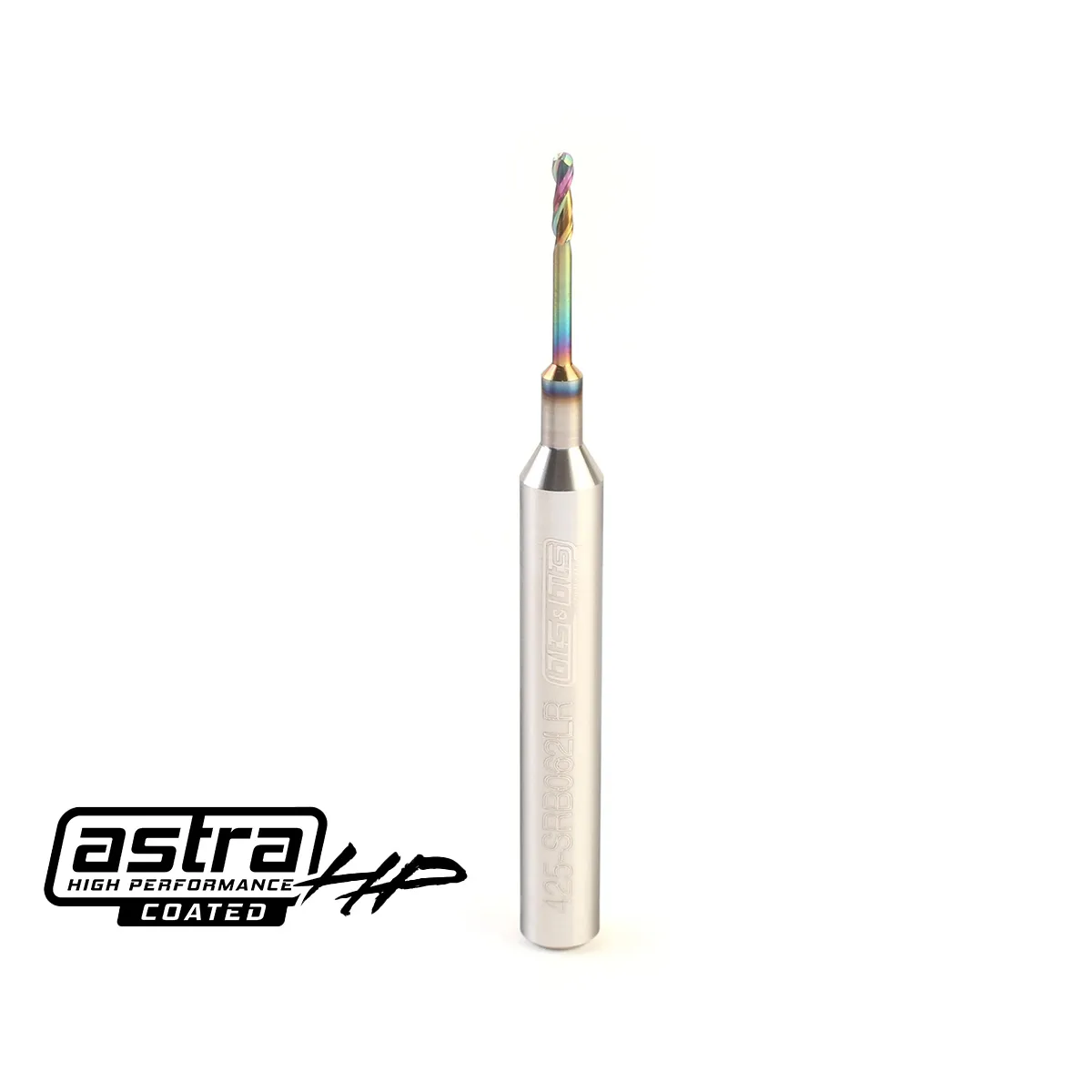
1/16″ Long-Reach Ball Nose Spiral Bit (AstraHP Coated)
-
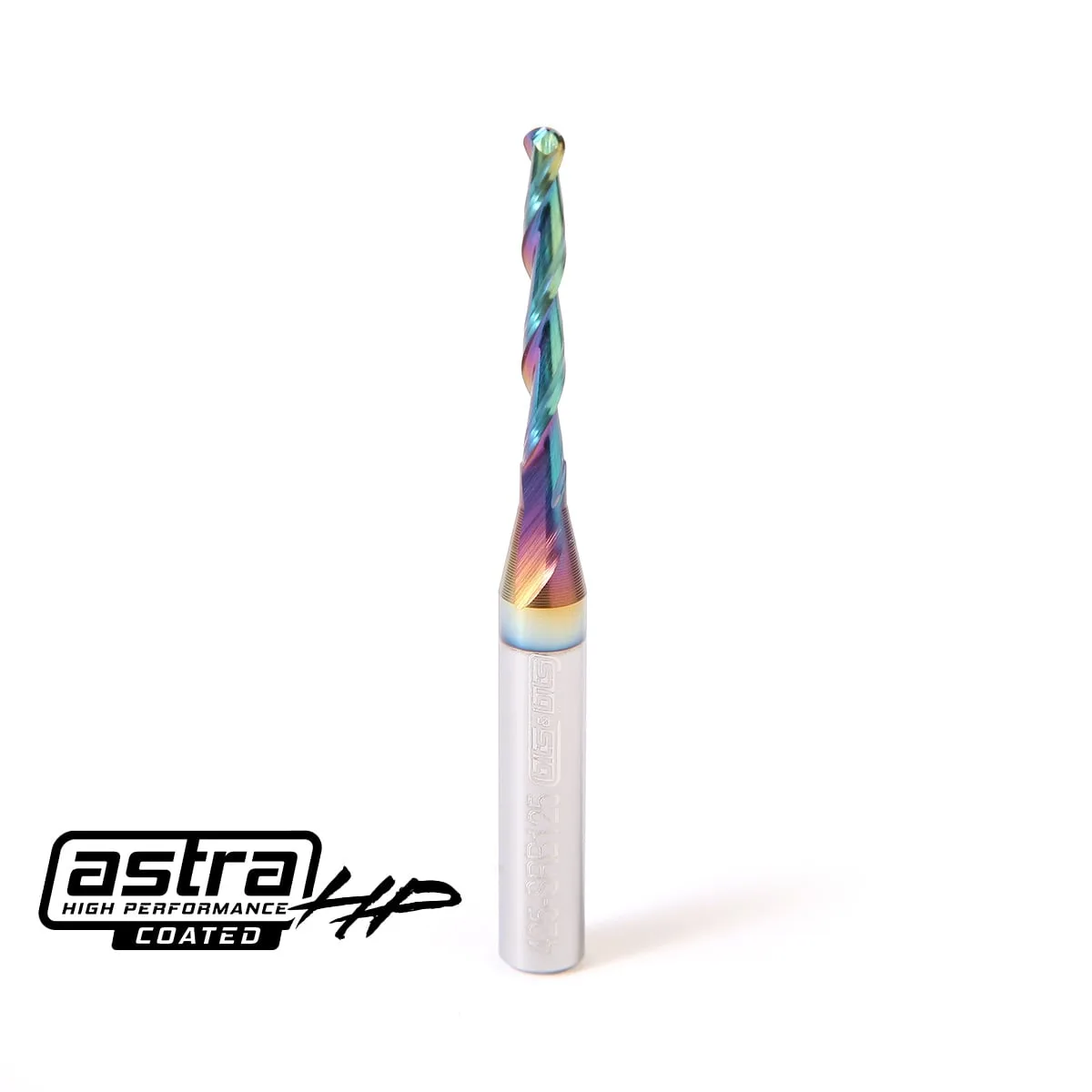
1/8″ Ball Nose Spiral Bit (AstraHP Coated): 1/8 inch tip diameter with 1 inch length of cut on a 1/4 inch shank. A middle radius with a full inch of cutting length handles general contour and slot work without the fragility of a very small tip.