Start with the two separate problems
A pad that slips and a pad that squishes are not the same complaint. Slipping means the pad is moving around the bar or drifting off the spot you need it. Squishing means the foam compresses more than you want under load, so the bar feels harder or sits differently than expected. Treat them separately, because the first is usually about fastening and positioning, and the second is usually about the pad's thickness and density.
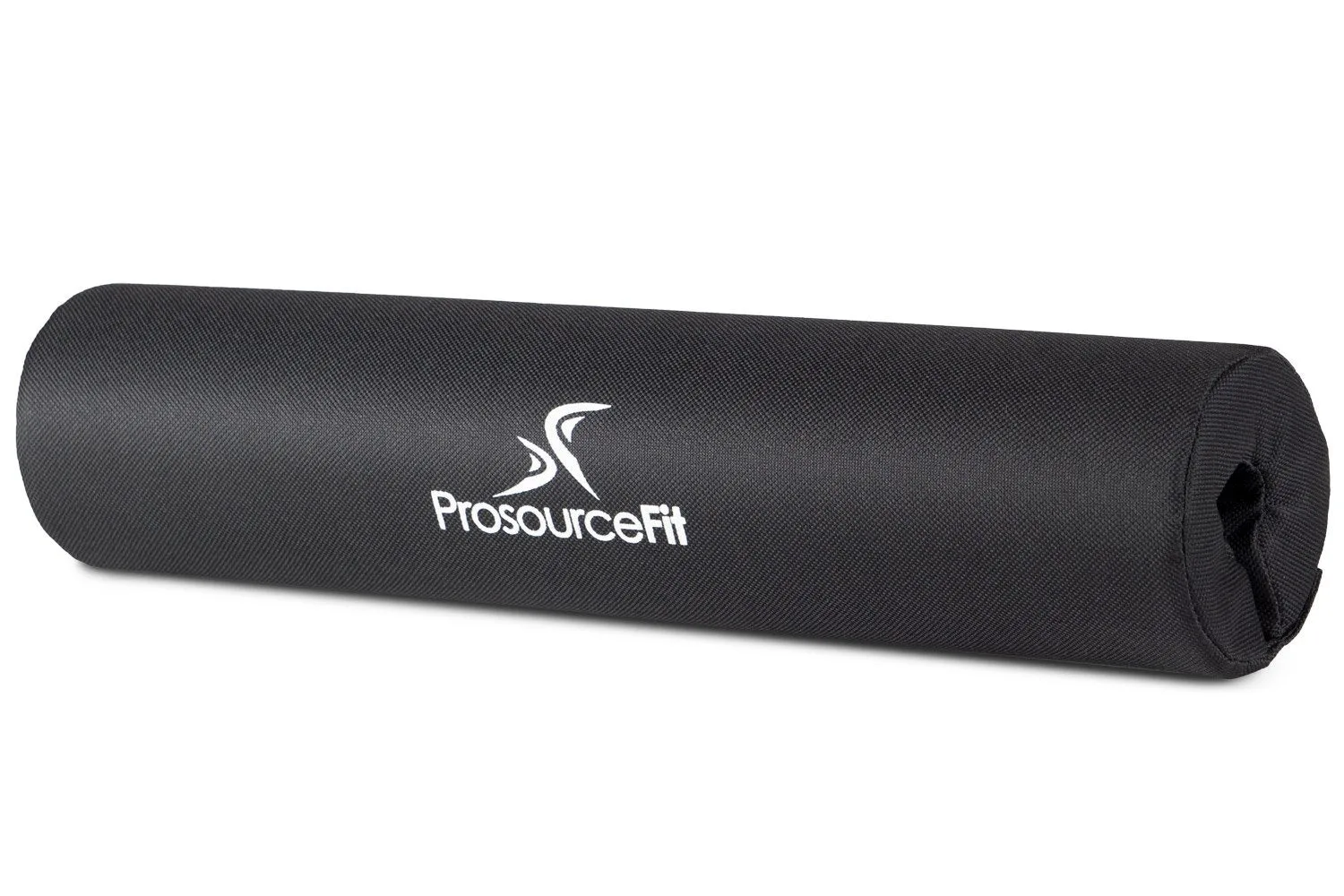
The ProsourceFit Weight Lifting Barbell Pad is a thick, dense-foam pad with a Velcro flap that wraps around the bar. Those two features tell you where to look first: the flap for slipping, and the foam for squishing.
A positioning and fastening check for a slipping pad
Work through these in order. Each one is a supported feature of the pad or a direct consequence of how it is built.
- Center the pad where the bar actually contacts you: The pad protects the traps, shoulders, upper back and hips. Line it up with the contact point for the lift you are doing, not with the middle of the bar by habit.
- Wrap the Velcro flap fully around the bar: The extra flap is designed to wrap around the entire bar and hold the pad in place. A flap that is only partly closed, or stuck to itself instead of around the bar, is the most likely reason a pad shifts.
- Press the flap down along its full length: Run a hand around the closed flap so the Velcro engages evenly. A partially seated flap can peel loose once the bar rolls.
- Check that the pad sits on the bar, not on the plates: The pad fits around Olympic bars and barbells. If it is riding onto the sleeve or a collar, it has less bar to grip and will move.
- Re-seat the pad between lifts if you change position: Squats, lunges and hip thrusts put the bar in different places. Sliding the pad along the bar for the next movement is normal; leaving it where the last lift put it is how it ends up off-center.
Why a hip thrust pad slips more than a squat pad
In a hip thrust, the bar sits across the hips and the pad is squeezed between the bar and your body while your hips travel. That combination of compression and movement is harder on fastening than a squat, where the pad mostly sits still across the upper back. If your hip thrust pad slipping is the specific problem, the Velcro flap is the first thing to inspect, and the second is whether the pad has crept toward one hip.
The pad is listed as ideal for squats, hip thrusts and lunges, so slipping in a hip thrust is not a sign you are using the wrong product. It is a sign the flap or the centering needs attention.
What the ProsourceFit pad is built to do
-
Weight Lifting Barbell Pad: The extra flap uses Velcro to wrap around the entire bar and keep it in place. This is the pad's anti-slip mechanism. If the pad is moving, check this flap before blaming the foam.
Weight Lifting Barbell Pad
-
Weight Lifting Barbell Pad: Fits standard Olympic bars, barbells and Smith machines. Fit is the first filter. A pad that is not seated on a compatible bar has no chance of staying put.
-
Weight Lifting Barbell Pad: A thick bar pad with dense foam protects the traps, shoulders, upper back and hips. The same thickness that protects these areas is what some lifters experience as squish.
When the pad feels too thick or too squishy
A thick pad changes the distance between the bar and your body, and dense foam still compresses under a loaded bar. If the bar feels unstable, rolls more than you like, or sits farther from your back than you expect, the pad's thickness is a plausible contributor. That is a preference and stability question, not a defect.
The supplied information describes the foam as thick and dense but does not give a thickness measurement or a density rating. So there is no honest way to tell you from the listing alone whether this pad will feel too soft for your working weight. The practical test is your own setup: if the pad squishes enough that the bar no longer feels planted, a thinner pad is the usual direction, and if it feels fine, thickness is not your problem.
One thing the evidence does not support is the idea that a pad should be tightened, strapped down or modified to reduce squish. The only fastening described is the Velcro flap, and it is there to hold the pad on the bar, not to change how the foam behaves.
Slipping vs squishing: which fix applies
- Pad rotates or slides along the bar: Fastening and positioning problem. Re-wrap the Velcro flap fully around the bar and re-center the pad on the contact point.
- Pad drifts to one side during hip thrusts: Positioning problem. Center the pad across both hips and re-seat it between sets.
- Bar feels unstable or sits too far from your back: Thickness and preference problem. Consider whether a thick pad suits your lift; the supplied information does not give a thickness figure.
- Pad is uncomfortable but stays put: Not a slipping issue. The pad is doing its protective job; the question is whether its feel matches what you want.
The gym-pad habit worth breaking
The ProsourceFit pad is compact and light enough to carry in a gym bag, which matters if you have been relying on the shared pad at the gym. A shared pad is often overused and may not have its flap closed properly, so you inherit someone else's slipping problem. Bringing your own means you know the flap is wrapped and the pad is centered before you load the bar.
If you are still deciding whether a pad belongs in your bag at all, the honest summary is this: it is a comfort and protection accessory for squats, lunges and hip thrusts on Olympic bars, barbells and Smith machines. It is not a fix for a bar that is the wrong size for you, and the supplied information does not describe any other compatibility range.