A battery fan moves air—it doesn't create cold
The most persistent myth about battery portable fans is that they cool the air itself. They don't. A fan moves the air already around you, and that moving air helps your body shed heat more effectively—especially when your skin is damp. The relief is real, but it's personal cooling, not room air conditioning.
That distinction matters when you shop. A rechargeable fan with a big battery and strong airflow can make a hot desk, tent, or golf car seat more bearable, but it won't lower the temperature of an enclosed space. If you expect a battery fan to chill a room the way an AC unit does, you'll be disappointed—not because the fan is weak, but because that's not what airflow does.
Four claims worth checking before you buy
- “More speed settings always means better cooling”: Speed settings change airflow, not air temperature. Four speeds give you more control over comfort and battery drain, but the top speed isn't automatically the right choice—especially if you want the battery to last through a long afternoon.
- “A bigger battery means it runs longer”: Battery capacity (measured in mAh) is only one part of runtime. Fan size, speed setting, and how often you run it at maximum all affect how long a charge lasts. A 10000mAh battery gives you more capacity to work with, but the record doesn't promise a specific number of hours.
- “USB powered means it works with any charger”: USB powered confirms the charging interface, not the exact charger, cable, or power adapter you should use. The supplied record doesn't list charging time or a recommended adapter, so treat those as open questions rather than assumptions.
- “A clip-on fan is only for desks”: A sturdy clamp is a mounting method, not a room limitation. The same clip-on design can attach to a desk, golf car, or travel setup—but the surface needs to be something the clamp can grip securely.
What the Koonie 8-inch clip-on fan record actually confirms
-
Koonie White 10000mAh Rechargeable Portable Fan, 8-Inch Battery Operated Clip on Fan, USB Fan, 4 Speeds, Strong Airflow, Sturdy Clamp for Office Desk Golf Car Outdoor Travel Camping Tent Gym Treadmill: 8-inch clip-on fan with a sturdy clamp The clamp is the mounting system. It tells you the fan is designed to attach to a surface rather than sit on a flat base, which suits desks, golf cars, and similar edges.
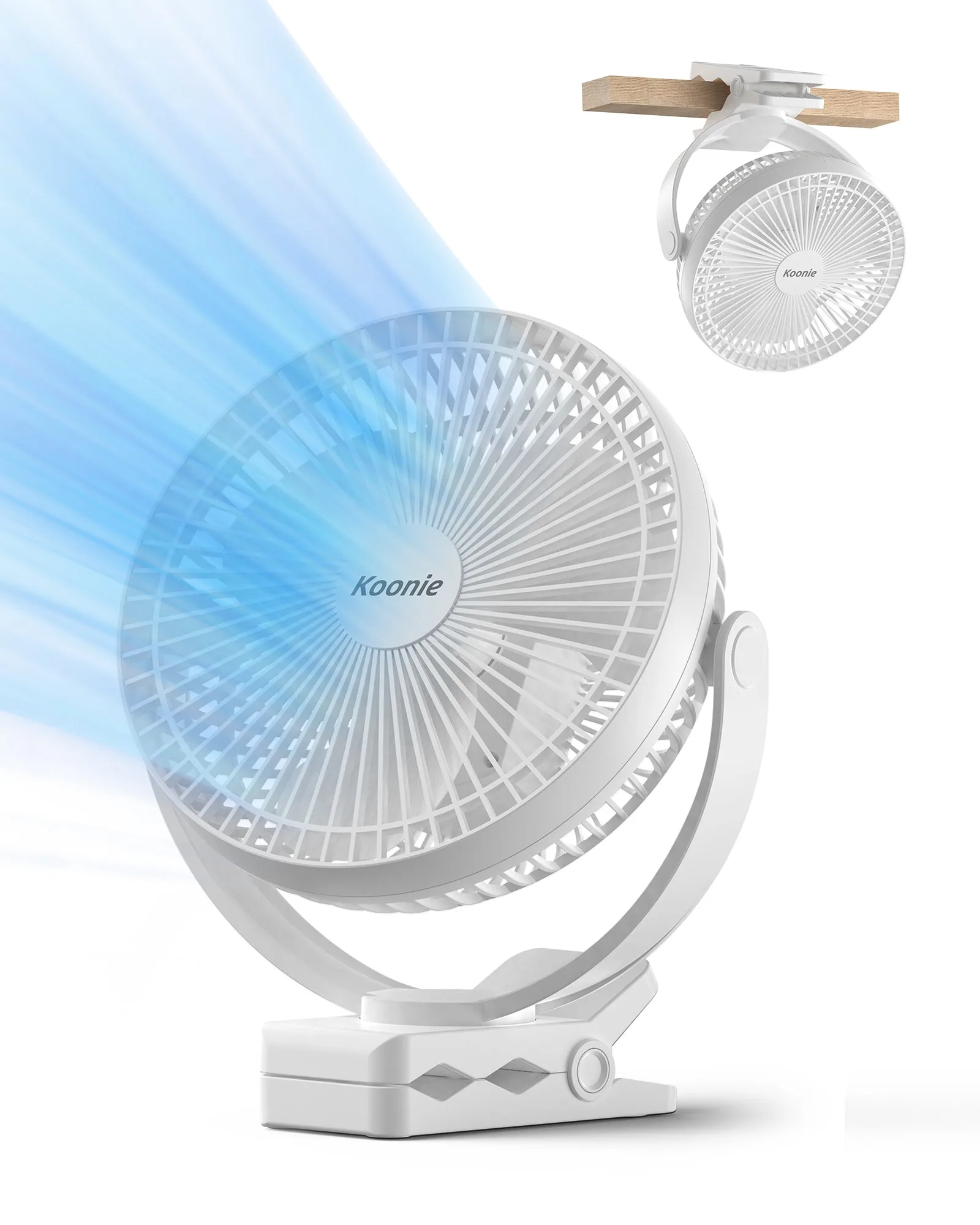
Koonie White 10000mAh Rechargeable Portable Fan, 8-Inch Battery Operated Clip on Fan, USB Fan, 4 Speeds, Strong Airflow, Sturdy Clamp for Office Desk Golf Car Outdoor Travel Camping Tent Gym Treadmill
-
Koonie White 10000mAh Rechargeable Portable Fan, 8-Inch Battery Operated Clip on Fan, USB Fan, 4 Speeds, Strong Airflow, Sturdy Clamp for Office Desk Golf Car Outdoor Travel Camping Tent Gym Treadmill: 10000mAh rechargeable battery This is the battery capacity you're working with. It's a real number to compare against other fans, but it doesn't translate directly into a guaranteed runtime.
-
Koonie White 10000mAh Rechargeable Portable Fan, 8-Inch Battery Operated Clip on Fan, USB Fan, 4 Speeds, Strong Airflow, Sturdy Clamp for Office Desk Golf Car Outdoor Travel Camping Tent Gym Treadmill: USB powered for convenient charging USB charging is the confirmed interface. The record doesn't specify a charger wattage or charging time, so plan around the USB connection rather than a specific adapter.
-
Koonie White 10000mAh Rechargeable Portable Fan, 8-Inch Battery Operated Clip on Fan, USB Fan, 4 Speeds, Strong Airflow, Sturdy Clamp for Office Desk Golf Car Outdoor Travel Camping Tent Gym Treadmill: Four speed settings with strong airflow Four speeds give you a range between gentle and strong. You can trade airflow for battery life depending on the setting you choose.
Why “strong airflow” and “cooling” aren't the same claim
Marketing language often blurs airflow and cooling. Strong airflow describes how much air the fan moves; cooling describes what that air does to your body. A fan with strong airflow can feel more refreshing on a hot day, but the record for the Koonie clip-on fan doesn't claim it lowers room temperature or provides a specific temperature drop.
The practical takeaway: judge a battery fan by whether it moves enough air where you need it, not by whether the box promises “cooling.” For personal use, airflow across your skin is the mechanism that helps you feel cooler. For a room, you need ventilation or AC—not a battery fan.
Speed settings: use them for comfort and battery, not temperature
Four speeds are useful, but not because a higher number makes the air colder. Lower speeds are often enough to keep air moving over your skin, and they draw less from the battery. Higher speeds help when you're farther from the fan or in still air, but they also use more power.
A simple habit: start on a lower speed and move up only if you still feel stale. That approach gets more use out of a single charge and avoids the myth that maximum speed is always the “best” setting.
The battery myth that costs people the most
The most expensive myth is assuming a rechargeable fan will last a full day at top speed. The supplied record confirms a 10000mAh battery and four speeds, but it doesn't state runtime hours. That's not a flaw in the product—it's a limit of the information. If runtime is critical for a workday or camping trip, plan to recharge or bring a backup power source rather than relying on an unverified estimate.
Similarly, the record doesn't list charging time or a recommended charger. USB powered tells you the connection type, not the full charging procedure. Check the fan's own instructions when it arrives for the manufacturer's guidance.
Personal fan cooling tips that hold up
- Aim the airflow at you, not the room: A clip-on fan works best when the moving air reaches your skin. Clamp it to a nearby edge and angle it toward you rather than pointing it into open space.
- Use the lowest speed that feels comfortable: You don't need maximum airflow to get the benefit of moving air. Lower speeds are quieter and typically draw less battery.
- Pair the fan with shade or ventilation: A battery fan doesn't lower air temperature. In a hot enclosed space, combine it with open airflow or shade so you're not asking the fan to do a job it can't.
- Check your clamp surface before relying on it: The sturdy clamp needs a suitable edge to grip. Test the attachment before you walk away, especially on a golf car or travel setup.
What the evidence leaves open
The supplied record for the Koonie White 10000mAh Rechargeable Portable Fan confirms the 8-inch size, the sturdy clamp, the 10000mAh battery, USB charging, and four speeds. It does not confirm exact runtime, charging time, charger specifications, noise level, or whether the clamp fits every surface. Those aren't reasons to avoid the fan—they're reasons to check the product's own documentation or ask the seller if those details matter for your use.
Myth-busting isn't about dismissing battery fans. It's about expecting the right thing: personal airflow you can move from desk to golf car to campsite, not a portable air conditioner. Once you separate those ideas, choosing and using a rechargeable fan gets a lot simpler.