Start with the contract, not the rulebook
BattleTech Encounters is a 1-8 player, fast-paced, push-your-luck dice and card game. Players act as mercenary commanders taking on contracts for the Great Houses. Defeating the enemies set to stop them earns C-bills to spend on the equipment needed to keep their unit afloat, and defeating enough enemies completes the contract and earns the reputation mercenaries seek.
For a beginner session, the fastest way to teach that loop is to frame the table as a mercenary command taking a job. Explain that everyone is a mercenary commander working a contract, that C-bills buy equipment, and that reputation is the reward for finishing the job. Then put dice in hands and start the first contract. The theme does the teaching; you do not need to lecture through the whole box before the first roll.
What the box promises your table
-
BattleTech Encounters: BattleTech Encounters is a 1-8 player, fast-paced, push-your-luck dice and card game. The player count and push-your-luck description tell you this is a flexible filler-to-main-event game, so you can run it for a solo player, a pair, or a full table without changing the core activity.
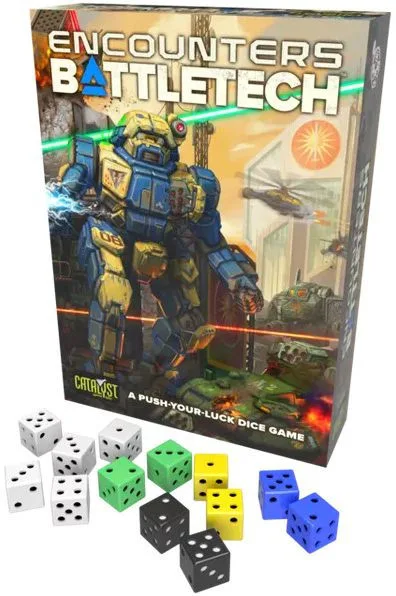
BattleTech Encounters
-
BattleTech Encounters: Players act as mercenary commanders taking on contracts for the Great Houses, and defeating the enemies set to stop them earns C-bills to spend on equipment. This is the economic spine of the session: every enemy defeated feeds the equipment pool, which gives new players a clear reason to keep pushing their luck.
-
BattleTech Encounters: If they defeat enough enemies, they'll complete their contract and gain the hard-earned reputation that all mercenaries seek. Use the contract-completion moment as the session's natural stopping point or campaign hook, rather than inventing your own win condition.
A practical first-session setup
The supplied product information confirms the components and flow at a high level but does not include a printed setup sequence, card counts, or a first-round script. Treat the steps below as table organization, not as manufacturer instructions, and check the rulebook in the box for the exact deal and turn order.
- Pick a player count and seat the table: The box supports 1-8 players. For a first teach, a smaller group keeps the push-your-luck decisions visible; a full eight-player table works better once one or two players already know the loop.
- Assign mercenary units: The product description invites players to pick their favorite mercenary unit. Let each player choose one before the first contract so the theme lands immediately.
- Stage the dice and cards within reach: Because play combines dice and cards, give each player clear space for their unit and their C-bill and equipment pool. A shared central area for the contract and enemy cards keeps the table from turning into a pile.
- Explain the contract before the first roll: Tell players what the current contract asks them to defeat, that defeated enemies earn C-bills, and that C-bills buy equipment. Keep the explanation to the current contract rather than the whole game.
- Run one open contract, then reset: Play the first contract with decisions discussed openly so new players can see how push-your-luck choices connect to C-bills and equipment. Once the contract resolves, deal the next one and let the table play it with less coaching.
Teaching push-your-luck without stalling the table
Push-your-luck games live or die on the moment a player decides whether to keep going. New players often freeze there, so build a simple rhythm into the teach.
- Name the stake out loud: Before a player rolls, ask what they are risking and what the C-bills would buy. That turns an abstract gamble into a concrete equipment decision.
- Let the first contract be a little reckless: New players learn push-your-luck by feeling a bust. Resist the urge to coach every roll; let one contract go badly and use the result to explain the next decision.
- Keep equipment spending short: When C-bills hit the table, give players a quick, bounded choice rather than an open shopping trip. The game is fast-paced, and long equipment debates break that pace.
- Use reputation as the finish line: Remind the table that completing enough contracts earns the reputation mercenaries seek. That gives the session a visible arc instead of an endless series of rolls.
Pacing a session for mixed experience
With 1-8 players, the biggest risk to a beginner session is downtime between turns. Seat new players next to someone who can answer rules questions quietly, and keep the contract moving so no one waits through a long side conversation. If you are running a full table, consider splitting into two smaller groups for the first contract and rejoining for the second; the box supports up to eight, so smaller pods are a pacing choice, not a rules change.
For a solo player, the same loop works as a personal challenge: take a contract, push your luck, spend C-bills, and see whether you can complete enough enemies to earn the reputation. The box explicitly supports one player, so a solo session is a legitimate way to learn the game before teaching it.
What the listing leaves you to confirm in the box
The supplied product record does not include a printed setup sequence, card counts, a turn-order reference, or an age range. It also does not confirm a play time. Before you promise a group a specific session length or age suitability, check the rulebook and box copy that come with your copy. Those details are not missing from the game by default; they are simply not part of the catalog information used here.
What the record does confirm is enough to build a session around: 1-8 players, a fast-paced push-your-luck dice and card loop, mercenary commanders taking contracts for the Great Houses, C-bills spent on equipment, and reputation earned by completing contracts. Build your teach around those pillars, and let the rulebook fill in the procedure.