Quick answer
For most jewellers who need every knot to sit the same distance from the last, a bead knotting tool gives more even results with less hand fatigue than hand-knotting. Hand-knotting still wins when you want maximum tactile control on a short, high-value strand and don't mind working by feel.
Where hand-knotting still has the edge
Hand-knotting depends entirely on tension felt through your fingers. That gives you fine control over very soft or irregular beads, but it also means consistency drifts as your hand tires. On a long strand, the first knots and the last knots often look different.
A tool removes that guesswork by positioning the thread and drawing each knot down to the same point. The trade-off is that you must learn the tool's rhythm before it feels natural, and very delicate threads may need a lighter touch than the tool's default action.
What changes when you switch to a tool
The biggest practical difference is repeatability. With a forked prong and a retractable awl, each knot lands flush against the bead in the same way, so the strand looks uniform from first pearl to last. That matters most on graduated strands and on pieces you plan to sell.
Speed also improves once you are practised, because you are not re-gripping the thread for every knot. The trade-off is a short learning curve and a slightly less direct feel for the thread than bare hands.
Trade-offs at a glance
- Consistency: A bead knotting tool wins for even spacing because the prong and awl set each knot to the same position. Hand-knotting varies with hand tension and fatigue. If uniform knots are non-negotiable, choose the tool.
- Speed and fatigue: The tool reduces hand fatigue on long strands because you are not re-gripping thread for every knot. Hand-knotting is slower and more tiring over many pearls. For production or long strands, the tool saves time and hand strain.
- Tactile control: Hand-knotting gives direct feel for delicate threads and irregular beads. A tool adds a small learning curve and slightly less direct feedback. For very soft threads or one-off delicate work, hand-knotting may feel more controllable.
Product facts
-
Pearl & Bead Knotting Tool — Peach-Handled Jewellery Knotter for Consistent, Even Knots: Forked steel prong positions the thread while a retractable awl draws each knot down flush against the bead. This is what makes knot spacing repeatable, so you get even knots without relying on feel alone.
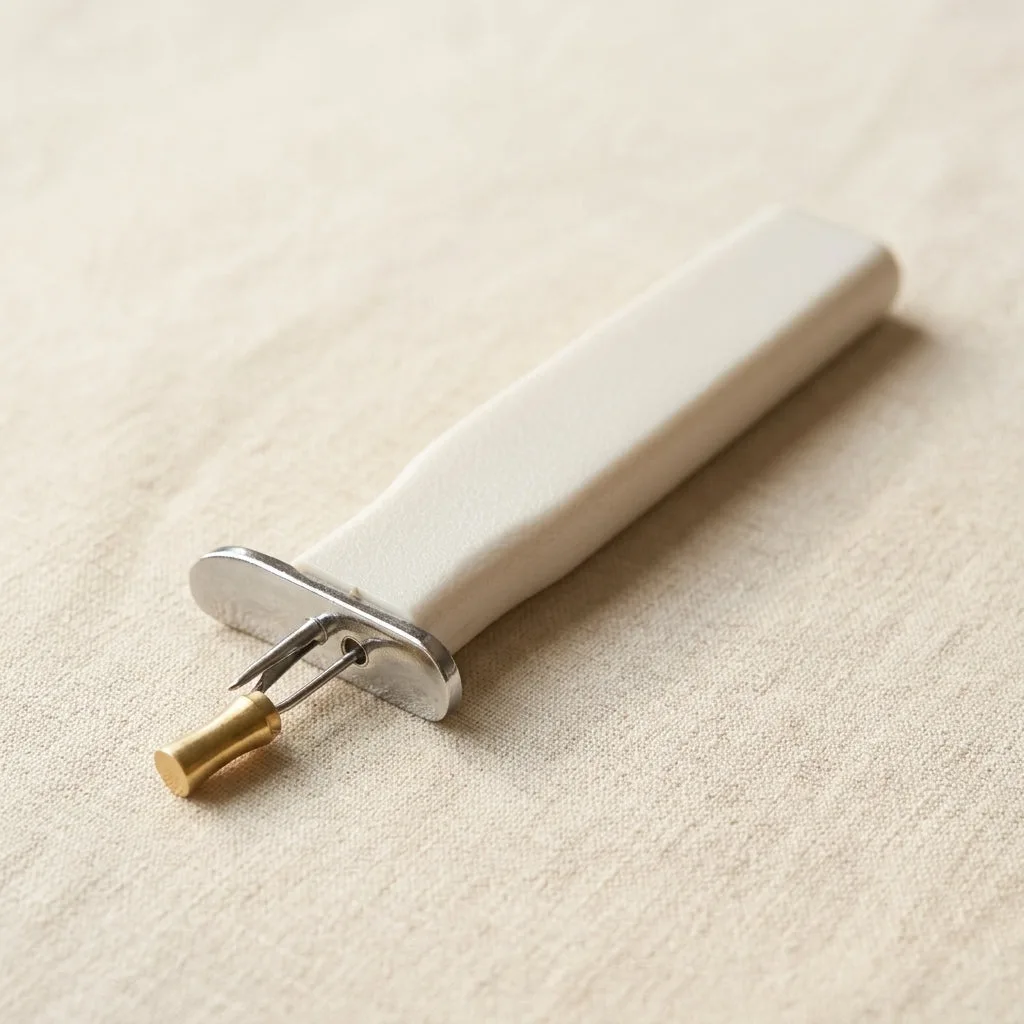
Pearl & Bead Knotting Tool — Peach-Handled Jewellery Knotter for Consistent, Even Knots
Which method fits you?
Choose the bead knotting tool if
- You are stringing pearls or beads and need every knot to look the same.
- You work on long strands or multiple pieces and want less hand fatigue.
- You want a repeatable method you can teach or delegate.
Choose hand-knotting if
- You are working with very delicate threads where direct finger feel matters most.
- You only knot short, one-off strands and prefer working entirely by hand.
- You want to avoid learning a new tool's rhythm.