Quick answer
Use a calm, structured approach to address challenging behaviors in inclusive classrooms. This guide provides a step-by-step process based on expert recommendations from Beth Aune's book.
Why a consistent framework matters
In inclusive classrooms, students with autism may exhibit behaviors that disrupt learning. Without a consistent plan, educators can feel overwhelmed and respond reactively. A structured framework helps everyone—teachers, aides, and students—know what to expect and how to respond.
Step-by-step behavior response plan
- Observe and identify the trigger: Before reacting, pause and note what happened right before the behavior. Look for patterns: a transition, a sensory issue, or a demand that felt too high. Common mistake: assuming the behavior is intentional defiance when it may be a stress response. Keep a simple log for a week to spot triggers you might otherwise miss.
- Use a neutral, low-key response: Speak in a calm, flat tone. Avoid showing frustration or surprise. Use short, clear phrases like 'Sit down, please' or 'Let's take a break.' Common mistake: talking too much or explaining why the behavior is wrong, which can escalate the situation. Practice your neutral tone in front of a mirror or with a colleague.
- Offer a choice or a break: Give the student two acceptable options, such as 'Do you want to finish the worksheet now or after a 2-minute break?' This returns a sense of control. Common mistake: offering an open-ended choice ('What do you want to do?') that overwhelms the student. Prepare two or three go-to choices in advance for common problem moments.
- Reinforce the desired behavior immediately: As soon as the student makes a positive choice, give specific praise: 'Good job sitting down after your break.' This builds a clear link between the action and the reward. Common mistake: waiting until the end of the day to praise, which is too late for the student to connect cause and effect. Use a visual token system (e.g., stickers on a card) to make reinforcement immediate and tangible.
- Debrief and adjust the environment: After the situation is calm, think about what could be changed to prevent it next time. Maybe the seating arrangement, the noise level, or the task length needs tweaking. Common mistake: focusing only on the student's behavior without examining the classroom environment that may have contributed. Share your observations with the special education team to find environmental fixes you haven't considered.
Expert resource for this guide
-
More Behavior Solutions In and Beyond the Inclusive Classroom; by Beth Aune, Beth Burt, & Peter Gennaro: This book expands on the first edition to cover behavior solutions beyond the classroom, in all areas of the school environment. It gives educators a practical, ready-to-use reference for handling unusual behaviors across different settings, not just during lessons.
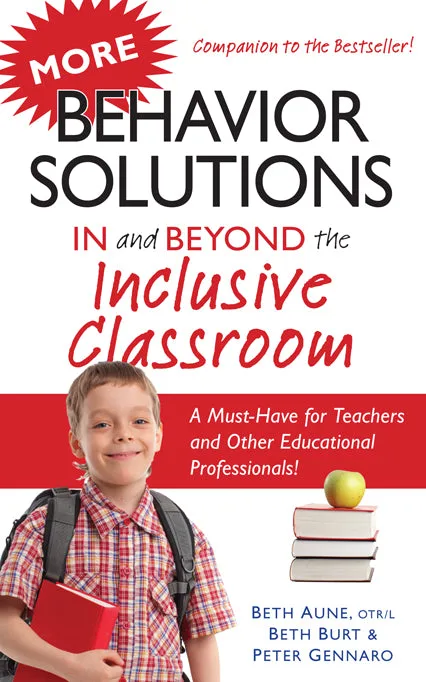
More Behavior Solutions In and Beyond the Inclusive Classroom; by Beth Aune, Beth Burt, & Peter Gennaro