Why a Dedicated Fastener Sizing Tool Saves Time
If you work on a bench mill or lathe, you regularly encounter loose bolts, nuts, and washers that need identification. Guessing the size or digging through a drawer of thread gauges and calipers slows you down. A dedicated bolt and nut checker, like the BoltSize-It, consolidates multiple sizing tasks into one pocket-sized tool.
Rather than measuring each dimension separately, you push the bolt through progressively smaller holes until it fits, then read the size directly. The same tool also gauges hex nuts, washers, and thread pitch, making it a practical addition to any machinist's bench.
What the BoltSize-It Covers
-
BoltSize-It - Bolt and Nut Checker: Size bolt diameter by pushing bolt through sizing holes This is the primary function: you get an instant diameter reading without calipers.
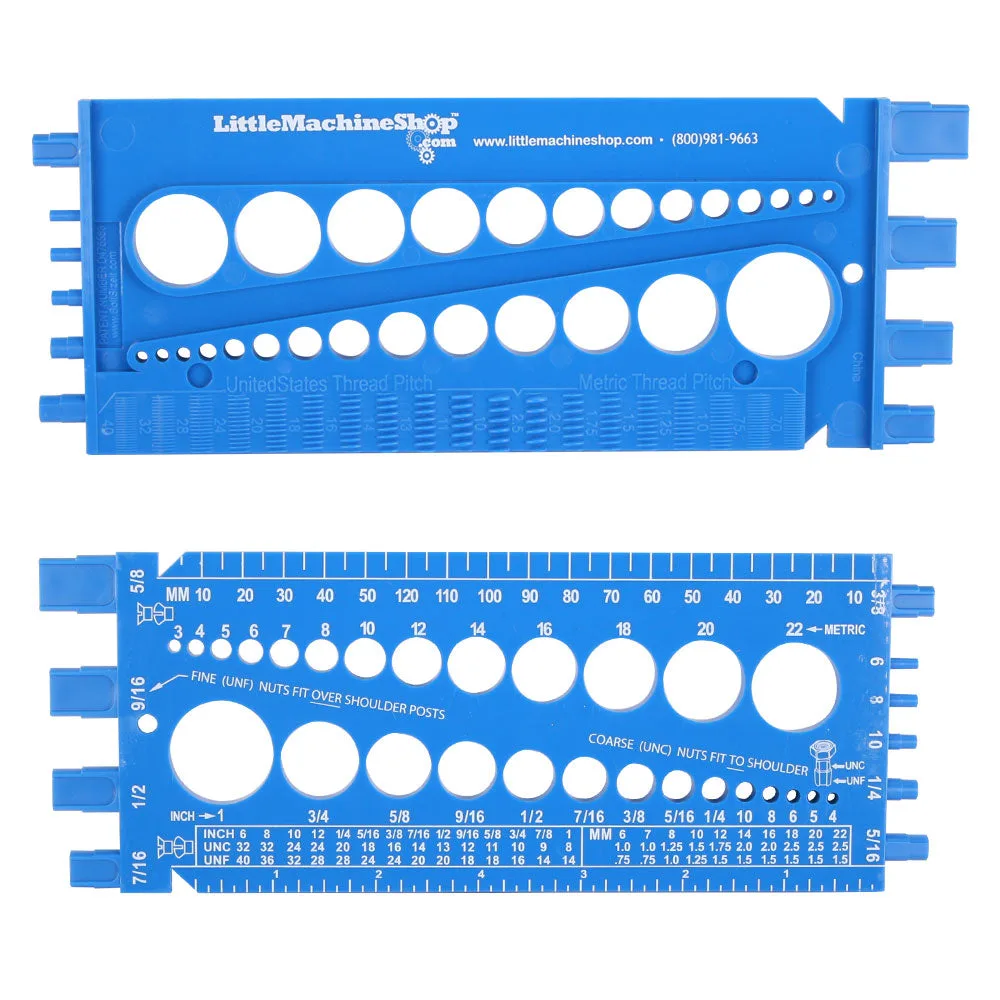
BoltSize-It - Bolt and Nut Checker
-
BoltSize-It - Bolt and Nut Checker: Gauges hex nuts and washers (USS, SAE) You can identify both US standard nuts and washers, which are common on bench machines.
-
BoltSize-It - Bolt and Nut Checker: Gauges metric hex nuts and washers by holding under metric holes Metric fasteners are also covered, so you don't need a separate tool.
-
BoltSize-It - Bolt and Nut Checker: Measure US and metric thread pitch Thread pitch is critical for selecting the correct replacement bolt or tap.
-
BoltSize-It - Bolt and Nut Checker: Special notch gauges flat headed metal and wood screws Flat head screws have unique head shapes; these notches help you identify them quickly.
-
BoltSize-It - Bolt and Nut Checker: Ruler marked with inches and millimeters A built-in ruler lets you measure length or other dimensions without a separate rule.
-
BoltSize-It - Bolt and Nut Checker: Sturdy and lightweight plastic resists water, alcohol, oil, and grease The tool holds up in a shop environment where cutting fluids and oils are present.
-
BoltSize-It - Bolt and Nut Checker: Fits in shirt pocket (8-5/8" x 3-1/4" or 217 mm x 82 mm) It's compact enough to keep on your person, so you don't have to walk back to a toolbox.
How to Use the BoltSize-It in Your Workflow
When you find an unidentified bolt, simply push its threaded end through the sizing holes on the gauge. Start with a larger hole and work down until the bolt fits snugly. The marked size next to that hole is the bolt diameter. Repeat for the nut or washer using the appropriate section of the gauge.
For thread pitch, use the dedicated thread gauge portion. Align the bolt's threads with the teeth on the gauge until they match perfectly. The pitch is printed beside the matching tooth. This is especially useful when you need to order a replacement bolt or tap a matching hole.
The tool also includes special notches for flat head screws. If you have a countersunk screw, try it in the notches to determine its size without guessing.
Limitations to Keep in Mind
The BoltSize-It is a manual sizing tool, not a precision measuring instrument. It gives you a fast, practical identification of common fastener sizes, but it does not replace a micrometer for critical fits. For example, if you need a tight-tolerance thread fit for a leadscrew nut, you should still verify with a thread mic or go/no-go gauge.
The gauge covers USS, SAE, and metric sizes, but it may not include every obscure or proprietary fastener. Always confirm with a known standard if the fastener feels loose or tight in the gauge.
BoltSize-It vs. Alternative Methods
For a bench top machinist who needs to identify fasteners frequently, the BoltSize-It offers a good balance of speed, convenience, and coverage. It won't replace precision tools for critical work, but it will save you time on everyday sizing tasks.
- BoltSize-It: Combines bolt diameter, nut/washer sizing, thread pitch, and a ruler in one compact plastic tool. Resists shop fluids. Pocket-sized.
- Calipers + Thread Gauge: More precise but slower. Requires two separate tools. Calipers need careful handling to avoid damage. Not always pocket-friendly.
- Trial and Error with Known Fasteners: No cost, but time-consuming and unreliable. You need a large reference collection. Not practical for identifying metric vs. SAE quickly.