When you need to cut a lock quickly—whether for emergency response, tactical breaching, or just getting into your own property after a lost key—the two most common tools are bolt cutters and angle grinders. Both get the job done, but they do it in very different ways. Choosing the wrong one can cost you time, energy, or even safety.
In this comparison, we break down the key differences between bolt cutters and angle grinders for cutting locks, including speed, portability, noise, safety, and cost. We'll also look at alternatives like reciprocating saws and specialized tools such as the Breachpen CertPen Kit, so you can make an informed decision for your specific needs.
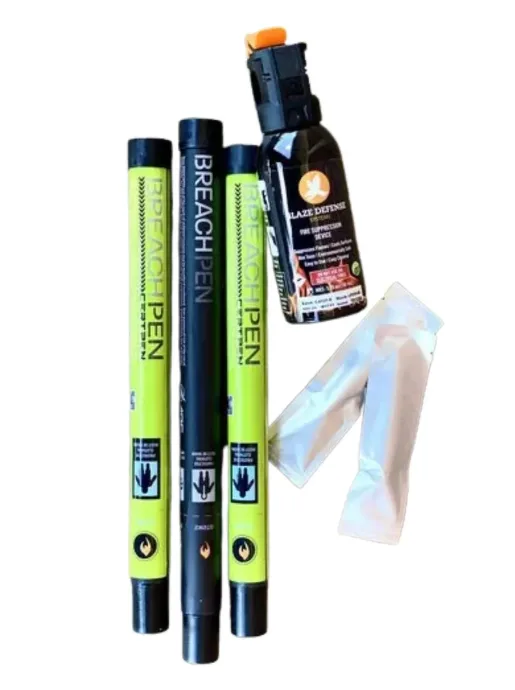
Breachpen CertPen Kit
How Bolt Cutters Work for Cutting Locks
Bolt cutters are a classic, manual tool that uses long handles and a compound leverage mechanism to generate enough force to shear through padlock shackles, chains, and other hardened steel. They are simple, reliable, and require no power source—just physical strength. For most standard padlocks, a good pair of bolt cutters can make quick work of the shackle, especially if the lock is not made of case-hardened steel.
The main advantage of bolt cutters is their portability and silence. They fit easily in a vehicle or backpack, and they don't produce sparks or noise, which can be crucial in tactical or covert operations. However, they have limitations: they struggle with hardened steel locks, and the user must have enough grip strength and leverage to apply the necessary force. For larger or more secure locks, you may need a longer handle or a hydraulic model.
- Best for: standard padlocks, chains, and non-hardened shackles.
- Pros: silent, portable, no power source needed, low cost.
- Cons: requires physical effort, may not cut hardened steel, can be bulky for large sizes.
How Angle Grinders Work for Cutting Locks
An angle grinder with a cutting disc is a power tool that spins an abrasive disc at high speed to grind through metal. It can cut through almost any lock, including hardened steel, in a matter of seconds. The main advantage is speed and versatility: you can cut padlocks, chains, bolts, and even rebar. Angle grinders come in corded and cordless versions, with the latter offering more portability but less runtime.
However, angle grinders are noisy, produce sparks, and require a power source. They also need a steady hand and safety gear, as the spinning disc can kick back or shatter. In tactical situations, the noise and sparks could give away your position. Additionally, they are heavier and bulkier than bolt cutters, making them less convenient for rapid deployment.
- Best for: hardened locks, heavy-duty chains, and quick cuts.
- Pros: fast, powerful, cuts through almost anything.
- Cons: noisy, produces sparks, requires power, needs safety training.
Bolt Cutters vs. Angle Grinders: A Side-by-Side Comparison
To help you decide, here's a quick comparison of the key factors when cutting locks with bolt cutters versus angle grinders. Keep in mind that the best choice depends on your specific scenario, whether it's emergency response, tactical breaching, or everyday use.
Speed: Angle grinders are significantly faster. A bolt cutter requires a few seconds of steady pressure, while an angle grinder can cut through a hardened shackle in under 10 seconds. If time is critical, the grinder wins.
Portability: Bolt cutters are lighter and more compact, especially if you choose a 24-inch or 18-inch model. Cordless angle grinders are portable but heavier and require battery management. For a quick grab-and-go kit, bolt cutters are easier to store and carry.
- Noise: Bolt cutters are silent; angle grinders are loud (often above 100 dB).
- Safety: Bolt cutters have minimal risk; angle grinders require eye and hand protection, and can cause kickback.
- Cost: Bolt cutters are generally cheaper, with good quality models available for under $50. Angle grinders range from $50 to $200, plus cutting discs that wear out.
When to Choose Bolt Cutters
Choose bolt cutters when you need a quiet, reliable, and low-cost tool for standard padlocks and chains. They are ideal for emergency kits, vehicle storage, and tactical operations where stealth is important. For example, if you're responding to a forced entry scenario and need to breach a gate with a standard padlock, a pair of bolt cutters can do the job silently and without drawing attention.
Bolt cutters are also a good choice for users who may not have access to power or who prefer a tool that never runs out of battery. They are simple to maintain and can last for years with proper care. However, if you regularly encounter hardened locks, you might need a heavy-duty model with longer handles or consider an alternative like the Breachpen CertPen Kit, which is designed for rapid breaching of locks and hinges.
- Silent operation is critical.
- You need a lightweight, compact tool.
- You're on a budget and want a long-lasting tool.
When to Choose an Angle Grinder
Choose an angle grinder when you need to cut through hardened steel quickly and you have access to power (or a charged battery). It's the go-to tool for heavy-duty locks, security chains, and rebar. In a controlled environment like a workshop or during a planned breaching operation where noise isn't an issue, an angle grinder is unmatched in speed and versatility.
However, angle grinders require more skill and safety precautions. You should always wear safety glasses, gloves, and hearing protection, and ensure the cutting disc is rated for metal. They are also more expensive to operate due to disc replacement and power consumption. If you're building a tactical breaching kit, you might combine an angle grinder with other tools to cover different scenarios.
- You need to cut hardened steel or thick chains.
- Speed is more important than silence.
- You have a power source or spare batteries.
Alternatives: Reciprocating Saws and Specialized Breaching Tools
Reciprocating saws (Sawzalls) with metal-cutting blades are another option for cutting locks. They are faster than bolt cutters but slower than angle grinders, and they produce less sparks but still significant noise. They are versatile and can cut through various materials, but they require a power source and can be awkward to use in tight spaces.
For specialized tactical applications, consider tools like the Breachpen CertPen Kit, which is a compact, manual breaching tool designed to break padlocks and shackles quickly. It's quieter than an angle grinder and more portable than bolt cutters, making it a great addition to a breaching kit. Similarly, other products from Blaze Defense Systems can enhance your tactical gear setup.
- Reciprocating saw: good balance of speed and portability, but noisy.
- Breachpen CertPen Kit: manual, compact, and effective for padlocks.
- Consider combining tools for maximum versatility.
In the end, the best tool for cutting locks depends on your priorities. If you value silence, portability, and simplicity, bolt cutters are a reliable choice. If you need raw speed and power to tackle hardened steel, an angle grinder is the way to go. For tactical professionals, having both in your arsenal—or a specialized tool like the Breachpen CertPen Kit—ensures you're prepared for any situation. Assess your typical scenarios and choose accordingly.