Quick answer
The Boss ET-800 Remote Dog Trainer is worth considering if you need long-range control and a stimulation type beyond standard vibration. If your work stays close and you prefer a simpler collar, it is more capability than you need.
Where the ET-800's feature set changes the buying decision
The ET-800 combines three correction or communication modes—stimulation, tone, and vibration—with a one-mile range. That combination matters most for handlers who work dogs at distance, such as in field searches or large properties, where a shorter-range unit would drop out.
The tapping sensation is the feature that separates this model from many remote trainers. It delivers a more intense feel than vibration, so it can serve as a middle option between vibration and stimulation. Handlers who want a step between those two modes should weigh that flexibility carefully.
The trade-off: more modes and levels mean more setup decisions
User-selectable stimulation levels from 1 to 100 give you fine control, but they also require you to find and record a working level for your dog rather than relying on a few preset steps. Expect to spend time on that calibration before field use.
The ergonomic design is described as innovative, but ergonomics are personal. If you wear gloves or handle the transmitter in cold or wet conditions, test the button layout and grip before committing to it as your primary remote trainer.
Decision rules for choosing the ET-800
- Match range to your actual working distance: Choose the ET-800 if your dog regularly works beyond the range of a typical short-range trainer—for example, across open ground or large properties. If your training stays within a few dozen yards, the one-mile range adds cost and bulk without practical benefit. Measure your typical working distance before buying; range you never use is money you do not need to spend.
- Decide whether you need a middle signal: Pick the ET-800 if you want tone, vibration, and a more intense tapping sensation in one unit. If tone and vibration alone have been enough for your dog, the extra tapping mode is not a reason to upgrade.
- Plan for level calibration: Because stimulation is selectable from 1 to 100, plan a session to find the lowest level your dog reliably notices, and record it. Do not start at a mid-range level and work up; start low and increase only as needed. Write your dog's working level on a card or in your training log so every handler uses the same starting point.
- Check handling before you commit: The transmitter is described as ergonomic, but fit is personal. If you train in gloves or bad weather, handle the unit—or buy from a store with a return policy—before making it your everyday remote.
Product facts at a glance
-
The Boss ET-800 Remote Dog Trainer: The Boss ET-800 offers a 1-mile range with stimulation, tone, and vibration modes. A one-mile range supports work at distance, while three modes let you choose the least aversive signal that gets your dog's attention.
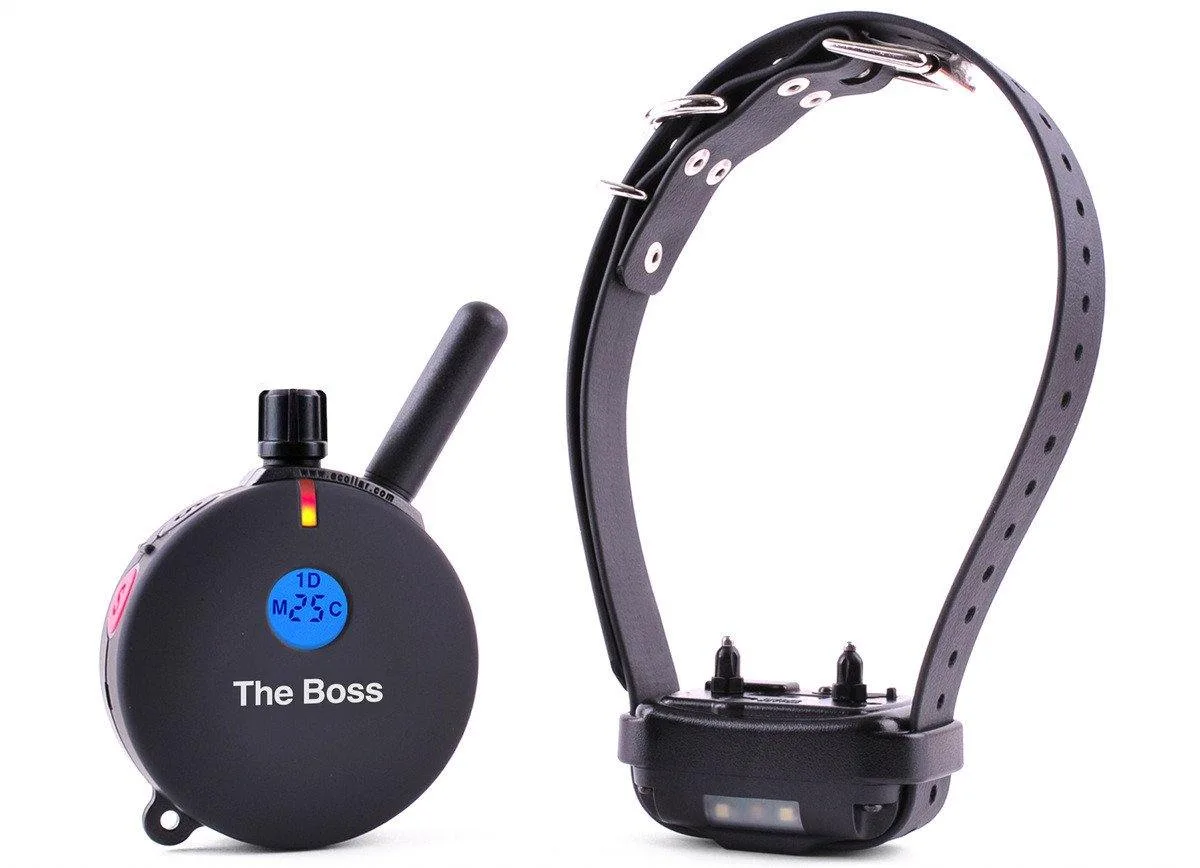
The Boss ET-800 Remote Dog Trainer
-
The Boss ET-800 Remote Dog Trainer: It provides user-selectable stimulation levels from 1 to 100. Fine level control helps you start low and adjust to your dog's response instead of jumping between coarse settings.
-
The Boss ET-800 Remote Dog Trainer: The tapping sensation is described as similar to vibration but more intense. That gives you an intermediate option when plain vibration is ignored but you want to avoid higher stimulation.
Who should buy the Boss ET-800?
Best for
- Handlers who work dogs at long distance and need a one-mile-range remote trainer
- Owners who want tone, vibration, and a more intense tapping option in one device
- Trainers who prefer fine 1-to-100 stimulation control over preset levels
Not for
- Owners whose training stays close and who do not need long-range control
- Handlers who already get reliable responses from tone or vibration alone
- Buyers who want a simple, preset-level collar without calibration time