Quick answer
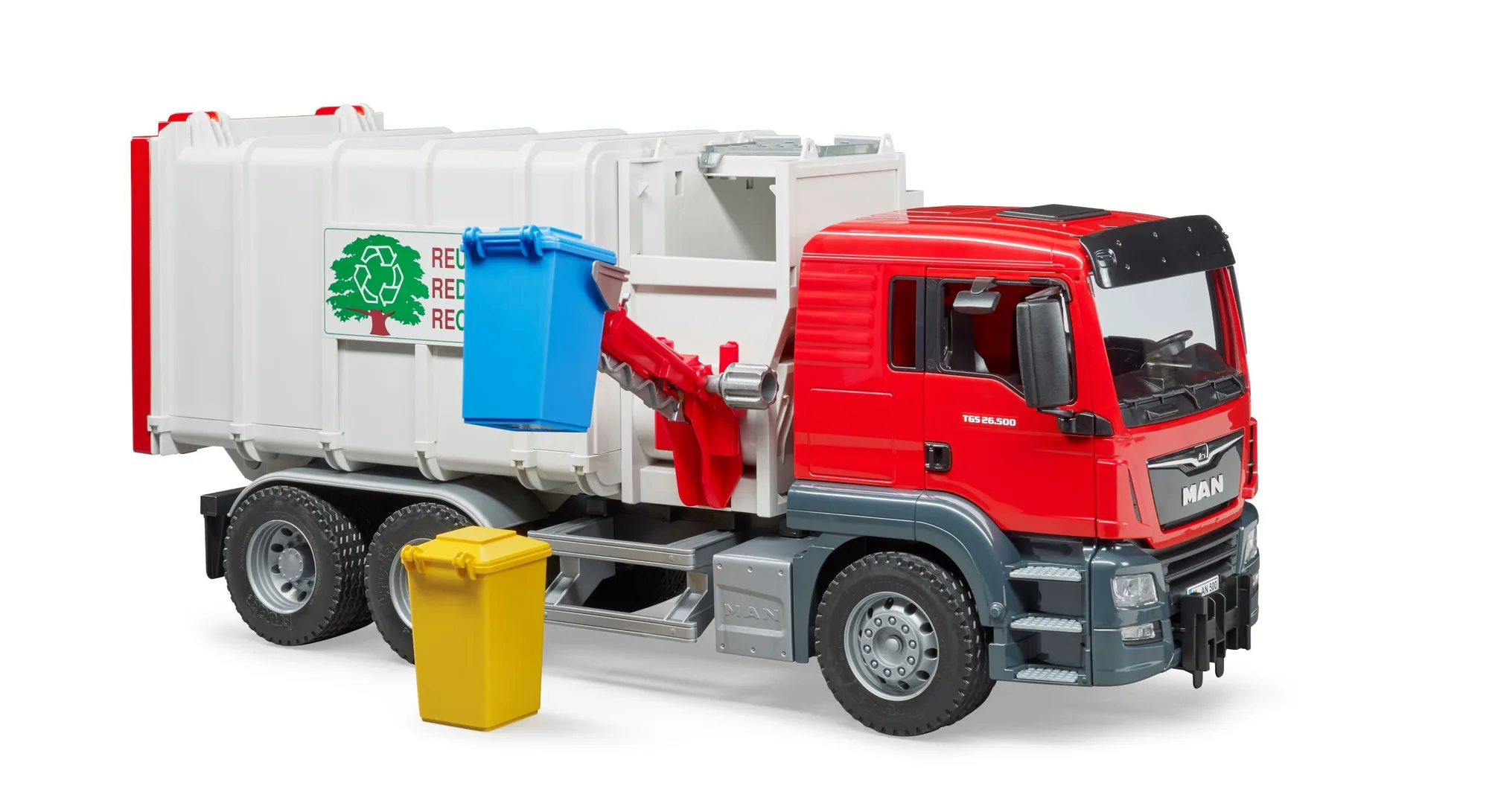
The Bruder 02812 Mack Granite rear loading garbage truck works as a manual toy: you move the driver's cab and operate the rear loading section by hand to load and empty the bin. The key is to load small items and check the rear mechanism's movement before each play session.
What the cab movement adds to play
The Mack Granite cab is designed to move, which lets kids tilt or shift it during loading and dumping routines. That movement is a play feature, not a motorized function, so expect to operate it by hand.
Because the cab moves, it is worth checking that it sits correctly before you start loading. A cab that is not seated properly can make the truck feel loose and distract from the rear loader.
Rear loader limits to plan around
This is a rear loading garbage truck toy, so the action happens at the back of the truck rather than at a side or front arm. The supplied product information does not list a motor, battery, or automatic lifting cycle, so treat the loading mechanism as a manual process.
That manual design is actually useful for pretend play: kids decide when to load, how much to load, and when to empty. The trade-off is that oversized or heavy items can jam the rear section, so keep loads small and light.
Scale and space before you start
At 27.4 x 7.3 x 10.4 inches, the truck needs a clear stretch of floor or a driveway-sized play area. Set up a loading zone and a dumping zone with enough room to turn the truck around.
If space is tight, shorten the route rather than rushing the rear loader. A short, repeatable route gives kids more chances to practice the loading steps.
How to load and empty the rear loader, step by step
- Set up a clear loading zone: Place the truck on a flat surface with room behind it for the rear loader and room in front for the cab to move. Mark a loading spot and a dumping spot with tape or two small boxes. If the truck rocks or the cab feels unstable, move to a flatter surface before loading.
- Check the cab before loading: Press the cab down gently and make sure it is seated. Move it through its range by hand once so you know how it behaves. A cab that pops out of place during play usually means it was not seated before loading.
- Load small, light items only: Use crumpled paper, small blocks, or toy trash that fits easily into the rear opening. Avoid hard or oversized objects that could jam the mechanism. If an item does not drop in freely, remove it rather than forcing it.
- Operate the rear loader by hand: Move the rear loading section slowly and watch the load as it goes in. Stop if anything catches or the section feels stiff. Smooth, slow movement is the checkpoint; forcing the loader is the common mistake.
- Empty at the dumping zone: Drive to the dumping spot, then open or tip the rear section by hand to release the load. Keep a small tray underneath to catch the items. Empty over a tray so small pieces do not scatter and get lost.
- Reset and inspect after play: Return the cab and rear loader to their starting positions and check for trapped items. Wipe the truck with a dry cloth and store it indoors. A quick post-play check prevents small toys from being left inside the loader.
Product facts
-
Bruder 02812 Mack Granite Rear Loading Garbage Truck 28.12.10: The Mack Granite rear loading garbage truck has driver's cab movement and function. Kids can act out the cab movement during loading and dumping, which adds a realistic step to the routine.
Bruder 02812 Mack Granite Rear Loading Garbage Truck 28.12.10
Bruder 02812 Mack Granite Rear Loading Garbage Truck 28.12.10
-
Bruder 02812 Mack Granite Rear Loading Garbage Truck 28.12.10: Overall dimensions are listed as 27.4 x 7.3 x 10.4 inches. Plan a play space long enough for the truck plus a loading and dumping zone.