Quick answer
Use the BUSTER Soft Ball Cube as a quiet indoor ball-and-puzzle toy: start with short, low-energy rolls on a non-slip rug, then add treats only after your dog settles into the game. Keep sessions brief and stop before your dog gets overexcited.
Why the Soft Ball Cube suits indoor play
The BUSTER Soft Ball Cube is a softer version of the BUSTER Cube, designed to make less noise during play. That matters on wooden or laminate flooring, where a hard toy can clatter and slide. The cube still provides mental challenges, so it works as enrichment rather than just a fetch object.
Because it contains no softeners, it is not a chew toy. Treat it as a play and puzzle tool that you supervise, and put it away when the game ends.
Indoor fetch vs. treat games: pick one job per session
Indoor fetch with a soft dog toy works best when you keep the toy low to the ground and roll it rather than throw it. A rolling cube is easier to track on a hallway floor and less likely to knock things over.
Dog cube toy games with treats add mental work, but they also raise arousal. Choose one mode per session: a calm rolling game, or a treat-search game. Mixing both often leads to a dog who gulps treats and then demands more action.
When to skip the cube indoors
If your dog is a strong chewer, the Soft Ball Cube is the wrong toy for unsupervised play. The catalog note says it should only be used under supervision, so choose a different outlet when you cannot watch your dog.
Also skip indoor fetch on bare laminate if your dog slides. The cube is quiet, but a sliding dog is still a fall risk. Use a rug or move the game to a carpeted room.
Five steps for a calm indoor session
- Clear a low-slip play zone: Choose a hallway or room with a rug or carpet, and remove breakable items from the floor. Common mistake: playing on bare laminate where the cube slides too far and your dog scrambles. Check that your dog can stop without sliding before you start.
- Start with a rolling fetch, not a throw: Roll the cube gently along the floor and let your dog chase and pounce. Keep the roll short so the game stays in the room. Common mistake: throwing the cube like a ball, which invites jumping and knocking things over. If your dog jumps repeatedly, switch to rolling only.
- Add treats only after the first calm round: Once your dog is settled, place a few small treats inside the cube and let your dog work them out. Common mistake: filling the cube before your dog has calmed down, which can cause frantic pawing and barking. Stop the treat game if your dog starts biting at the cube.
- Keep sessions to a few minutes: End the game while your dog is still interested, then put the cube away. Common mistake: letting the session run until your dog is overtired, which can lead to chewing or demand barking. A short session that ends calmly is more useful than a long one that ends in frustration.
- Supervise and inspect after play: Stay in the room for the whole game, and check the cube for damage afterward. The catalog note says it should only be used under supervision. Common mistake: leaving the cube on the floor as a free-access toy. Store the cube out of reach when the session ends.
Product facts
-
BUSTER Soft Ball Cube: A softer version of the BUSTER Cube made for less noise during play, with no clattering on the floor. You can play in a living room or hallway without the hard-toy noise that disturbs the household.
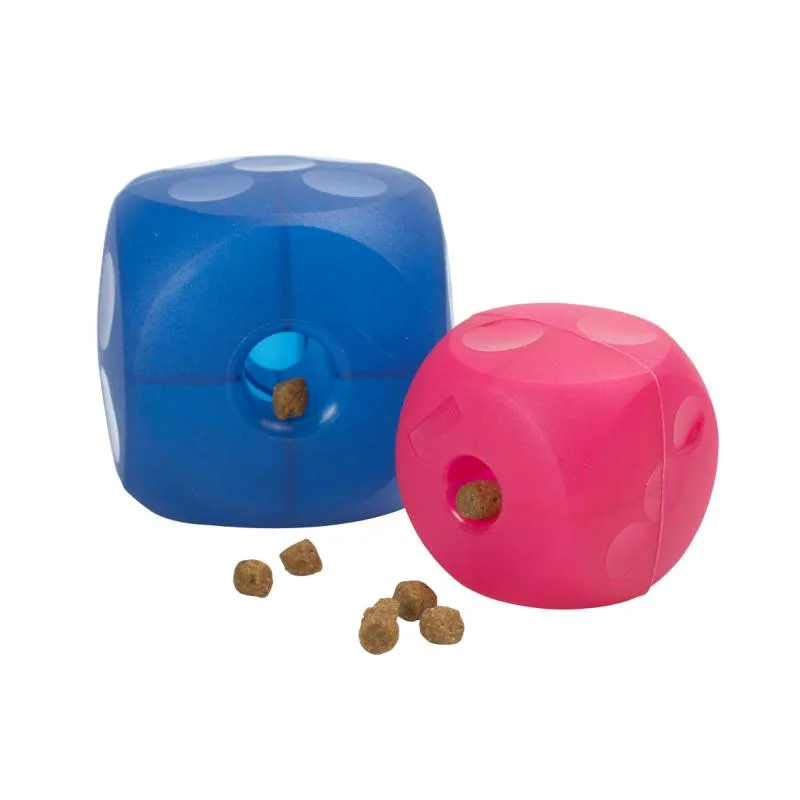
BUSTER Soft Ball Cube
-
BUSTER Soft Ball Cube: Provides mental challenges to keep a dog occupied for a long time. Short puzzle sessions can tire a dog mentally without needing a long walk.
-
BUSTER Soft Ball Cube: Particularly suitable for use on wooden or laminate flooring. It is a practical choice for homes where hard floors make other toys slide and rattle.