Quick answer
Yes, a power bank with a built-in wall plug, like the ToughTested Thor 10AC, can replace a wall charger for many daily charging needs, especially when you value portability and convenience over raw charging speed.
When a power bank works better than a wall charger
A power bank with a built-in wall plug eliminates the need to carry a separate charging brick and cable. That makes it ideal for travel, commuting, or moving between rooms. The ToughTested Thor 10AC, for example, plugs directly into an outlet and includes a USB-C cable, so you don't have to remember extra accessories.
For overnight or desk charging, a power bank's slower charge rate (typically 20W) is often fine. You plug it in, and by morning both the power bank and your device are ready.
When a wall charger is still better
Wall chargers usually deliver higher wattage (30W, 60W, or more) for faster charging, especially for laptops and tablets. If you need a quick top-up before a meeting, a high-watt wall charger will refill your device faster than a 20W power bank.
Also, a power bank's internal battery has a limited number of charge cycles. Using it as your primary charger every day will wear it out faster than using a dedicated wall charger that doesn't have a battery.
Frequently asked questions
Can I leave a power bank plugged in all the time?
Yes, if it has safety features like the semi-solid state battery in the ToughTested Thor 10AC. It's tested against nail punctures and hammer strikes with ultra-low fire risk, so it's safer than standard lithium-ion banks for continuous wall use.
Will a power bank charge my phone as fast as a wall charger?
Not always. The Thor 10AC delivers 20W USB-C Power Delivery, which is fast for phones and tablets. But many wall chargers offer 30W or more, so a wall charger will top up a drained phone faster. If speed matters most, keep a high-watt wall charger for quick top-ups.
Is a power bank with a wall plug worth it for daily use?
Yes, if you value convenience and portability. You get a charger and backup battery in one device. The trade-off is slower peak charging speed and eventual battery wear. For most people, it's a practical everyday companion. Consider your typical charging habits: if you often need a quick boost, a separate wall charger may still be useful.
Product facts
-
ToughTested Thor 10AC Semi-Solid State Power Bank with Wall Plug: Semi-solid state power bank: swaps flammable liquid electrolyte for a safer semi-solid cell. This makes it safer to leave plugged in overnight or carry in a bag, reducing fire risk compared to traditional lithium-ion power banks.
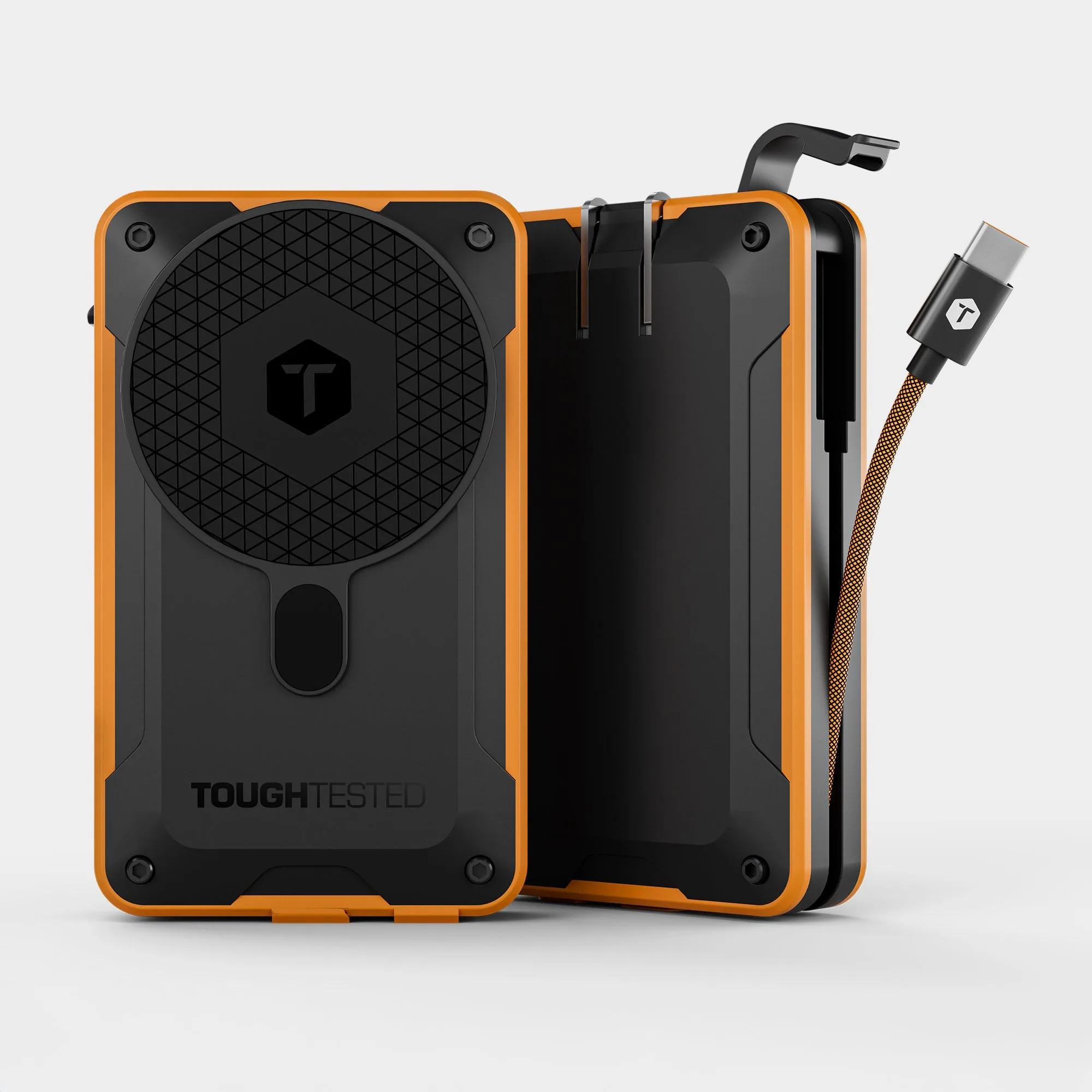
ToughTested Thor 10AC Semi-Solid State Power Bank with Wall Plug
-
ToughTested Thor 10AC Semi-Solid State Power Bank with Wall Plug: Built-in wall plug and USB-C cable: no brick or cable to lose. You can use it as a wall charger without carrying extra accessories, making it a true 2-in-1 device for daily carry.
-
ToughTested Thor 10AC Semi-Solid State Power Bank with Wall Plug: 20W USB-C Power Delivery: fast-charges phones, tablets, even a MacBook Air. It covers most personal electronics, but won't charge a larger laptop as fast as a 60W+ wall charger would.