Quick answer
Buy the Canon EOS 90D 18-135mm kit in 2026 if you shoot fast action, prefer an optical viewfinder, and want one zoom that covers wide to telephoto. Skip it if you mainly shoot video or want the smallest possible body.
What the 32.5MP sensor and 18-135mm zoom actually give you
The 90D's APS-C sensor is the headline: 32.5MP gives you room to crop into a distant subject and still print large. That matters for sports and wildlife, where you often can't fill the frame. The 18-135mm kit lens covers a genuinely useful range, from group shots at 18mm to a tight portrait or sideline action at 135mm, so you can start shooting without buying a second lens.
The trade-off is that this is a DSLR kit, not a compact one. The mirror box and the zoom's reach make it a bag camera rather than a pocket camera. If you want something you'll carry every day, that bulk is the first thing to weigh.
Where a DSLR still beats mirrorless for you
An optical viewfinder shows the scene with no lag and no battery drain, which many action shooters find easier to track with. DSLR bodies also tend to last a long time per charge, and the 90D's handling is built around physical dials and a deep grip. If you already own Canon EF lenses, the 90D lets you use them natively without an adapter.
The honest counterpoint: mirrorless systems now dominate new lens development, and an electronic viewfinder gives you exposure preview and focus peaking. If you're starting from scratch and shoot a mix of stills and video, compare mirrorless options before committing to the DSLR path.
The video question
The 90D records UHD 4K at 30p and Full HD at 120p, so it can handle slow-motion clips and 4K projects. What the catalog doesn't tell you is how the autofocus behaves in video or whether there are crop factors in 4K; those details aren't supplied, so check them against your own workflow before buying. If video is your priority, a mirrorless body with modern eye-tracking autofocus is usually the easier tool.
Decision rules for buying the 90D kit in 2026
- You shoot fast action outdoors: Choose the 90D kit if you need an optical viewfinder, long battery life, and a zoom that reaches 135mm for field sports or wildlife. Confirm the 18-135mm reach matches your typical shooting distance before you buy.
- You already own Canon EF lenses: The 90D mounts EF lenses natively, so your existing glass works without an adapter. That makes the kit a lower-cost upgrade than switching systems.
- Video is more than half your work: Pick a mirrorless body instead. The 90D records 4K30p and 120p Full HD, but the catalog doesn't specify video autofocus behavior or 4K crop, so verify those before relying on it for video. Check video autofocus and crop details you can't confirm from the spec sheet.
- You want the smallest possible kit: Skip the 90D. The DSLR body and 18-135mm zoom are built for handling, not pocketability. A smaller mirrorless kit will get carried more often.
Product facts
-
Canon EOS 90D with 18-135mm Lens Kit: 32.5MP APS-C CMOS sensor with ISO up to 25600 and the DIGIC 8 processor. High resolution gives you cropping headroom for distant action, while the ISO range supports indoor and evening shooting.
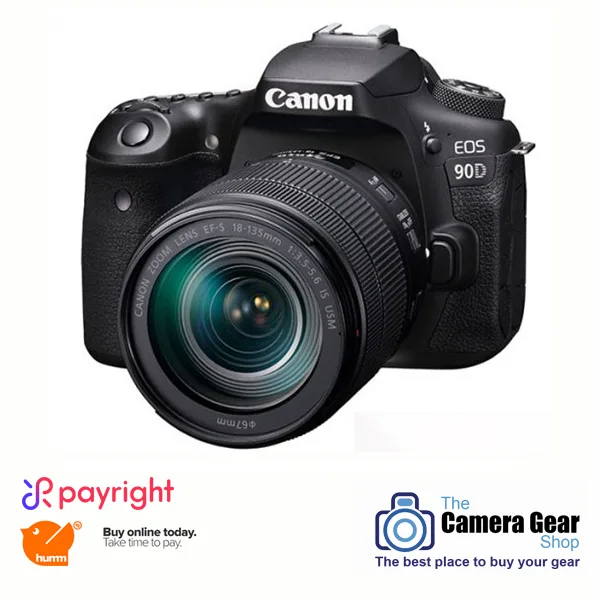
Canon EOS 90D with 18-135mm Lens Kit
-
Canon EOS 90D with 18-135mm Lens Kit: UHD 4K30p and Full HD 120p video recording. You get 4K for detail and 120p for slow motion without adding a second camera.
-
Canon EOS 90D with 18-135mm Lens Kit: Kit includes the 18-135mm zoom lens. One lens covers wide group shots through tight telephoto, so you can shoot sports and travel without swapping glass.
Who should buy it
Best for
- Sports and wildlife shooters who prefer an optical viewfinder
- Canon EF lens owners who want a high-resolution APS-C body
- Photographers who want one zoom for wide to telephoto coverage
Not for
- Video-first creators who need modern mirrorless autofocus
- Travelers who prioritize a compact, lightweight kit
- Beginners who want the newest lens ecosystem