Quick answer
Choose your carbide rosette cutter diameter to match the trim's visual scale—2-1/8" for standard door/window casings, 2-3/4" for larger columns or exterior trim—then cut at 1500–3000 RPM with a slow, steady feed.
Why diameter matters more than profile
Rosette cutter diameter sets the outer footprint of the block, so it must relate to the width of the casing and the size of the room. A 2-1/8" cutter suits most interior door and window trim where the casing is 3" to 4" wide; a 2-3/4" cutter gives more presence on column wraps, exterior trim, or large openings. If the rosette overpowers the casing, the trim looks top-heavy; if it is too small, the block disappears.
The cutter's cutting geometry and profile are fixed by the manufacturer; diameter is the variable you control at purchase. That is why sizing is the first decision, not an afterthought.
When a drill press makes more sense than a lathe
The supplied cutters are designed for use on a lathe or drill press. A lathe is convenient for centering and rotating the work, but a drill press with a stable fence and clamp can be safer for short blocks because the cutter stays stationary and the workpiece is held down. Whichever you use, the block must be secured against rotation and the cutter must enter squarely.
If you are turning a single rosette on a lathe, use a faceplate or chuck with enough jaw contact; do not rely on friction alone.
Speed and feed are not suggestions
The catalog recommends 1500–3000 RPM and a slow feed into the material. Running faster may burn the profile or dull the carbide; feeding too fast can tear end grain or stall a small drill press. Start at the low end of the range, especially in hard wood, and increase only if the cut is clean and the machine feels stable.
Step-by-step: cutting a rosette block
- Measure the casing width: Measure the actual width of your door or window casing. Choose a rosette cutter diameter that leaves at least 1/4" of flat margin around the profile on each side; for a 3-1/2" casing, a 2-1/8" rosette leaves about 11/16" margin, while a 2-3/4" rosette leaves only 3/8". If the margin is under 1/4", step down to the smaller diameter or widen the block.
- Prepare a square, flat block: Cut your wood rosette block 1/4" to 1/2" larger than the cutter diameter in both directions and plane both faces flat. The block must sit flush on the machine table or lathe faceplate; any rock will cause an uneven cut. Check flatness with a straightedge—if you can see light, joint or sand before cutting.
- Center the cutter precisely: On a drill press, align the cutter spindle to the center mark on the block using a fence and stop blocks. On a lathe, center the block on the chuck or faceplate. A center that is off by 1/16" will make the profile look lopsided. Mark center with a awl, not a pencil, so the point stays visible.
- Clamp or chuck the block securely: Clamp the block to the drill press table with at least two clamps on opposite corners, or mount it in a chuck with full jaw contact on a lathe. Never hold a rosette block by hand during cutting. If you can move the block by hand, it is not secure enough.
- Set speed to 1500–3000 RPM: Start at 1500 RPM for hard woods and 2000 RPM for soft woods. Do not exceed 3000 RPM. On a lathe, engage the lowest back-gear range that reaches this speed. If the cutter chatters at 1500 RPM, check clamp rigidity before increasing speed.
- Feed slowly and steadily: Advance the cutter into the block at a rate that produces visible chips, not dust. Pause if the sound changes or the cutter slows; clear chips before continuing. A slow feed protects the carbide edge and leaves a cleaner profile. Two light passes are safer than one heavy pass, especially in end grain.
- Inspect and repeat: Stop when the profile is fully formed and the center pip is minimal. Check the rosette for tear-out and symmetry before cutting the next block. Adjust feed or speed for the next piece based on what you see. Keep a test block from the same wood to confirm settings before cutting a full set.
Product facts
-
Infinity Tools Carbide Tipped Rosette Cutters, 2-1/8" Diameter: 2-1/8" diameter, micro-grain carbide tipped, for lathe or drill press, 1500–3000 RPM. A compact size that fits standard interior casing and stays manageable on a drill press.
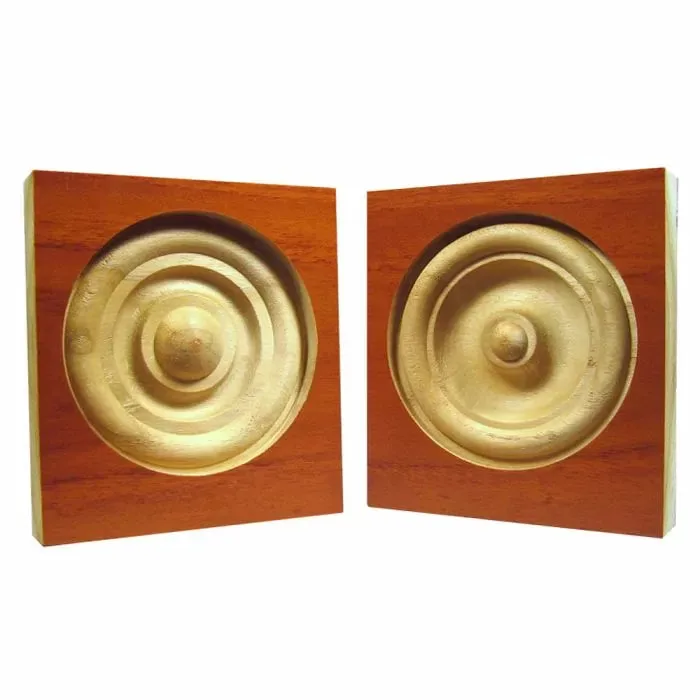
Infinity Tools Carbide Tipped Rosette Cutters, 2-1/8" Diameter
-
Infinity Tools Carbide Tipped Rosette Cutters, 2-3/4"" Diameter: 2-3/4" diameter, micro-grain carbide tipped, for lathe or drill press, 1500–3000 RPM. Larger footprint for column wraps and exterior trim where a bigger rosette is proportional.
Infinity Tools Carbide Tipped Rosette Cutters, 2-3/4"" Diameter