The wok claims worth testing
A carbon steel wok gets sold on a long list of promises: it's lighter than cast iron, it's naturally nonstick, it works on any stove, and it makes stir-fry better than a fry pan. Some of those claims hold up. Others depend on how you cook, and a few are simply overstated. The honest answer to whether a wok is worth it starts with the evidence, not the marketing.
This is not a case for replacing every fry pan. It's a case for knowing which jobs a wok actually does better, and where a standard skillet still wins.
Four common wok claims, checked
- Myth: a wok is always lighter than cast iron: Partly true, and it's the claim with the clearest support. The Viking Blue Carbon Steel 12-Inch Wok is described as lighter and more maneuverable than cast iron, which matters if the weight of cast iron is what keeps you from cooking with a wok. That is a relative comparison, not a promise that every wok feels light in every hand.
- Myth: a wok is naturally nonstick out of the box: Seasoning is what creates the nonstick surface, not the steel alone. The Viking wok arrives pre-seasoned with vegetable oil, so it starts with a base layer. How well that layer performs depends on how you cook and care for it. The supplied information does not include a seasoning schedule, so treat the pre-seasoning as a starting point rather than a permanent finish.
- Myth: a wok works on any stove, so stove type doesn't matter: The Viking wok is listed as compatible with electric, gas, grill, induction and oven cooking. That is broad compatibility, but a wok's curved base can sit differently on a flat electric or induction surface than a flat-bottomed fry pan does. Compatibility tells you it can be used; it does not guarantee identical browning on every surface.
- Myth: a wok is only for stir-fry: A wok's shape suits tossing and high-heat searing, but the Viking wok is rated safe up to 600°F, which opens up oven use and high-heat searing beyond a quick stir-fry. That said, the supplied information does not list specific recipes or techniques, so use your own judgment about what fits the pan's shape.
Where a wok genuinely beats a fry pan
For stir-fry specifically, the wok's advantage is shape and heat tolerance. A 12-inch wok gives you a wide, sloped cooking surface that lets you push food up the sides and keep it moving, which is the motion stir-frying depends on. A flat fry pan holds food in a single layer and makes tossing harder.
The Viking wok's 600°F rating and pre-seasoned carbon steel construction support high-heat cooking, and the lighter build compared with cast iron makes it easier to lift and toss. If stir-fries, fried rice, and quick high-heat searing are regular meals in your kitchen, those are real, evidence-backed reasons to choose the wok.
What the Viking Blue Carbon Steel 12-Inch Wok actually offers
-
Viking Blue Carbon Steel 12-Inch Wok: Pre-seasoned blue carbon steel construction with a vegetable oil seasoning You can start cooking without a separate first seasoning, though the seasoning still needs ongoing care.
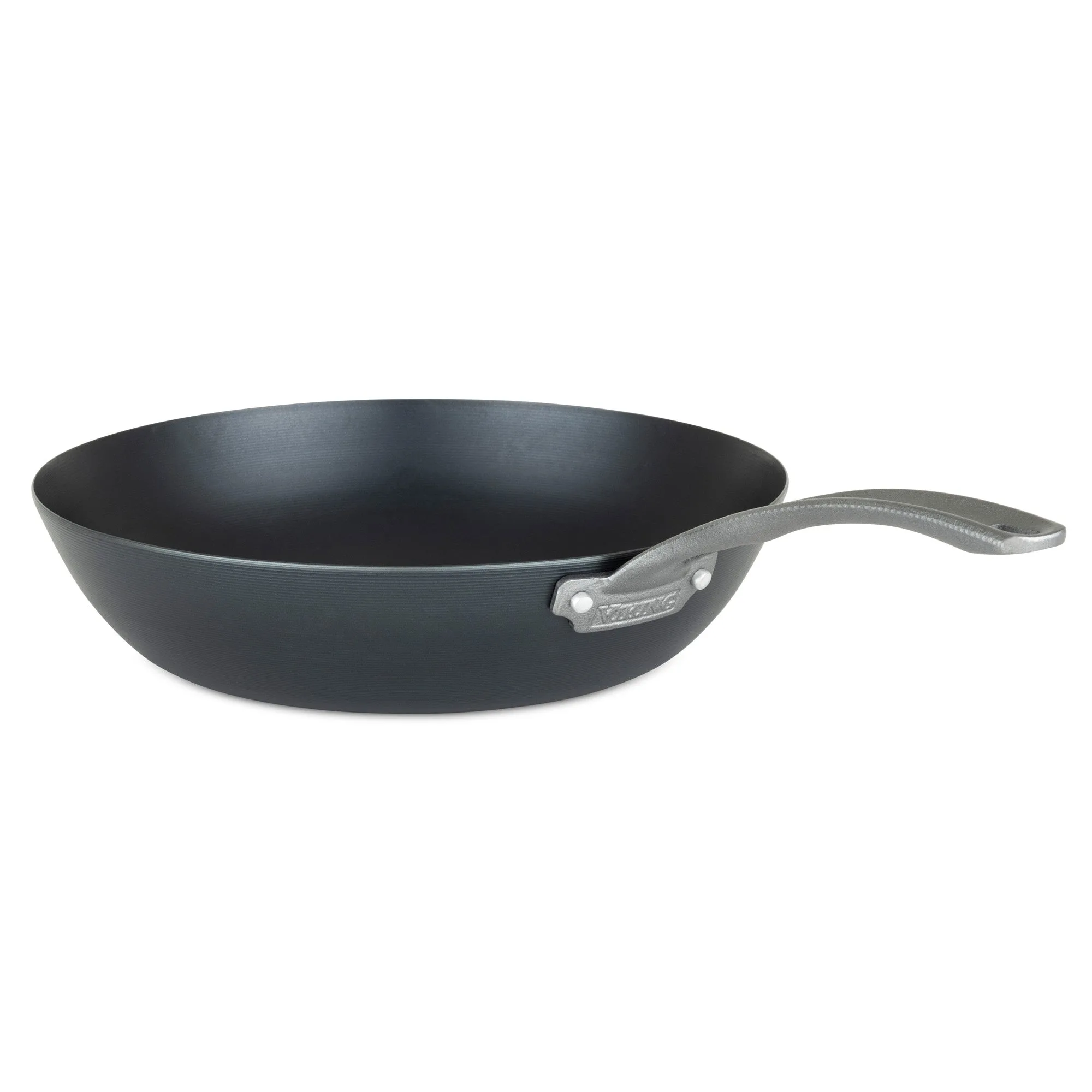
Viking Blue Carbon Steel 12-Inch Wok
-
Viking Blue Carbon Steel 12-Inch Wok: Lighter and more maneuverable than cast iron This is the clearest supported advantage if cast-iron weight has been a barrier for you.
-
Viking Blue Carbon Steel 12-Inch Wok: Safe up to 600°F and compatible with electric, gas, grill, induction and oven It covers high-heat searing and oven use across common stove types, though wok shape on flat surfaces still affects performance.
-
Viking Blue Carbon Steel 12-Inch Wok: Hand wash only This is a real maintenance commitment, and it is the strongest argument for keeping a fry pan in rotation if easy cleanup matters to you.
The trade-offs a wok won't tell you about
A wok is not a drop-in replacement for a fry pan. The Viking wok is hand wash only, which is a stricter care routine than many nonstick or stainless fry pans. If you rely on quick cleanup, that is a genuine reason to keep a fry pan for everyday eggs, pancakes, and pan sauces.
The supplied information does not include a seasoning maintenance schedule, specific cooking techniques, or a weight figure, so you cannot use this record to compare exact weights or plan a detailed seasoning routine. What you can say is that the wok is pre-seasoned, lighter than cast iron, and built for high heat. Those are the facts to weigh, not the myths.
Practical tips for a 12-inch carbon steel wok
- Respect the 600°F limit: The wok is rated safe up to 600°F, so high-heat searing and oven finishing are within its range. Do not assume it can go beyond that.
- Hand wash and dry promptly: Because the wok is hand wash only, avoid leaving it soaking. The supplied information does not include a specific drying or re-oiling procedure, so follow the care guidance that comes with the product.
- Use the shape, not just the heat: The wok's advantage in stir-fry comes from pushing food up the sloped sides and keeping it moving. If you cook everything flat on the bottom, you lose much of the benefit over a fry pan.
- Keep a fry pan for flat-surface jobs: Eggs, pancakes, and pan sauces are easier in a flat fry pan. The wok earns its space for stir-fries and high-heat searing, not for every meal.