Quick answer
To play Mancala, set the board between two players, place four stones in each of the six small pits, and take turns scooping stones from one pit and dropping one stone per pit around the board. The player who gathers the most stones in their store wins. Teach kids by starting with a simplified version and focusing on one rule at a time.
Why Mancala works well for teaching kids
Mancala is simple to learn but challenging to play, which makes it a good fit for children who are ready for turn-taking and counting but not yet ready for complex rule sets. The board has no hidden information, so you can talk through each move together without spoiling the game.
The physical stone-moving also helps younger kids stay engaged: they can see and touch the pieces, which reinforces counting and one-to-one correspondence.
Common rule variations to decide before you start
Many families play with slightly different rules, especially about what happens when the last stone lands in an empty pit or in the player’s store. Before you teach a child, agree on one version and stick to it for the whole game. For a first game, the simplest version is usually best: if your last stone lands in your store, you get another turn; otherwise, turn passes. Skip the capture rule until the child is comfortable with the basic loop.
How to play and teach Mancala step by step
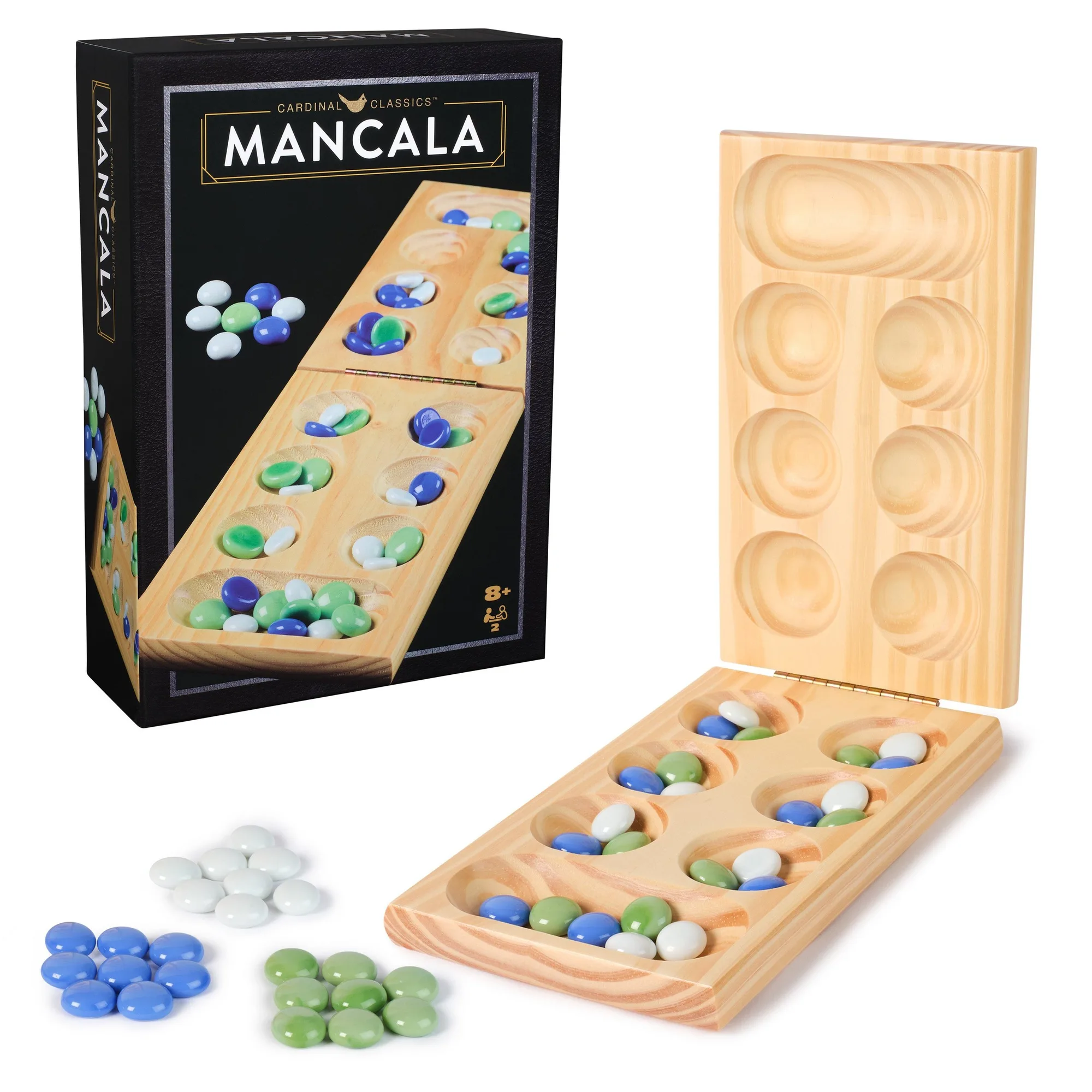
- Set up the board: Unfold the wood board and place four stones in each of the six small pits on your side. Each player owns the six pits directly in front of them and the large store to their right. Checkpoint: count the stones together aloud so the child sees that both sides start equal. If the stones are not evenly distributed, fix it before the first move.
- Explain the goal: Tell the child that the goal is to collect the most stones in your store by the end of the game. Point to the store and say, “This is your treasure box.” Common mistake: kids may think they need to empty their own pits first, so clarify that stones move around the board, not just off it. Ask the child to repeat the goal in their own words before starting.
- Teach the basic move: On your turn, pick up all the stones from one of your pits and drop one stone into each pit as you move counterclockwise around the board, including your own store. Do not drop a stone into your opponent’s store. Checkpoint: have the child practice a single move slowly while you count each drop. If they skip a pit, have them redo the move from the start.
- Handle the last stone: If your last stone lands in your store, you get another turn. If it lands in an empty pit on your side, you capture that stone and any stones in the opposite pit and place them in your store. For a first game with a young child, you can skip the capture rule and simply pass the turn. Common mistake: players often forget the extra turn when the last stone lands in the store. Announce “extra turn” out loud to reinforce the rule.
- End the game and count: The game ends when one player’s six pits are all empty. The other player then scoops any remaining stones from their side into their own store. Count the stones in each store; the higher total wins. Checkpoint: count together and let the child announce the winner. If the child loses interest, play a shorter game by starting with two stones per pit.
Product facts
-
Cardinal Classics Mancala: The high-quality wood board folds for easy storage or on-the-go fun. Folding design makes it practical to bring to a grandparent’s house or pack away quickly after play.
Cardinal Classics Mancala