What the Cayin IHA-8 Offers
The Cayin IHA-8 is a fully-balanced, discrete pure Class A headphone amplifier designed for demanding listeners. It uses a four-channel differential circuit, with each channel featuring a discrete Class A input buffer and a three-stage large bias current pure Class A output stage. This architecture aims to deliver low noise, low distortion, and high current drive—key traits for driving a wide range of headphones, including high-impedance models.
Key Specifications at a Glance
-
Cayin IHA-8 Class A Headphone Amplifier: 70W high-power low magnetic leakage toroidal power transformer A robust power supply is essential for stable, clean power delivery, especially in Class A operation where the amplifier runs hot and draws continuous current.
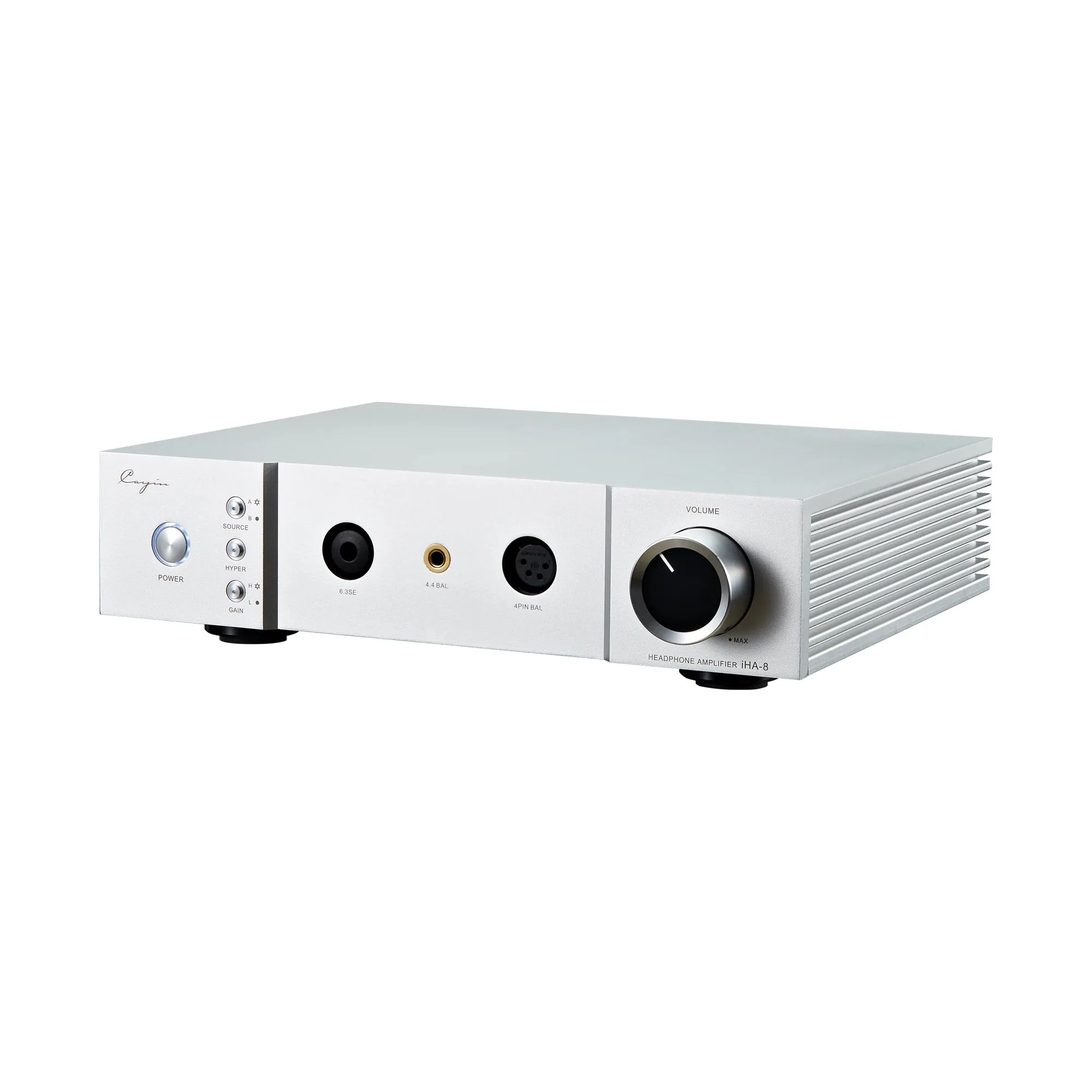
Cayin IHA-8 Class A Headphone Amplifier
-
Cayin IHA-8 Class A Headphone Amplifier: 50,000µF Nichicon main filter capacitor Large capacitance helps maintain voltage stability and provides reserve energy for dynamic peaks, supporting a solid, controlled bass response.
-
Cayin IHA-8 Class A Headphone Amplifier: ALPS customized step potentiometer combined with JRC MUSES72320V electronic volume chips This hybrid volume control offers precise, low-noise adjustment in the analogue domain, which is important for fine-tuning volume with sensitive or high-impedance headphones.
Understanding Hyper Mode
The IHA-8 includes a Hyper Mode that increases the static operating current and voltage of the Class A stage, raising output power and gain while preserving pure Class A operation. According to the manufacturer, this mode yields a "more pristine and transparent sound" with a "well-defined and dynamic soundstage." It is designed for listeners who want maximum performance from the amplifier, though it will increase heat output—the side panels are designed as ridged heat sinks to manage thermal dissipation.
Pairing with Headphones
The IHA-8 offers three headphone outputs (balanced and single-ended), covering most popular connector types. Its high current capability and low output impedance make it suitable for both low-impedance planar magnetic headphones and high-impedance dynamic models (e.g., 300Ω or 600Ω). The amplifier's DC offset servo circuit maintains a stable output DC offset, which helps protect sensitive drivers. For high-impedance headphones, the IHA-8's voltage swing and current reserve in Hyper Mode can provide the headroom needed for dynamic peaks without strain.
Balanced vs. Single-Ended Connection
The IHA-8 accepts both XLR and RCA inputs, allowing connection to a variety of sources (CD players, DACs, portable players). For optimal performance with high-impedance headphones, a balanced connection is recommended to leverage the amplifier's full differential design.
- Balanced (XLR): Uses the full four-channel differential circuit, providing higher output power and lower noise. Best for headphones with balanced cables, especially high-impedance or power-hungry models.
- Single-Ended (RCA): Convenient for standard headphones. The amplifier still operates in Class A, but output power is lower than balanced mode. Suitable for less demanding headphones.
Honest Trade-Offs
Class A amplification produces significant heat. The IHA-8's ridged side panels dissipate heat effectively, but the amplifier will run warm to the touch, especially in Hyper Mode. Ensure adequate ventilation and avoid stacking other components directly on top. Additionally, the IHA-8 is a dedicated headphone amplifier—it does not include a built-in DAC or preamp outputs, so you will need a separate source with line-level output (RCA or XLR). The amplifier's weight and size (due to the toroidal transformer and large capacitors) mean it is best suited for a desktop setup rather than portable use.