Quick answer
Choose the CEJAY Phoenix Jr 123 Flex Mount if you need a simple, flexible way to attach a Phoenix Jr 123 Signaling Beacon to a helmet, uniform, or pack using its included hook-and-loop peel-and-stick backing. Skip it if you need a permanent hard mount or a mount for a different beacon.
Why a flexible rubber mount changes your setup
The Phoenix Jr 123 Flex Mount is made of flexible rubber, so it can be flexed to fit a variety of surfaces. That matters when your helmet or gear has curves, webbing, or uneven areas where a rigid mount would sit poorly or create pressure points. Because the mount uses hook-and-loop peel-and-stick backing, it is a low-commitment attachment: you can reposition it as your kit changes, but you should not expect the same permanence as a bolted or screwed mount.
Where the flex mount works best—and where it doesn’t
The mount is designed for the Phoenix Jr 123 Signaling Beacon, which is sold separately. It attaches to helmets, uniforms, packs, or other objects with the included hook-and-loop backing. That makes it a good fit for secondary gear like a backup pack or a helmet that you reconfigure often. It is not a universal mount for other beacons, and it is not a hard-mounted solution for heavy accessories. If you need to mount a different light or a heavier device, this is the wrong product.
Trade-offs to accept before you buy
Hook-and-loop attachment trades permanence for flexibility. On rough or dirty surfaces, the adhesive backing may not bond as well, and the hold depends on the quality of the surface preparation. The rubber body flexes to fit curves, but extreme curves or very small surfaces may reduce contact area. Also, the mount is sold without the beacon, so factor in the separate cost of the Phoenix Jr 123 Signaling Beacon if you do not already own one.
Decision rules for the Phoenix Jr 123 Flex Mount
- Match the beacon first: Use this mount only with the Phoenix Jr 123 Signaling Beacon. If you own a different beacon, do not buy this mount. Check your beacon model before ordering.
- Check your surface: The mount works on helmets, uniforms, packs, or other objects with a smooth, clean area for the hook-and-loop backing. Avoid porous, oily, or heavily textured surfaces where the adhesive may not bond well. Clean and dry the surface before applying.
- Decide on permanence: Choose this flex mount if you want a repositionable, tool-free attachment. If you need a permanent, hard-mounted solution, look for a bolt-on mount instead. Repositionable is not the same as permanent.
- Plan for curves: The rubber body flexes to fit curves, but very tight curves or small surfaces may reduce contact area. Test-fit the mount before peeling the backing. Dry-fit first to confirm contact.
- Budget for the beacon: The Phoenix Jr 123 Signaling Beacon is sold separately. Factor that into your total cost if you do not already own one. Mount price alone is not the full setup cost.
Product facts
-
CEJAY Phoenix Jr 123 Flex Mount: Flexible rubber body can be flexed to fit a variety of surfaces. This lets you mount the beacon on curved helmets or gear where a rigid mount would not sit flush.
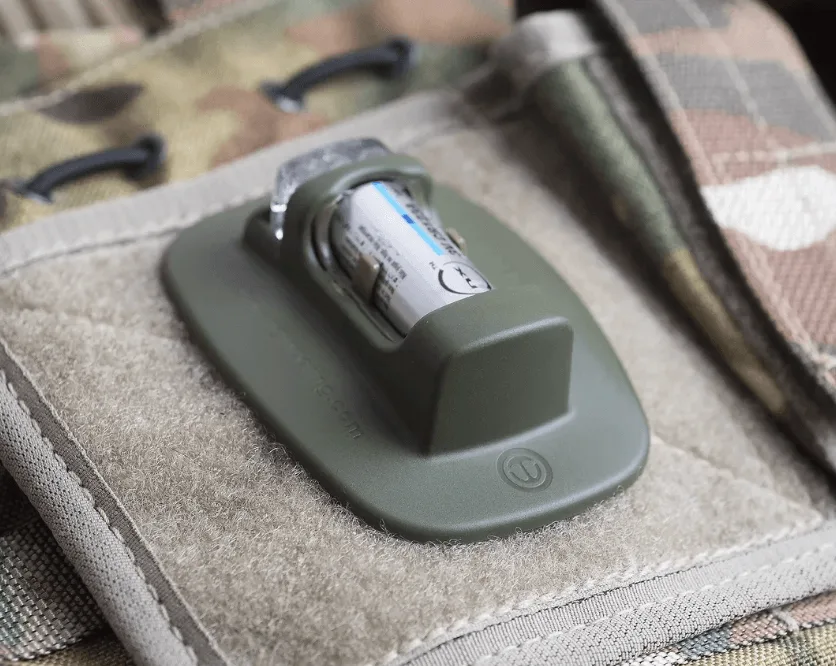
CEJAY Phoenix Jr 123 Flex Mount
-
CEJAY Phoenix Jr 123 Flex Mount: Includes hook-and-loop peel-and-stick backing for attaching to helmets, uniforms, packs, or other objects. You can install it without tools and reposition it later, but the hold depends on surface preparation.
-
CEJAY Phoenix Jr 123 Flex Mount: Shown with Phoenix Jr 123 Signaling Beacon, which is sold separately. Budget for the beacon separately unless you already have one; the mount alone will not signal.
Who should choose this mount
Best for
- Users who already own or plan to buy the Phoenix Jr 123 Signaling Beacon
- Helmet setups that need a flexible, repositionable mount on curved surfaces
- Attaching a beacon to a pack, uniform, or backup gear without tools
Not for
- Mounting a different beacon or a heavier accessory
- Permanent, hard-mounted installations that require bolts or screws
- Surfaces that are dirty, oily, or too curved for reliable adhesive contact