Start with the table, not the box
The fastest way to choose a Magic Puzzle bundle is to work backward from your table and your calendar. How many people will actually sit down at once, and how long do you want the puzzle to last? A bundle gives you three separate puzzles, so you can spread them across several evenings or hand them to different households. The catalog does not list piece counts or solving times, so use the number of puzzles in a bundle as your planning unit rather than guessing minutes per piece.
That means a three-puzzle bundle is best treated as three sessions, not one marathon. If your group meets weekly, one bundle can cover a month of casual nights. If you are buying for a single long evening, a bundle is more puzzle than you need, but it still works as a gift that keeps going.
Match the bundle to your group size
Use these practical groupings to narrow the choice before you compare prices. They are planning suggestions, not manufacturer specifications.
- Solo or two solvers: A three-puzzle bundle gives you variety without buying three separate series. You can work one puzzle at a time and save the others for later evenings.
- Three to four at the table: This is the classic puzzle-night size. A bundle lets each person claim a puzzle or rotate roles across sessions, and the Series 3 Bundle's three named puzzles give you clear handoffs.
- Five or more, or mixed ages: More people means more downtime at one puzzle. A bundle helps because you can split into smaller tables or run a puzzle rotation. Check the age range and warnings on the product page before buying for children, since the supplied catalog does not confirm those details.
- Gift for another household: A bundle is easier to wrap and explain than three loose puzzles, and it signals a shared activity rather than a solo toy.
Time: how many evenings will a bundle fill?
Think in sessions. A three-puzzle bundle supports three separate sittings if your group solves one puzzle per meetup. If you solve faster, it becomes a single weekend. If you solve slowly or only meet monthly, the same bundle stretches across a season. The catalog does not publish difficulty ratings, so the honest answer is that the bundle's pacing depends on your group, not on a printed time.
For a family night that happens once, a single puzzle is the simpler purchase. For a recurring family night, a bundle removes the "what do we do next week" question. That is the real time value: not speed, but repeatability.
Series 3 Bundle vs Series 5 Bundle: what the catalog shows
Both bundles follow the same three-puzzle structure, so the decision comes down to which set of scenes your group wants and how the price compares at checkout.
- Series 3 Bundle: Contains The Secret Soup, The Puzzled Patron, and The Gnomes' Homes. Catalog price is USD 46.50, compared with a catalog comparison price of USD 75.00. The catalog also describes the bundle structure as buy 3 for the price of 2.6 and save $10.
- Series 5 Bundle: Contains The Drippy Trip, The Golden Goose, and The Coveted Comet. The catalog lists the same save $10 bundle framing. Specific pricing for Series 5 is not included in the supplied evidence, so compare it on the product page before deciding.
- Series 4 Bundle: Contains Big Rock City, The Awakened Artifacts, and The Peckish Pirates. Also listed with the save $10 bundle framing. Use it if those scenes suit your group better than Series 3 or 5.
- Series 1 and Series 2 Bundles: Series 1 includes The Happy Isles, The Mystic Maze, and The Sunny City. Series 2 includes The Busy Bistro, The Crystal Caves, and The Forest Feast. Both are three-puzzle bundles in the same format.
Series 3 Bundle: the value case in one place
-
Series 3 Bundle: Three puzzles: The Secret Soup, The Puzzled Patron, and The Gnomes' Homes. Three named scenes give a group clear choices for different evenings and let gift-givers describe what is inside.
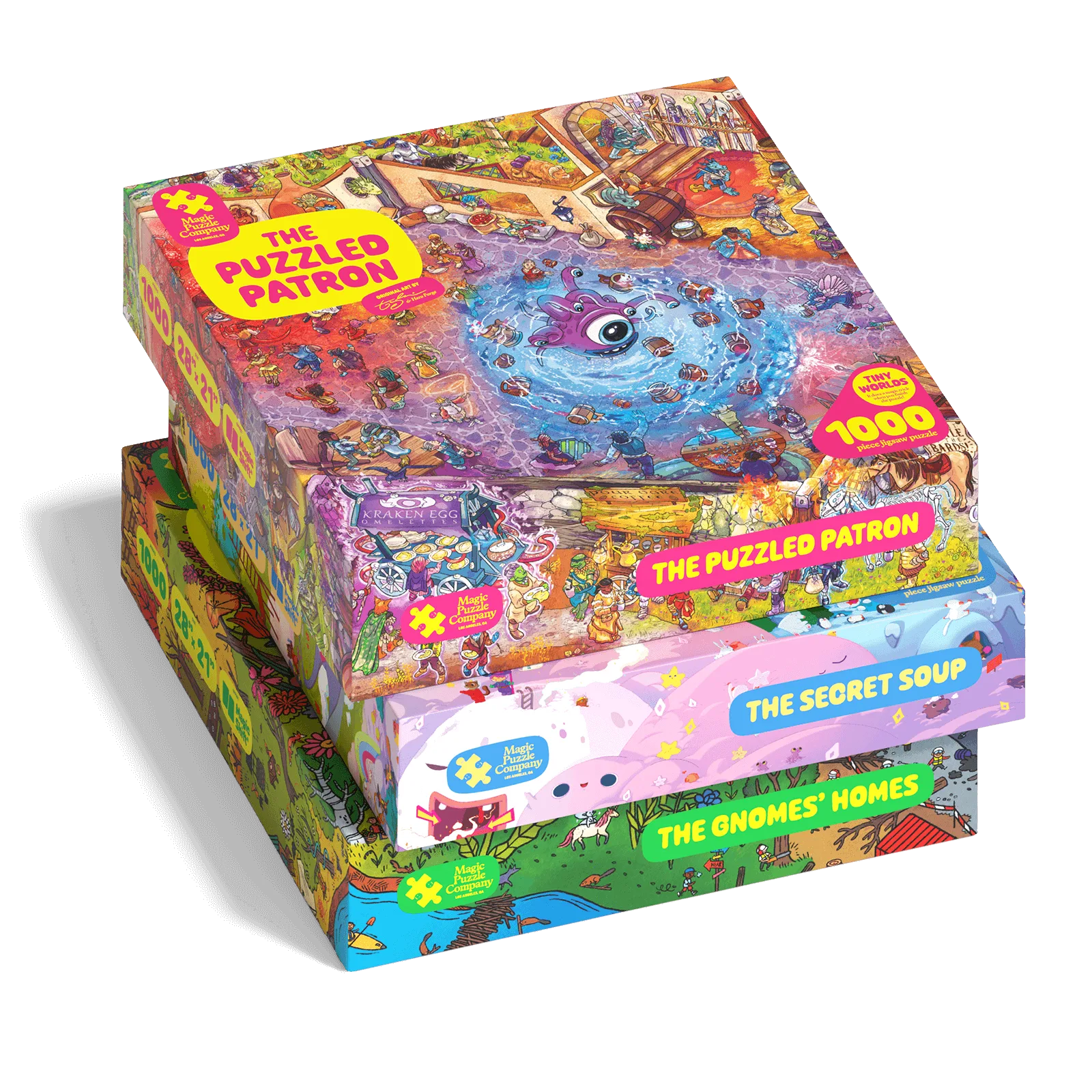
Series 3 Bundle
-
Series 3 Bundle: Catalog price USD 46.50, with a catalog comparison price of USD 75.00. The gap between the two catalog figures is the clearest value signal in the supplied evidence, but treat the comparison price as a reference rather than a guarantee.
-
Series 3 Bundle: The catalog describes the bundle offer as buy 3 for the price of 2.6 and save $10. This explains the bundle logic in plain terms: you are paying for roughly two and a half puzzles to get three.
The trade-offs the catalog does not settle
The supplied information does not include piece counts, solving times, age ranges, or safety warnings for the Series 3 Bundle. That is a real limitation for group planning: you cannot promise a specific finish time or confirm suitability for young children from the catalog alone. Check the product page for those details before you buy, especially for a gift.
There is also no confirmed information about whether the puzzles in a bundle are individually boxed or how the bundle is packaged. If presentation matters for a gift, verify that on the product page rather than assuming.
A quick decision sequence before checkout
Run through these four checks in order. Each one eliminates options faster than comparing prices first.
- 1. Count your regular solvers: If you usually have two people, any three-puzzle bundle works. If you regularly have five or more, plan to split into smaller groups or rotate puzzles.
- 2. Decide how many sessions you want: One evening: buy a single puzzle. A month of weekly nights: a three-puzzle bundle fits. A gift for occasional use: a bundle is still reasonable because it stores easily.
- 3. Pick the series by scene appeal: Series 3 offers The Secret Soup, The Puzzled Patron, and The Gnomes' Homes. Series 5 offers The Drippy Trip, The Golden Goose, and The Coveted Comet. Choose the set your group will actually want to look at for several evenings.
- 4. Confirm the price and missing details: Compare the Series 3 Bundle's USD 46.50 catalog price against the Series 5 Bundle on its product page, and check for age range, warnings, and packaging details that the supplied catalog does not confirm.
When a bundle is the wrong purchase
A bundle is not automatically the better buy. If you solve one puzzle a year, three puzzles is more storage than you need. If you are buying for a child and cannot confirm the age range from the product page, a single puzzle with clearer labeling may be safer. And if your group strongly prefers one specific scene, buying that puzzle alone avoids paying for two you may never open.
The bundle makes most sense when you already know you will use all three puzzles, or when you are giving variety as the gift. That is the honest trade-off behind the Series 3 Bundle's catalog price: you save per puzzle only if the extra puzzles actually get solved.