Quick answer
Choose a school shirt for eczema-prone skin that is 100% organic cotton, free from latex and elastane, and fitted enough to stay close without pulling at the shoulders or cuffs. If your child scratches through long sleeves, add kids' organic cotton protective arm sleeves underneath. For wriggly children who scratch legs and tummies, anti-scratch dungarees or a PJ set can cover the areas a shirt leaves exposed.
What to look for in an eczema friendly school uniform shirt
Start with the fibre content, not the colour or collar style. A shirt labelled 100% organic cotton with no latex or elastane gives you a predictable fabric that is less likely to trap heat or trigger contact irritation than blended school shirts. GOTS certification adds a verifiable organic supply chain, which matters if your child reacts to residues left in conventional cotton.
Then check the construction. Internal labels, raised seams, and stiff interfacing at the collar are common scratch points. A shirt with a classic collar, front button fastening, and adjustable cuffs lets you loosen or tighten the fit as the day goes on, which helps when creams make fabric drag against the skin.
Fit rules for a slim fit school shirt on sensitive skin
A slim fit school shirt for sensitive skin should skim the body, not compress it. You want enough room to pinch about a centimetre of fabric at the upper arm and chest, because a shirt that is too tight rubs continuously at the elbow crease and underarm. A shirt that is too loose bunches under a jumper and creates friction folds.
Check three points before you buy or keep a shirt: the shoulder seam should sit on the shoulder bone rather than hanging past it, the cuff should close without leaving a red mark, and your child should be able to raise both arms without the shirt pulling free at the waist. If the shirt fails any of these, size up or choose a different cut rather than hoping it softens.
When to add arm sleeves or anti-scratch layers
A shirt alone cannot cover every scratch zone. Kids who scratch forearms and elbows through sleeves often do better with a thin organic cotton arm sleeve worn underneath the school shirt. The sleeve adds a smooth layer between skin and seams, and it can be washed at 60c to remove allergens and creams without wearing out the shirt.
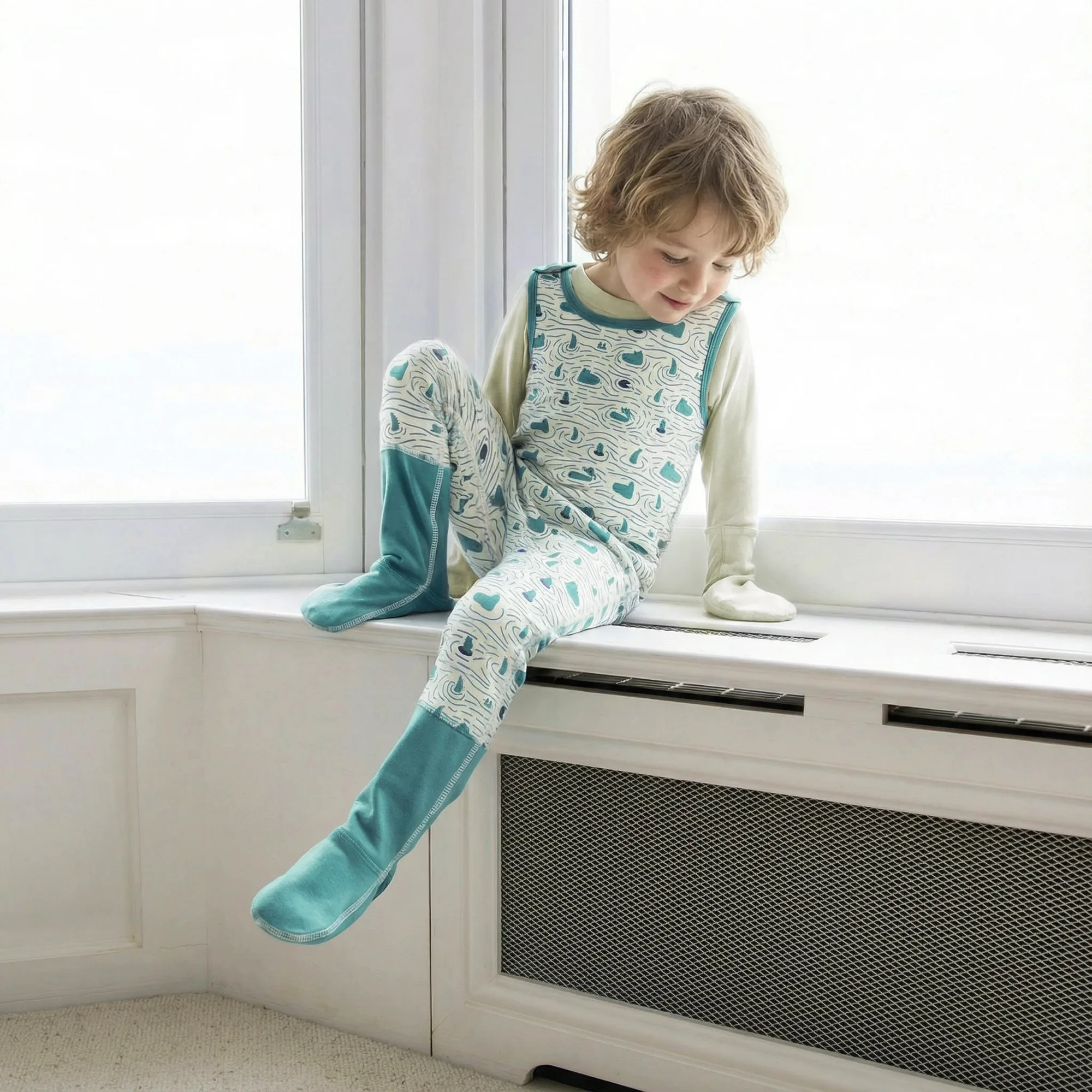
For children who scratch legs, feet, or tummies, the shirt is only part of the uniform. Anti-scratch dungarees keep allergens away from sore feet, ankles, and legs and protect itchy tummies, with a double layer over ankles and feet to reduce damage from rubbing at night. If your child mainly scratches at night, a kids anti-scratch PJ set with flat internal seams and no scratchy labels is the better purchase than another school shirt.
Washing and rotation decisions that extend shirt life
Buy two or three shirts rather than one, because eczema-friendly school shirts need frequent washing at 60c to remove allergens and creams. Wash inside out with non-bio liquid or powder and cool tumble dry. Rotating shirts also gives fabric a rest day, which reduces the wear that turns a smooth shirt into a rough one.
If your child wears arm sleeves under the shirt, wash those at 60c too and keep a spare pair in the school bag. A clean dry sleeve is more comfortable than a damp one, and it protects the shirt from cream transfer during the day.
Decision rules for buying a school shirt with eczema
- Rule 1: Fibre first: If the label lists elastane, latex, or a polycotton blend, skip it. Choose 100% organic cotton, ideally GOTS certified, so the fabric is predictable against sore skin. No elastane or latex is the non-negotiable starting point.
- Rule 2: Fit must allow movement: A slim fit school shirt for sensitive skin should let your child raise both arms without pulling at the waist and close at the cuff without leaving a mark. If it fails, size up or change cut. Skim, do not compress.
- Rule 3: Match the layer to the scratch zone: Arms and elbows: add kids' organic cotton protective arm sleeves under the shirt. Legs, feet, or tummy: choose anti-scratch dungarees. Night-time scratching: choose an anti-scratch PJ set instead of another shirt. Buy the layer that covers where your child actually scratches.
- Rule 4: Plan for 60c washing: Buy at least two shirts and wash inside out at 60c with non-bio detergent, cool tumble dry. Keep a spare pair of arm sleeves in the school bag. Frequent hot washing is part of the purchase, not an afterthought.
Product facts that matter for eczema-prone skin
- School Shirt Slim Fit - 100% Organic Cotton: School Shirt Slim Fit - 100% Organic Cotton, GOTS certified, no latex or elastane, with a classic collar, front button fastening, and adjustable cuffs. The certified organic cotton and absence of latex or elastane reduce likely irritation points, while adjustable cuffs let you fine-tune the fit as creams or growth change how the shirt sits.
- Protective Arm Sleeves - Kids - 100% Organic Cotton: Protective Arm Sleeves - Kids - 100% Organic Cotton (undyed), no latex or elastane, no itchy internal labels, washable at 60c. They add a smooth barrier under the school shirt for children who scratch forearms and elbows, and the 60c wash helps remove allergens and creams between wears.
- Kids Anti Scratch PJ Set: Kids Anti Scratch PJ Set - 100% Organic Cotton, no elastane or latex, flat internal seams, no scratchy internal labels, washable at 60c. This is the better choice when night-time scratching is the main problem, because flat seams and label-free construction remove the friction points a school shirt cannot cover.
- Anti Scratch Dungarees - Crocodile Print: Anti Scratch Dungarees - Crocodile Print - 100% Organic Cotton, no latex, double layer over ankles and feet, protects itchy tummies and keeps allergens away from sore feet, ankles, and legs. Choose these when scratching extends below the waist, since a school shirt only covers the upper body and the double ankle layer reduces rubbing damage.
Who this school shirt approach is for
Best for
- Children who scratch mainly at the arms, elbows, and upper body during the school day
- Parents who need a washable, GOTS certified organic cotton shirt that can be rotated and washed at 60c
- Kids who can wear a slim fit cut without compression and need adjustable cuffs for creams
Not for
- Children whose main scratching is at night, on the legs, feet, or tummy — choose an anti-scratch PJ set or dungarees instead
- Kids who need a loose, boxy fit and cannot tolerate a tailored cut
- Families looking for a non-cotton or stretch-blend shirt, since this guide rules out elastane and latex