Quick Answer
For your first bondage kit, prioritize soft, easy-to-release restraints, a safe word, and a simple design that you can manage alone—avoid complicated rope ties or gear that requires advanced skill.
Why Material and Restraint Type Matter
The material of your restraints determines both comfort and safety. Soft cuffs with padding or plush lining are gentler on wrists and ankles, while rough rope or hard cuffs can cause friction burns or numbness if used incorrectly. For beginners, adjustable cuffs with quick-release buckles are often the safest choice because they can be removed quickly in an emergency.
Think about the type of play you want to explore. If you're curious about impact play, a kit with a flogger or paddle lets you experiment with sensation. If you're more interested in sensory play, look for blindfolds or feather ticklers. A kit that includes a variety of items gives you a chance to discover what you enjoy without buying everything separately.
The Trade-Off: Versatility vs. Simplicity
Some beginner bondage kits come with many pieces—restraints, blindfolds, floggers, and more. While this can be exciting, it can also be overwhelming. A simpler kit with just a few essential items lets you learn each piece properly and avoids wasting money on items you may never use. Start with a kit that covers the basics: a blindfold, cuffs, and maybe a small flogger or paddle. You can always expand later.
Another trade-off is between adjustable and fixed-size restraints. Adjustable cuffs fit more body types and are easier to share with a partner, but they might have more straps that can tangle. Fixed-size cuffs are simpler but may not fit everyone comfortably. Consider who will be using the kit and choose accordingly.
Decision Rules for Choosing Your First Bondage Kit
- Safety First: Quick-Release Mechanism: Choose restraints that can be removed quickly, such as cuffs with buckles or Velcro. Avoid locks or complex knots that could be hard to undo in an emergency. Test the release mechanism yourself before using it on a partner.
- Material Comfort: Opt for soft, breathable materials like padded leather, neoprene, or plush-lined cuffs. Avoid rough rope or hard plastic that can chafe or cut off circulation. If you have sensitive skin, look for hypoallergenic materials.
- Start Simple: Pick a kit with only a few essential items—restraints, a blindfold, and maybe a small flogger. This lets you learn each piece without feeling overwhelmed. You can always add more tools later as you discover your preferences.
- Consider Adjustability: If the kit will be used by multiple people or body types, choose restraints with adjustable straps. If it's for one person, fixed-size might be simpler and more secure. Measure wrist and ankle circumference before buying to ensure a good fit.
- Set a Safe Word and Plan: Before any play, agree on a safe word and a signal for when you can't speak. Make sure both partners know how to remove the restraints quickly. Keep a pair of safety scissors nearby, even if the kit includes quick-release cuffs.
Product Spotlight
-
Fort Troff - FF Trainer Kit: The Fort Troff - FF Trainer Kit includes two differently sized smooth hand-shaped toys made from flexible PVC, plus a Vac-U-Lock suction base for hands-free use. This kit is designed for gradual anal training, but its suction base and flexible material also make it a versatile addition to a beginner's bondage or sensation-play collection—though it's not a traditional restraint kit.
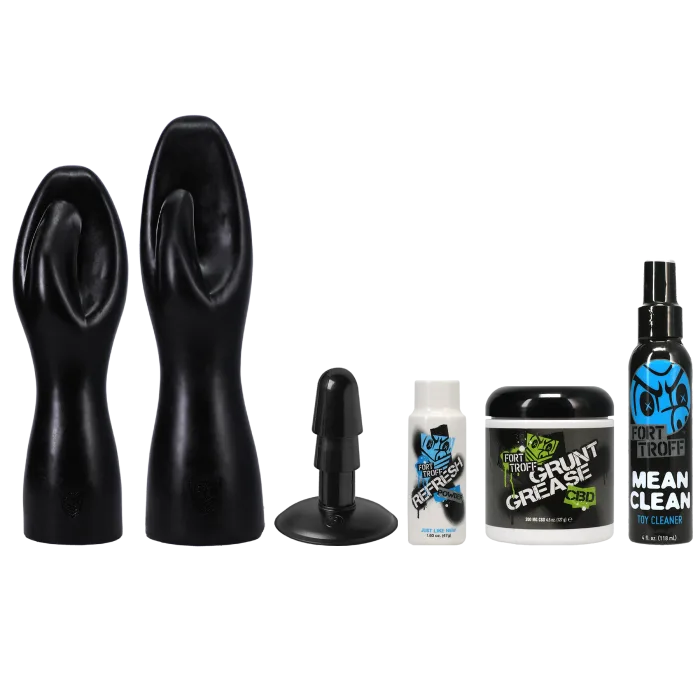
Fort Troff - FF Trainer Kit
Who Should Choose This Type of Kit
Best for
- Complete beginners exploring bondage for the first time
- Couples who want a simple, low-commitment introduction to restraint play
Not for
- Experienced players looking for advanced rope or suspension gear
- Those seeking a kit with impact play tools like paddles or crops (unless specifically included)