Start with the set that matches what you want to teach
If you are buying a first wooden puzzle, the most useful decision is not the brand or the finish but the learning target. A chunky wooden puzzle set can cover letters, numbers or shapes, and each one asks a different kind of attention from a toddler. The 3 Set Chunky Wooden Puzzles for Toddlers bundles all three in one box: an Alphabet peg puzzle, a Numbers peg puzzle and a Geometric Forms peg puzzle. That makes it a practical starting point if you want variety without buying three separate products, but it also means you should think about which board will actually get used first.
The supplied product information describes the set as natural, simple educational puzzles for early development and learning. The images are printed directly on the wood, which the listing says makes them water- and scratch-resistant. That matters for a toddler product because boards get wiped, dropped and chewed far more than adult puzzles do.
What the three boards give you
-
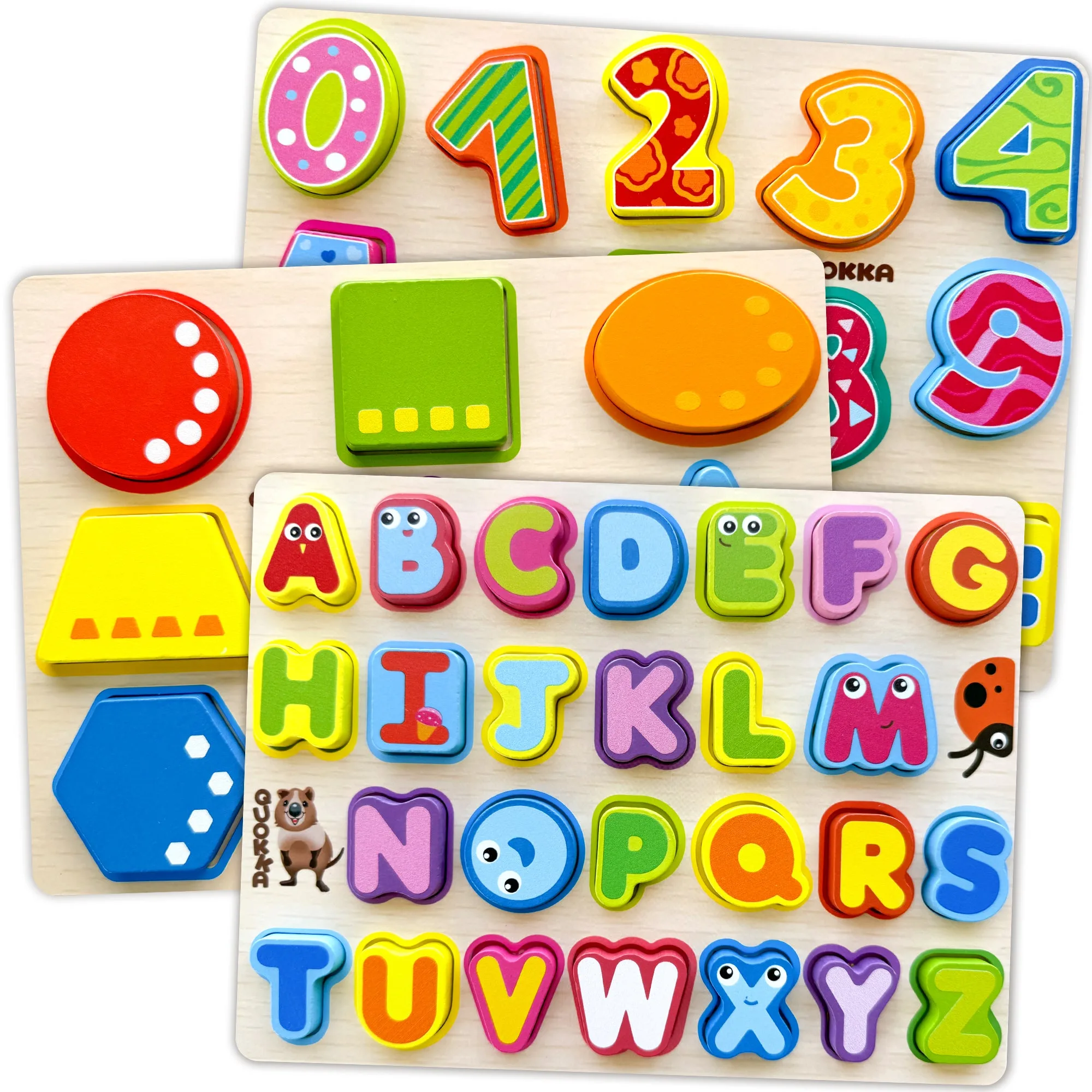
3 Set Chunky Wooden Puzzles for Toddlers | Alphabet, Numbers & Geometric Forms: The set includes a Wooden peg puzzle "Alphabet", a Wooden peg puzzle "Numbers", and a Wooden peg puzzle "Geometric Forms". Three distinct boards let you rotate focus between letter recognition, counting and shape matching instead of relying on one theme.
3 Set Chunky Wooden Puzzles for Toddlers | Alphabet, Numbers & Geometric Forms
-
3 Set Chunky Wooden Puzzles for Toddlers | Alphabet, Numbers & Geometric Forms: Large jigsaw puzzle pieces are safe for toddlers 12 months and up. The stated age floor tells you this is designed for the earliest puzzle stage, not for older preschoolers who need smaller, more intricate pieces.
-
3 Set Chunky Wooden Puzzles for Toddlers | Alphabet, Numbers & Geometric Forms: The puzzles measure 9.8 x 1 x 7.4 inches. That footprint is small enough to sit on a highchair tray or a lap, but check it against your own storage and travel space before ordering.
The peg and groove details are the real buying points
Chunky puzzles live or die on how easily a small hand can grip and place a piece. The supplied listing notes special grooves beside the wooden puzzle pieces to make the matching game comfortable. It also calls the pieces large jigsaw puzzle pieces. Together, those details suggest a board built for grabbing and repositioning rather than for tight interlocking, which is the right call for a 12-month-old.
The listing also says the easy jigsaw puzzle games give kids a sense of achievement and encourage hand-eye coordination, fine motor skills and cognitive development. Treat those as the intended benefits rather than measured outcomes. What you can verify from the record is the physical design: three boards, large pieces, grooves for grip and printed-on images.
Which board should you introduce first?
There is no single correct order, but the boards differ in what they demand. Use this as a rough starting logic, then follow your child.
- Geometric Forms first: Shape matching is the most concrete of the three. A circle or square has a fixed outline, so the match is visible even before a child knows the name. This is often the gentlest entry point for a 12-month-old.
- Numbers second: Number boards add counting and numeral recognition. The supplied record does not specify whether the numbers board includes counting objects or only numerals, so check the product images before you count on a counting feature.
- Alphabet later or alongside: Letters are the most abstract. The alphabet wooden puzzle set can still be used early for grip and placement practice, with letter names added as your child shows interest.
What the set does not tell you
The supplied record does not include care instructions, cleaning methods or paint-safety details. It also does not confirm whether the boards are self-correcting, whether the pieces are magnetic, or whether replacement pieces are available. If any of those are deal-breakers, ask the store before buying rather than assuming.
The record also does not list a piece count per board. You know there are three puzzles, but not how many letters, numbers or shapes each one contains. For a first toddler chunky puzzle set that is usually a minor gap, but if you are buying for a classroom or a child who finishes boards quickly, it is worth confirming.
A quick fit check before you order
- Your child is around 12 months to early preschool: The stated age floor is 12 months, and the large pieces and grooves suit that stage. Older children may want more pieces or tighter fits.
- You want one box instead of three purchases: The set covers alphabet, numbers and shapes together, which is convenient if you are starting a puzzle shelf from scratch.
- You need wipe-clean surfaces: The printed-on images are described as water- and scratch-resistant, which is a useful trait for a toddler product, though the record gives no specific cleaning instructions.
- You have limited storage: Each board is 9.8 x 1 x 7.4 inches. Three boards at that size need a shelf or bin with a little room, but they are not floor puzzles.
The product at a glance
- 3 Set Chunky Wooden Puzzles for Toddlers | Alphabet, Numbers & Geometric Forms: Designed in the U.S.A. by Adducate. Gives you the design origin if that is part of how you choose toys.
- 3 Set Chunky Wooden Puzzles for Toddlers | Alphabet, Numbers & Geometric Forms: Catalog price is USD 18.26, compared with a catalog comparison price of USD 28.99. At that price for three boards, the set is positioned as an affordable way to try multiple puzzle types rather than a single premium board.