Quick answer
Choose the City Sidewalk Bundle if you need ready-to-use, double-sided sidewalk layouts that instantly define city blocks and scale with your table. Choose Unpainted Bridges & Barricades if you want modular wooden crossings, platforms, and removable panels for vertical play and chokepoints. They solve different problems, so the real question is whether you are laying out streets or building obstacles.
What each set actually gives you
The City Sidewalk Bundle contains five mats—one of each size—with double-sided sidewalk template maps. That means you can flip a mat to change the urban design without buying a second product. The mats are designed to complement Metropolis buildings, so if your table already uses those structures, the scale and style line up. The bundle is a surface layer: it tells you where sidewalks, curbs, and street zones are.
Unpainted Bridges & Barricades is a construction kit. It includes four pieces that can be built as wooden footbridges or barricades, plus a pair of small square wooden platforms, four sets of wooden steps, and a pair of wooden door panels. All parts come in colored plastic, and removable panels let you create gaps in the bridges or holes in the barricade. This set adds height, cover, and routes rather than defining a flat street layout.
How they play differently on the table
Sidewalk mats are passive terrain. They do not block line of sight or movement, but they make a board readable at a glance. In a skirmish game, that readability speeds up movement and cover calls. The double-sided designs also let you change the look of a district between games without repainting or rebasing anything.
Bridges and barricades are active terrain. A footbridge creates a crossing point that can be blocked or held. A barricade with removable panels can be opened to create a gap or closed to force a detour. Platforms and steps add vertical positions. If your scenarios rely on chokepoints, elevation, or destructible cover, this set does more mechanical work than a flat mat.
Mixing them without wasting money
You do not have to pick one forever. A common approach is to lay down the City Sidewalk Bundle as your base street grid, then place the Unpainted Bridges & Barricades pieces on top where you want crossings or roadblocks. The mats define the neighborhood; the bridges and barricades define the fight.
If your budget is tight, start with the set that fixes your biggest table problem. If your games feel flat and samey, the sidewalk bundle adds visual structure fast. If your games feel too open and shooty, the bridges and barricades add the cover and elevation that change how players move.
Trade-offs at a glance
- Setup speed vs. modularity: The City Sidewalk Bundle lays out a full street in minutes because the mats are ready to place. Bridges & Barricades takes longer to arrange and may need assembly, but every piece can be repositioned to create new routes. Pick the bundle for fast games; pick bridges and barricades for replayable layouts.
- Visual coverage vs. gameplay impact: Sidewalk mats cover a large area and make the table look like a city, but they do not block movement or line of sight. Bridges, barricades, and platforms create physical obstacles and elevation that directly affect tactics. If your table looks good but plays flat, add the bridges and barricades.
- Style control vs. paint time: The City Sidewalk Bundle comes with printed double-sided designs, so the urban look is done. Unpainted Bridges & Barricades arrives in colored plastic and is described as unpainted, so you can match your own palette but you may want to paint or wash it for a finished look. Choose based on whether you want table-ready or a painting project.
Key product facts
- City Sidewalk Bundle: Includes five versatile mats—one of each size—with double-sided sidewalk template maps designed to complement Metropolis buildings. You get multiple street layouts in one purchase, and the mats match Metropolis scale without extra work.
- Unpainted Bridges & Barricades: Contains four pieces that can be built as wooden footbridges or barricades, plus two small square platforms, four sets of steps, and two door panels, all in colored plastic with removable panels. This is modular vertical terrain and cover, not a flat surface—so it changes movement and line of sight.
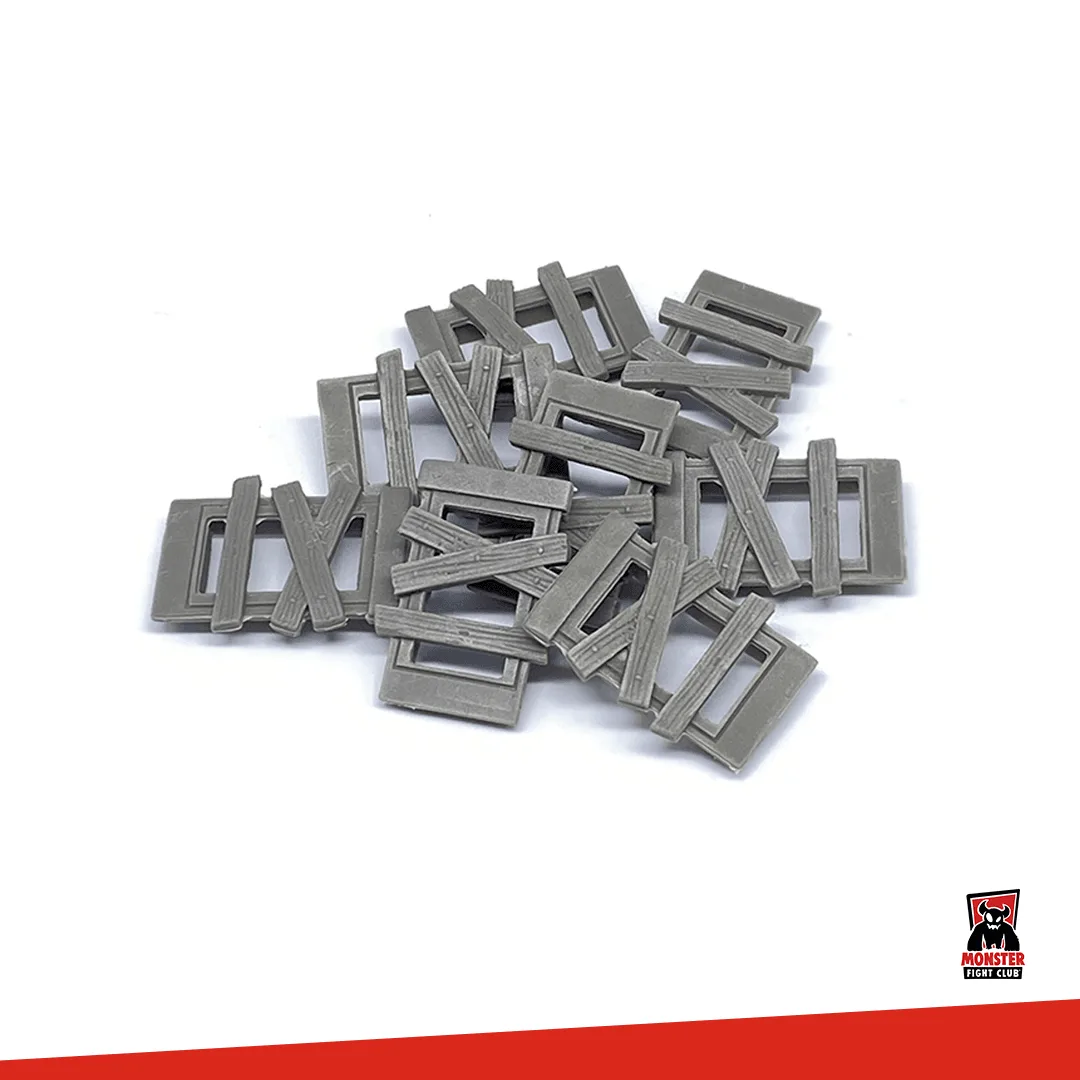
- Boarded Up Windows: Eight boarded-up window inserts designed to slot into Metropolis window cavities for a weathered, abandoned look. A cheap way to push your city toward post-apocalyptic or rundown without replacing buildings.
- Tire Set: Scatter set with one big pile of tires, two tall stacks, three double tire sets, and four single tires for blocking line of sight and rough terrain. Adds gritty clutter and small cover pieces that work on either sidewalk mats or bridge layouts.
Which set fits your table?
Best for
- Players who want an instant city street layout that matches Metropolis buildings
- Groups that change districts often and want double-sided options without buying new terrain
- Beginners building their first urban table who need readable, flat terrain
Not for
- Tables that already have plenty of flat streets and need vertical cover instead
- Players who want to build and paint every piece of terrain from scratch
- Games where line-of-sight blocking and chokepoints are the main tactical focus