Quick answer
Choose a clamp meter when you need to measure high AC or DC current without breaking the circuit. Stick with a multimeter for low-current electronics, precise voltage, and continuity checks. The FNIRSI DMC-100 clamp meter bridges both worlds with True RMS and DC current capability.
When a Multimeter Is the Better Choice
A standard digital multimeter excels at measuring low currents (milliamps), small resistances, and continuity in circuits you can probe directly. It is the go-to tool for debugging Arduino projects, testing batteries, and checking component values on a breadboard. Most multimeters also offer higher accuracy on voltage and resistance ranges compared to entry-level clamp meters.
When a Clamp Meter Wins
A clamp meter measures current by clamping around a single conductor, so you do not need to cut wires or desolder connections. This is invaluable for troubleshooting live circuits, motor drives, or household appliances. The FNIRSI DMC-100 handles both AC and DC current up to 600A, making it suitable for automotive battery drain tests and solar panel monitoring where high DC currents are common.
The Trade-Off: Accuracy vs Convenience
Clamp meters are generally less accurate on low currents than a dedicated multimeter. If you need to measure a 10 mA signal, a multimeter is still the right tool. However, for currents above 1A, the convenience of a non-contact measurement often outweighs the small accuracy difference. The FNIRSI DMC-100 includes True RMS (TRMS) for accurate AC readings on non-sinusoidal waveforms, a feature usually found on higher-end multimeters.
Key trade-offs at a glance
- Current measurement method: Clamp meter: clamp around a wire, no circuit break. Multimeter: must insert in series with the circuit.
- Current range: Clamp meter: typically 0.1A to 600A or more. Multimeter: usually up to 10A, with a separate fused input.
- Low-current accuracy: Multimeter: excellent for mA and µA measurements. Clamp meter: less accurate below 1A.
- Voltage and resistance: Both tools measure voltage and resistance. Clamp meters often have lower input impedance on voltage ranges. If you need precise voltage readings, a multimeter is still preferred.
- True RMS (TRMS): The FNIRSI DMC-100 includes TRMS for accurate AC readings on distorted waveforms. Many budget multimeters lack this. TRMS matters for motor drives, LED drivers, and switching power supplies.
Product facts
-
FNIRSI DMC-100 Clamp Meter TRMS AC/DC 600A: The FNIRSI DMC-100 measures AC and DC current up to 600A using a clamp, without breaking the circuit. You can safely measure high currents in automotive, solar, or appliance circuits without disconnecting wires.
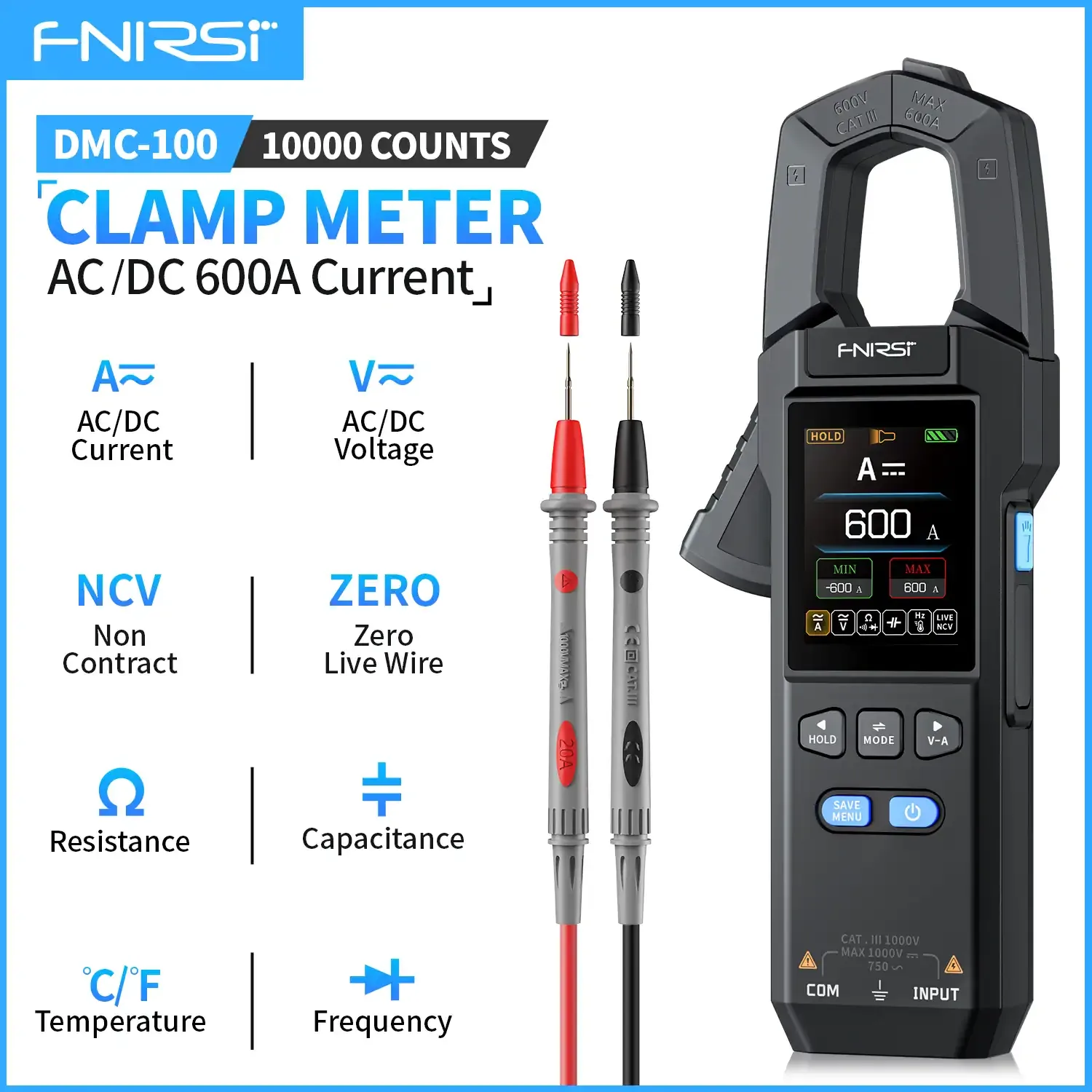
FNIRSI DMC-100 Clamp Meter TRMS AC/DC 600A
Which one fits your work?
Best for
- Electricians and technicians who troubleshoot live circuits, motors, or appliances
- Hobbyists working with automotive, solar, or high-current DC systems
Not for
- Precision low-current electronics debugging (choose a multimeter instead)
- Breadboard-level component testing where milliamps matter