One canister, six tanks: what the splitter actually changes
A 6-way CO2 splitter sits between your regulator and your aquariums. Instead of buying a separate CO2 tank and regulator for every planted tank, you run one canister into the splitter and send CO2 out to as many as six tanks. The Castle Dawn Aquatics 6-Way CO2 Splitter does exactly this: it supplies CO2 to up to six aquariums using one regulator, so you do not need extra tanks.
The part that matters for planted tanks is the needle valves. Each of the six valves adjusts independently, so a slow-growing carpet tank and a fast-growing stem tank can receive different CO2 flow from the same source. That is the real reason to use a needle valve CO2 manifold rather than a simple T-connector or a fixed splitter with no adjustment.
Setting up the splitter on a multi-tank rack
- Mount the splitter above the tanks: Place the splitter where you can reach every needle valve without leaning over glass. The supplied extension rod is included to help you reach and adjust the valves; keep the rod with the unit so you are not hunting for it later.
- Check your tubing size before cutting anything: The splitter is compatible with 4–6 mm CO2 tubing. Measure a short offcut of the tubing you already use. If it falls outside that range, the splitter is not the right fit for your current line set.
- Connect the regulator output to the splitter inlet: Run tubing from your regulator to the splitter inlet. The supplied information does not specify a single inlet orientation, so follow the markings on the unit and keep the run short and untangled.
- Run one line to each tank: Connect a length of 4–6 mm tubing from each outlet to the CO2 delivery point in each aquarium. Label both ends of each line with tape so you know which valve feeds which tank when you adjust flow.
- Set every needle valve to closed before opening the regulator: Close all six needle valves, then open the regulator slowly. Open one valve at a time and watch the bubble counter or CO2 indicator in that tank before moving to the next. This keeps you from flooding several tanks at once while you learn how sensitive the valves are.
Build and fit details that affect installation
-
CO2 Splitter – 6-Way Needle Valve with FREE Extension Rod: Crafted from high-grade stainless steel and aluminium alloy, this splitter is designed for reliability and precision. The metal body is meant to withstand long-term CO2 use, which matters on a rack where the splitter stays pressurized.
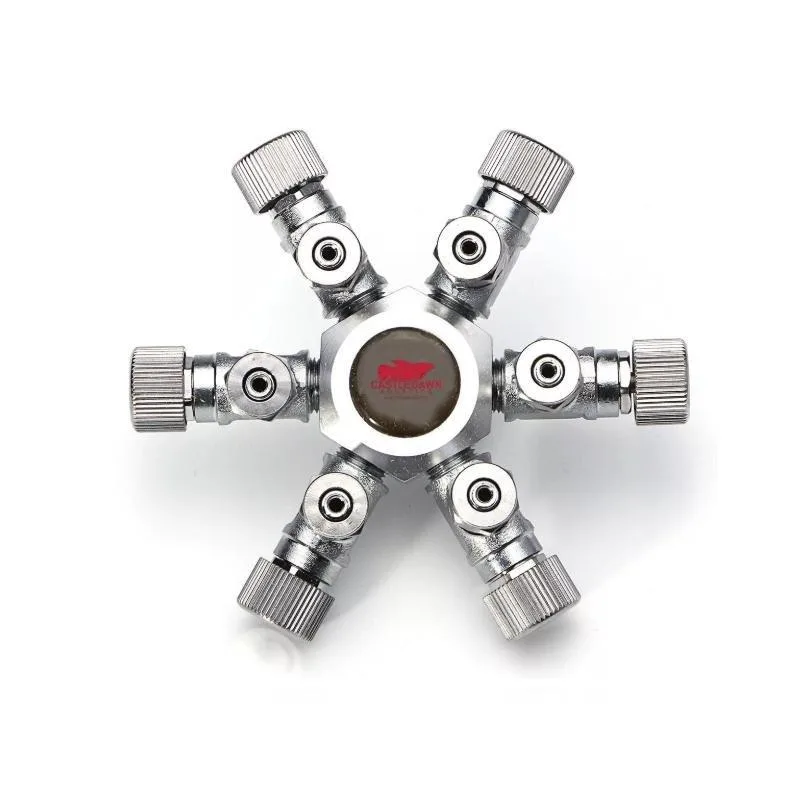
CO2 Splitter – 6-Way Needle Valve with FREE Extension Rod
-
CO2 Splitter – 6-Way Needle Valve with FREE Extension Rod: Compatible with 4–6 mm CO2 tubing for easy integration with most setups. Tubing size is the first compatibility check; confirm your line fits this range before planning the run.
-
CO2 Splitter – 6-Way Needle Valve with FREE Extension Rod: Each needle valve can be independently adjusted for precise CO2 delivery per aquarium. Independent adjustment is what lets one canister serve tanks with different plant mass and light levels.
Balancing CO2 flow across tanks without chasing bubbles
Balancing CO2 flow is not about making every tank bubble at the same rate. It is about giving each tank what its plants and livestock tolerate. Start with the tank that has the least plant mass or the most sensitive fish, set that valve first, and leave it alone once the tank looks stable. Then move to the next tank.
Use the needle valves in small increments. Because each valve adjusts independently, a quarter turn on one outlet does not change the others. That is an advantage over a fixed manifold, but it also means you should change one valve at a time and give the tank time to respond before adjusting again. Keep a simple note of which valve position suits which tank so you can return to it after maintenance.
Where a 6-way splitter fits against other CO2 distribution choices
A splitter is not the right answer for every multi-tank setup. Use this comparison to decide whether the 6-way unit solves your problem or adds complexity.
- 6-way needle valve splitter: Best when you already run one regulator and want individually adjustable CO2 to several tanks. The Castle Dawn Aquatics unit covers up to six aquariums and uses 4–6 mm tubing.
- Dual regulator with two outputs: Simpler if you only ever plan to run two tanks and do not need six adjustable outlets. A splitter becomes useful when your tank count grows beyond what your regulator offers.
- Separate regulator per tank: The most independent option, but it means more canisters, more refills, and more space on the rack. A splitter trades some independence for one central CO2 source.
Safety and buying checks before you pressurize
CO2 equipment is not the place to save a few dollars on an unbranded part. The supplied product warning is direct: beware of cheap CO2 splitters on large e-commerce platforms, because many are not built to proper safety standards for CO2 use and can pose serious risks. Check the following before you connect anything.
- Confirm the body material and build: The Castle Dawn Aquatics splitter is made from stainless steel and aluminium alloy, described as durable for long-term CO2 use. Avoid units where the body material is unspecified.
- Check the tubing range against your lines: 4–6 mm CO2 tubing is the supported range for this splitter. Tubing that is too loose can leak; tubing that is too tight can split at the barb.
- Plan for leak checks at every joint: The supplied information does not include a leak-test procedure, so follow your regulator or CO2 system instructions for checking joints. Do this before leaving the system running unattended.
- Keep the extension rod accessible: The free extension rod is included to help with adjustment. Store it near the rack so valve changes do not require moving equipment.
When the 6-way splitter is more manifold than you need
If you run one or two planted tanks, a 6-way splitter adds outlets you will never open and takes up space on the rack. A dual regulator or a simpler two-way splitter may be a better match. The 6-way unit earns its place when you are already maintaining three or more tanks from one canister and want per-tank adjustment without buying another regulator.
Also consider your maintenance routine. Six lines mean six places to check for kinks, six delivery points to clean, and six valves to revisit after any change. The splitter reduces equipment cost and refill logistics, but it does not reduce the attention each tank needs. If you are not ready to monitor CO2 in every tank, start with fewer tanks and add lines as your routine settles.