Quick answer
For most bench lathe work, a coarse diamond knurl with 14 lines per inch gives a good grip without overpowering small parts. Set the knurls to the work diameter, use plenty of cutting oil, and feed in about 0.010–0.020 inch per revolution.
Why diamond knurls are the go-to choice
Diamond knurls create a crosshatch pattern that provides a secure grip in both directions, making them ideal for handles, knobs, and thumb screws. Coarse diamond patterns (like 14 lines per inch) are aggressive and best for larger diameters or parts that need extra traction. Fine patterns are better for small diameters or when you want a smoother finish.
The knurl wheel size matters: a 3/4" diameter knurl with a 1/4" shaft hole fits most bench lathe knurling tools. Always match the knurl size to your tool holder's capacity.
Trade-offs: coarse vs. fine knurls
Coarse knurls displace more material, so they require more spindle power and can cause deflection on thin parts. They also leave a deeper pattern that may need deburring. Fine knurls are easier on the machine and produce a more refined texture, but they may not provide enough grip for heavy-duty applications.
If you're knurling soft materials like aluminum or brass, coarse diamond knurls work well. For hardened steel, consider a finer pattern to reduce stress on the tool.
Step-by-step knurling setup and use
- Mount the knurls: Install the coarse diamond knurls in your knurling tool holder, ensuring they are centered and aligned with the workpiece. Tighten the holder securely. Check that the knurls rotate freely and are not binding.
- Set the work diameter: Measure the workpiece diameter and adjust the lathe speed to a slow setting (around 200-400 RPM for steel, lower for larger diameters). Use a live center if needed. A too-fast spindle speed causes chatter and poor knurl definition.
- Engage the knurls: Bring the knurls into contact with the workpiece and apply firm pressure. Move the carriage along the work surface at a feed rate of about 0.010-0.020 inches per revolution. Use cutting oil to reduce friction and prevent work hardening.
- Check the pattern depth: After one pass, stop and inspect the knurl pattern. It should be sharp and uniform. If it's too shallow, increase pressure slightly; if too deep, reduce pressure. A consistent depth is key to a professional finish.
- Deburr the edges: After knurling, use a fine file or deburring tool to remove any raised burrs at the edges of the knurl pattern. Deburring prevents injuries and ensures a clean fit with mating parts.
Knurls we recommend
-
Knurls, Coarse Diamond: These are a pair of coarse diamond high speed steel knurls, 3/4" diameter, 3/8" wide, with a 1/4" shaft hole, creating 14 lines per inch. The 14-line pattern gives a strong grip for handles and knobs, and the 3/4" size fits standard bench lathe knurling tools.
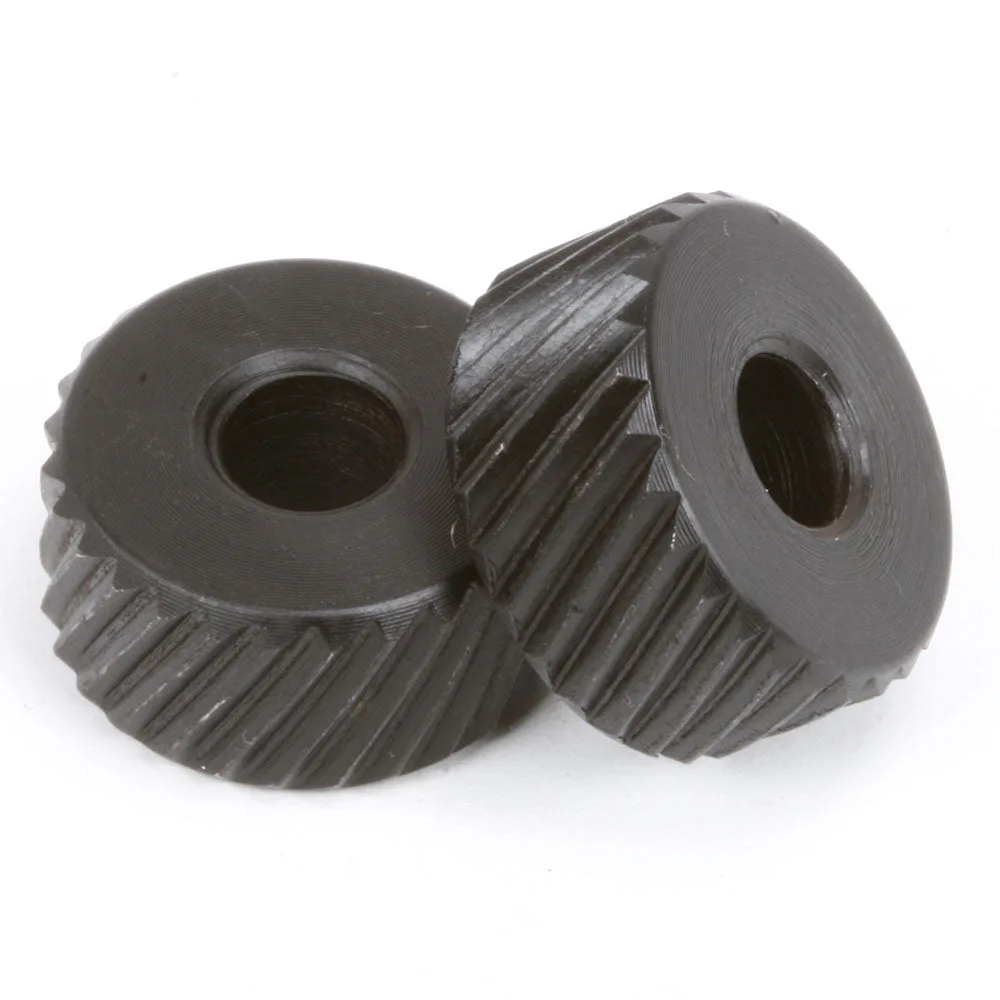
Knurls, Coarse Diamond